Facts
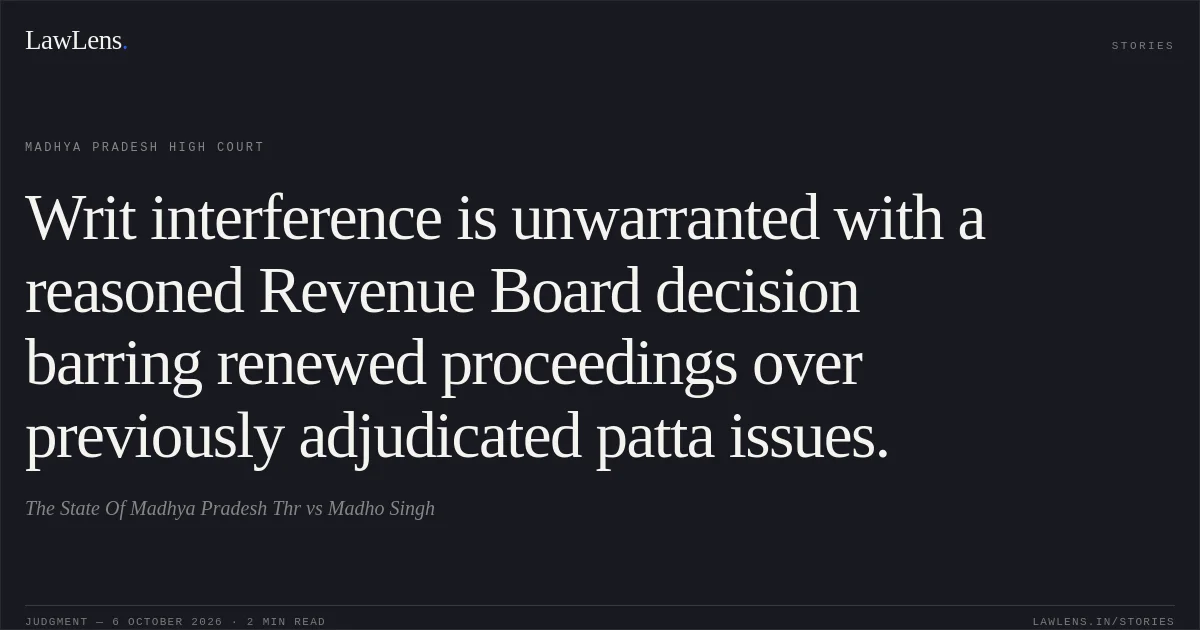
Shyam Singh applied to the Collector, Sheopur, to exchange land at Village Pahela for land at Village Nagda recorded in the names of respondents 1 and 2. During the inquiry, the Tahsildar reported that the original patta for the Nagda land had not been produced and that title and possession were disputed; the exchange was not recommended.
Source reference: p.1The Collector subsequently initiated suo motu proceedings to examine the patta and related revenue entries. The Commissioner dismissed the respondents’ revision, reasoning that the Collector had not made a final order and the respondents could present their case in the ongoing proceedings.
Source reference: pp.1–2The Board of Revenue, taking account of earlier proceedings concerning the same patta and entries, set aside the Collector’s and Commissioner’s orders. The State challenged the Board’s order under Article 226 of the Constitution.
Source reference: pp.2–3Issues
1. Whether the Board of Revenue’s order setting aside the Collector’s and Commissioner’s orders contained a jurisdictional error, perversity, or patent illegality warranting interference under Article 226.
Source reference: p.42. Whether the Collector’s initiation of proceedings to examine the patta and revenue entries could be sustained despite the earlier adjudication concerning the same subject matter.
Source reference: pp.4–5Law Applied
The Court applied the limited scope of judicial review under Article 226 of the Constitution: a writ court does not act as an appellate authority over every finding of a competent authority, and interference is warranted where the impugned decision involves lack of jurisdiction, manifest error of law, perversity, breach of natural justice, or a conclusion no reasonable authority could reach on the material before it.
Source reference: pp.5–6The judgment cited no specific statutory provision governing the revenue proceedings or precedent; it assessed the Board’s order against this Article 226 standard.
Source reference: pp.5–6Reasoning
The Court found that the Board had not set aside the Collector’s proceedings merely because they were at an initial stage. It had considered the earlier adjudication concerning the same patta and revenue entries and concluded that the Collector’s action, in the circumstances, was unsustainable.
Source reference: pp.4–5The fact that the Collector had issued only show-cause notices did not, by itself, make the Board’s order erroneous, because the Board was examining the legality of initiating and continuing the proceedings in light of the earlier proceedings.
Source reference: p.5The State did not establish that the Board ignored relevant material, relied on irrelevant considerations, or otherwise crossed the limits of lawful decision-making; the Board’s conclusion was a possible and legally sustainable view.
Source reference: pp.5–7Holding
The Court held that the State had not shown any jurisdictional error, patent illegality, perversity, or material irregularity in the Board of Revenue’s order.
It dismissed the writ petition and made no order as to costs.
Source reference: p.8Original Court PDF
The State Of Madhya Pradesh ThrvsMadho Singh
Click to open original judgment
Original judgment, available to read, download and summarize on LawLens.in