Facts
The petitioners approached the Chhattisgarh High Court seeking protection against alleged illegal demolition of their residential house, interference with their possession, and alteration of the physical features of property situated over Khasra Nos. 578/33 and 578/22 by respondent No. 2 on the basis of a disputed sale deed. They also sought police protection and restraint against demolition, dispossession, alienation, or alteration of the property.
Source reference: para. 1The petitioners claimed settled possession and relied upon pending civil litigation and an order of status quo passed by a co-ordinate Bench in Second Appeal No. 304 of 2024.
Source reference: para. 2The State opposed maintainability, contending that the dispute was essentially between private parties and involved disputed questions of title and possession already pending before the civil court.
Source reference: para. 3Issues
Whether the writ petition was maintainable for granting protection against alleged demolition, dispossession, and interference with possession when the dispute involved private rights, disputed title and possession, and pending civil proceedings?
Source reference: paras. 3–5Whether the petitioners were entitled to police protection or other preventive relief under writ jurisdiction despite the pending civil litigation and the existing status quo order?
Source reference: paras. 1–5Whether the petitioners should be granted liberty to pursue appropriate remedies before the competent civil court?
Source reference: para. 6Law Applied
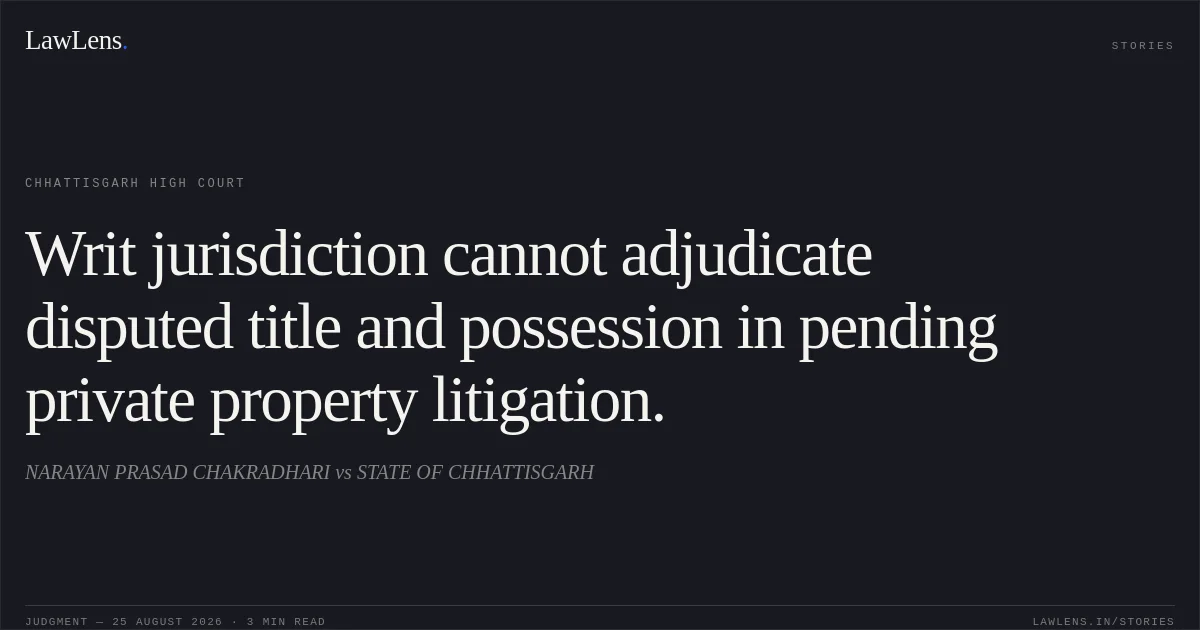
The Court applied the principle that writ jurisdiction is ordinarily not appropriate for adjudicating disputed questions of title, possession, or the physical identity of immovable property, particularly where the dispute concerns private rights and civil proceedings are already pending.
Source reference: paras. 4–5The existence of a status quo order in the pending second appeal did not justify adjudication of the underlying property dispute in writ proceedings.
Source reference: para. 4Appropriate relief relating to possession, injunction, demolition, or alteration of property must be sought before the competent civil court in accordance with law.
Source reference: para. 6No specific statutory provision or judicial precedent was cited in the order.
Source reference: no citationReasoning
The Court examined the reliefs claimed and the documents relied upon by the petitioners and found that the controversy essentially concerned private rights in immovable property, including disputed questions of title, possession, and the identity or physical features of the property.
Source reference: para. 4Since civil litigation between the parties was already pending and a status quo order had been passed in the second appeal, the Court held that exercising writ jurisdiction to determine or protect the claimed private rights would be inappropriate.
Source reference: para. 4Consequently, the requested directions for police protection, restraint against respondent No. 2, and prevention of demolition or dispossession could not be granted in the writ petition.
Source reference: para. 5The Court nevertheless preserved the petitioners’ right to seek suitable interim or substantive relief before the competent civil court.
Source reference: para. 6Holding
The High Court held that the writ petition was not maintainable because it involved private property rights and disputed questions of title and possession that were already pending before the civil court. The petition was accordingly dismissed.
The petitioners were granted liberty to approach the competent civil court within 15 days from the date of the order. For that 15-day period, the concerned respondent-authorities were directed not to take coercive steps against the petitioners concerning the subject matter of the petition.
Source reference: para. 6The Court clarified that it had expressed no opinion on the merits of the parties’ respective claims, and made no order as to costs.
Source reference: paras. 7–8Original Court PDF
NARAYAN PRASAD CHAKRADHARIvsSTATE OF CHHATTISGARH
Click to open original judgment
Original judgment, available to read, download and summarize on LawLens.in
![Courts will not interfere with transfers absent mala fides or violation of statutory rules.. M Ramya vs EMPLOYEES STATE INSURANCE CORPORATION (ESIC). CAT - ['Chennai']. LawLens](/stories/thumbnails/courts-will-not-interfere-with-transfers-absent-mala-fides-or-violation-of-statutory-rules-a6845e9ca6f548fca284c51c8351957f.webp)
![Courts cannot direct one-time recruitment age relaxation absent authority in the governing rules or advertisement.. UT OF PUDUCHERRY vs M ANDAL. CAT - ['Chennai']. LawLens](/stories/thumbnails/courts-cannot-direct-one-time-recruitment-age-relaxation-absent-authority-in-the-governing-895d78fde47143e2a8ed0207c4b6a44f.webp)
![A review cannot correct an allegedly erroneous decision absent an error apparent on the record.. Ajit Kumar Jha vs RAILWAY BOARD. CAT - ['Delhi']. LawLens](/stories/thumbnails/a-review-cannot-correct-an-allegedly-erroneous-decision-absent-an-error-apparent-on-the-re-8ac952fd4eba470c92f7da20af72a220.webp)