Facts
The petitioner, an illiterate rural woman, alleged that Respondent No. 5 and a power of attorney holder (Kejuram) fraudulently executed a sale deed for her land (0.80 acre) under the pretext of arranging a bank loan
Source reference: para. 3Although Police Station Kotwali registered FIR Nos. 213/2023 and 215/2023 under Section 420 IPC, the petitioner contended the investigation was improper as it ignored serious charges of forgery
Source reference: para. 4An internal police inquiry report dated 21.11.2025 by the City S.P. suggested that the initial investigation was deficient and warranted reinvestigation
Source reference: para. 5The petitioner approached the High Court seeking a writ of mandamus for a fresh inquiry and supplementary challan, noting that charge-sheets under Section 420 IPC had already been filed in 2024
Source reference: paras. 2, 6Issues
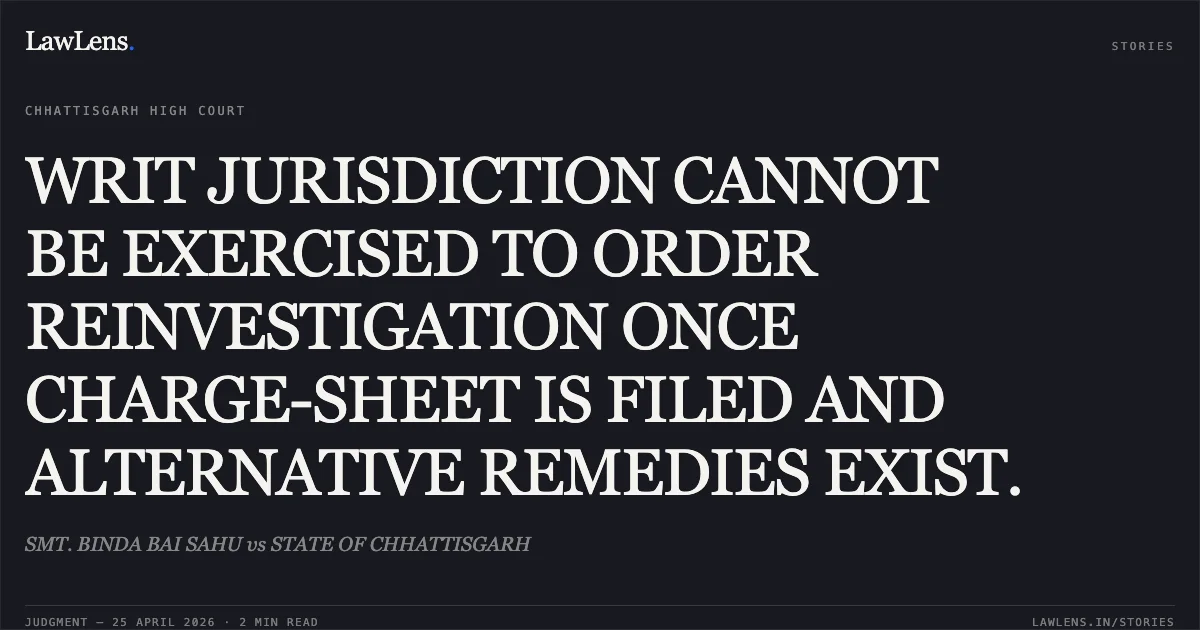
1. Whether the High Court should exercise its extraordinary writ jurisdiction under Article 226 to order a reinvestigation or fresh inquiry when a charge-sheet has already been filed and the matter is sub judice
Source reference: para. 82. Whether a writ petition is the appropriate remedy for disputes involving complex questions of fact such as fraud, forgery, and the validity of documents
Source reference: para. 8Law Applied
The court applied the principle of judicial restraint regarding Article 226 of the Constitution of India, establishing that writ jurisdiction is not intended for adjudicating "seriously disputed questions of fact"
Source reference: para. 8It further relied on the doctrine of "alternative statutory remedy," holding that once a charge-sheet is filed under the Code of Criminal Procedure (implied), the trial court/jurisdictional Magistrate possesses the authority to address deficiencies in investigation through appropriate statutory provisions
Source reference: paras. 8-9Reasoning
The Court reasoned that the petitioner’s claims regarding the fraudulent nature of the power of attorney and the execution of the sale deed are purely factual disputes that cannot be determined in a summary writ proceeding
Source reference: para. 8Critically, the Court noted that because the police had already completed the investigation and filed charge-sheets in 2024, the legal proceedings had moved into the domain of the trial court
Source reference: paras. 6, 8The Court observed that the petitioner has an "adequate and efficacious remedy" to raise her grievances—including the failure to include forgery charges—before the jurisdictional Magistrate
Source reference: para. 8Consequently, the existence of an alternative legal path made the exercise of extraordinary writ jurisdiction unnecessary and improper
Source reference: para. 9Holding
The Court dismissed the writ petition, holding that it would not interfere in a sub judice matter based merely on a party's dissatisfaction with an investigation
The Court ruled that the petitioner must seek relief before the trial court. Liberty was granted to the petitioner to avail alternative statutory remedies in accordance with the law
Source reference: para. 9No order as to costs was made
Source reference: para. 11Acts & Sections Cited
1 provisions across 1 statute referred to in this judgment. Each provision opens on LawLens.
Indian Penal Code, 18601
Original Court PDF
SMT. BINDA BAI SAHUvsSTATE OF CHHATTISGARH
Click to open original judgment
Original judgment, available to read, download and summarize on LawLens.in


