Facts
The petitioner was appointed as a Vidya Sahayak on 29.11.2008 following a 2006 recruitment process.
Source reference: p. 2After serving for nearly 17 years and being regularized in service, the District Primary Education Officer issued a show-cause notice dated 17.09.2025.
Source reference: p. 1-2The notice directed the petitioner to submit documents for the re-verification of the Sports Certificate utilized during the initial appointment.
Source reference: p. 2The petitioner submitted multiple representations in response to the notice (dated 25.09.2025, 06.11.2025, and 07.11.2025) but subsequently filed this writ petition under Article 226 of the Constitution of India to challenge the legality of the notice on grounds of inordinate delay and settled legal precedents.
Source reference: p. 3-4Issues
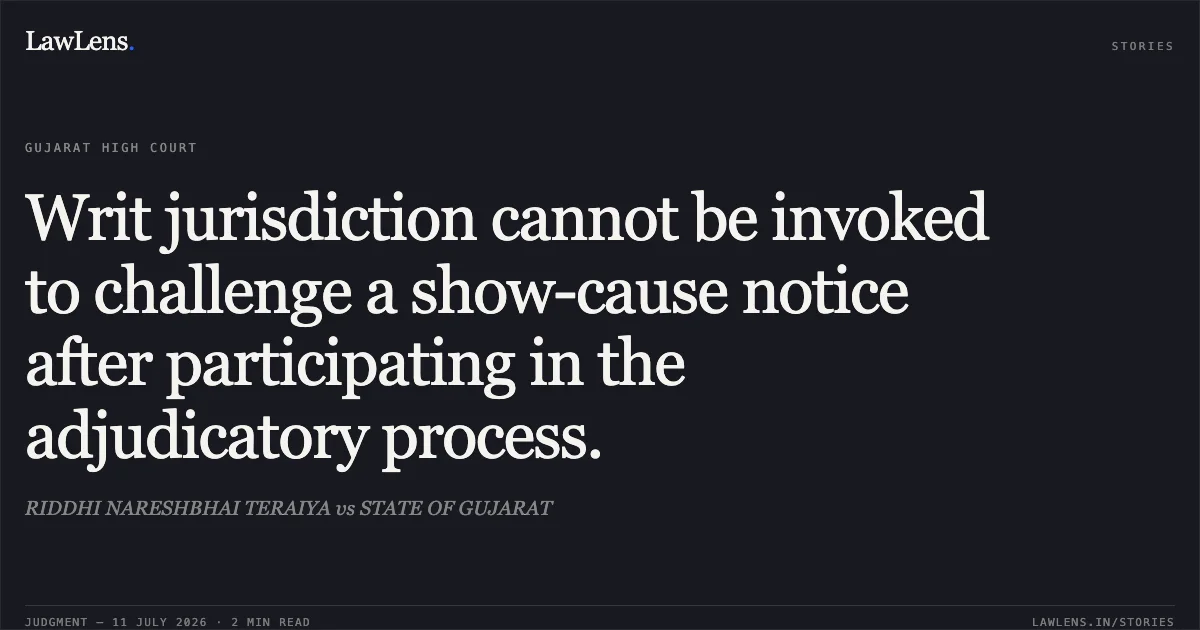
1. Whether a writ petition challenging a show-cause notice is maintainable when the petitioner has already participated in the administrative proceedings and no final order has been passed
Source reference: p. 5-6 / para. 9.1-9.22. Whether the Court should exercise its extraordinary jurisdiction under Article 226 to interdict statutory proceedings at a premature stage
Source reference: p. 6 / para. 9.3Law Applied
The Court applied the settled principle of judicial restraint regarding show-cause notices, holding that a writ petition is ordinarily not maintainable against a mere notice unless it is issued by an authority lacking inherent jurisdiction, is in patent violation of principles of natural justice, or is ex-facie without authority of law.
Source reference: p. 6Article 226 jurisdiction is equitable, discretionary, and supervisory, and should not be used to 'short-circuit' or 'pre-empt' statutory processes where a cause of action has not yet crystallized.
Source reference: p. 6-7Reasoning
The Court observed that the petitioner did not immediately challenge the notice but instead elected to respond on merits by filing detailed representations.
Source reference: p. 5By participating in the adjudicatory process, the petitioner cannot midway seek to stall proceedings through writ jurisdiction.
Source reference: p. 5-6The Court found that none of the exceptional circumstances (lack of jurisdiction or violation of natural justice) were present to warrant interference at the nascent stage of a show-cause notice.
Source reference: p. 6Since the competent authority is currently seized of the matter, any judicial intervention would be premature and would bypass the administrative machinery intended to verify the validity of the certificates.
Source reference: p. 7Holding
The High Court dismissed the petition, holding that it would not interfere with the show-cause notice at this stage.
The Court directed the competent authority to independently and objectively examine the petitioner’s replies and pass a reasoned order in accordance with the law.
Source reference: p. 8The dismissal is based solely on the maintainability of the petition at the notice stage and does not reflect an opinion on the merits of the case; the petitioner remains at liberty to challenge any final adverse order passed by the authority in the future.
Source reference: p. 7-8Original Court PDF
RIDDHI NARESHBHAI TERAIYAvsSTATE OF GUJARAT
Click to open original judgment
Original judgment, available to read, download and summarize on LawLens.in