Facts
The Petitioner, Nitin Seth, filed a writ petition under Article 226 of the Constitution of India seeking to set aside an Arbitral Award dated 30.07.2025 and a reference made by the Facilitation Council on 13.05.2022
Source reference: para 1-2The reference was made under Section 18(3) of the Micro, Small and Medium Enterprises Development Act, 2006 ("MSMED Act")
Source reference: para 2The Petitioner contended that the dispute arose from a "works contract," which falls outside the scope of the MSMED Act, and therefore the Facilitation Council and the resulting Arbitral Award were wholly without jurisdiction
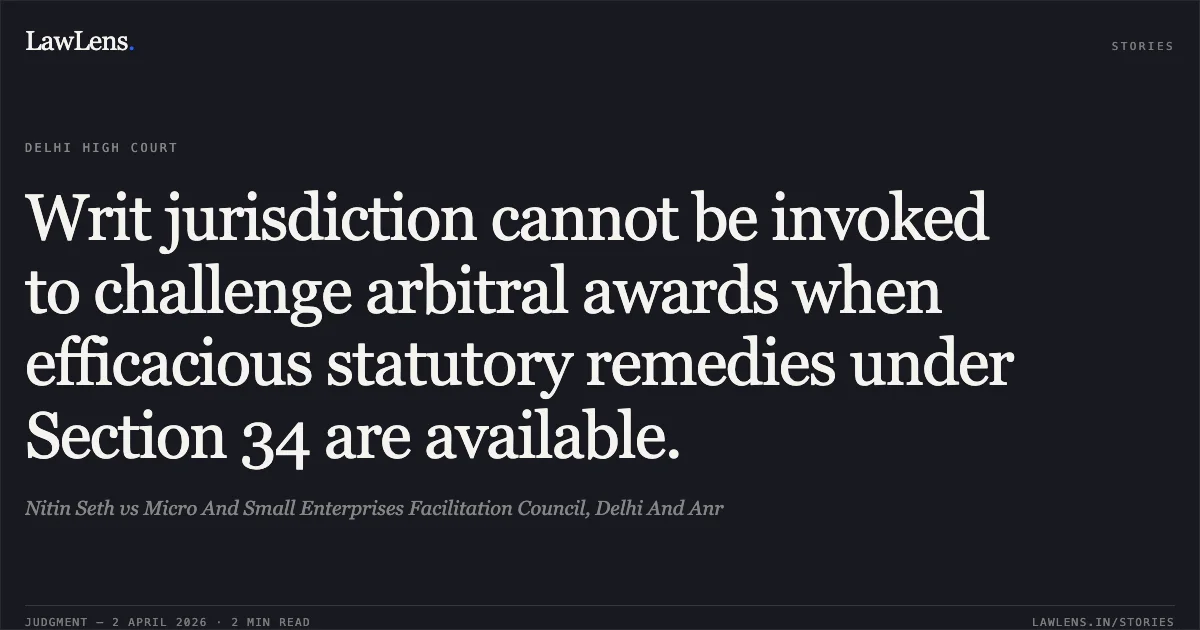
Source reference: para 3The Petitioner approached the High Court instead of invoking the statutory remedy under Section 34 of the Arbitration and Conciliation Act, 1996 ("A&C Act")
Source reference: para 4Issues
1. Whether a writ petition under Article 226/227 of the Constitution is maintainable to challenge an arbitral award when a statutory remedy exists under Section 34 of the A&C Act
Source reference: para 4, 102. Whether a jurisdictional challenge based on the nature of the contract (works contract) constitutes a "rare and exceptional circumstance" warranting interference by the Writ Court
Source reference: para 8, 10Law Applied
The Court primarily applied Section 18 and Section 19 of the MSMED Act, 2006, alongside Section 34 of the Arbitration and Conciliation Act, 1996
Source reference: para 4, 7It relied on the precedent in Executive Engineer and Others vs. Bholasingh Jaiprakash Construction Ltd., which holds that Article 226 cannot be invoked by litigants who fail to avail statutory remedies
Source reference: para 6The Court further cited M/s India Glycols limited v. MSME Facilitation Council, wherein the Supreme Court held that writ petitions should not be entertained to obviate the mandatory pre-deposit requirement under Section 19 of the MSMED Act
Source reference: para 7Additionally, it applied the principle of "minimal judicial interference" established in Bhaven Construction v. Executive Engineer, characterizing the A&C Act as a self-contained and comprehensive code
Source reference: para 8Reasoning
The Court reasoned that the Petitioner's jurisdictional objection—that the dispute involved a "works contract"—could have been raised before the Arbitral Tribunal or subsequently as a ground of "patent illegality" under Section 34 of the A&C Act
Source reference: para 4The Court observed that the Petitioner was essentially attempting to bypass the statutory framework of the MSMED Act and the A&C Act
Source reference: para 6It emphasized that the MSMED Act's objective would be defeated if parties were permitted to use writ jurisdiction to avoid the Section 19 requirement of a 75% pre-deposit for challenging awards
Source reference: para 7The Court highlighted that arbitration is a voluntary, private adjudicatory system, and the traditional litigation mechanism should not be reintroduced by casually entertaining writs against arbitral proceedings or awards
Source reference: para 9The Court concluded that the Petitioner failed to demonstrate "rare and exceptional circumstances," such as manifest bad faith or a complete absence of an efficacious alternative remedy, necessary to justify writ intervention
Source reference: para 8, 10Holding
The Court dismissed the writ petition, holding that it would not interfere with the arbitral process or the award under its extraordinary jurisdiction
The Court ruled that the Petitioner must seek recourse through the statutory remedies provided under the A&C Act
Source reference: para 4, 8However, all rights and contentions, including the issue of jurisdiction, were left open for the Petitioner to agitate at the appropriate legal stage
Source reference: para 8, 11Acts & Sections Cited
4 provisions across 2 statutes referred to in this judgment. Each provision opens on LawLens.
Micro, Small and Medium Enterprises Development Act, 20062
Arbitration and Conciliation Act, 19962
Original Court PDF
Nitin SethvsMicro And Small Enterprises Facilitation Council, Delhi And Anr
Click to open original judgment
Original judgment, available to read, download and summarize on LawLens.in