Facts
The petitioners, claiming ownership of agricultural land in Village Ghumanhera, Delhi, alleged that Respondent No. 4 fraudulently executed a sale deed for a valuable parcel of land on 21.11.2025 without paying consideration.
Source reference: para. 4While civil suits and complaints were pending, the petitioners alleged that on 07.05.2026, a large police contingent and private individuals forcibly dispossessed them and detained family members in police vehicles.
Source reference: para. 7Despite submitting multiple complaints regarding police atrocities and collusion between local officials and private respondents, no action was taken.
Source reference: para. 7Consequently, the petitioners filed a writ under Article 226 of the Constitution and Section 528 of the Bharatiya Nagarik Suraksha Sanhita, 2023 (BNSS), seeking a court-directed inquiry by the CBI or Crime Branch.
Source reference: paras. 3, 8Issues
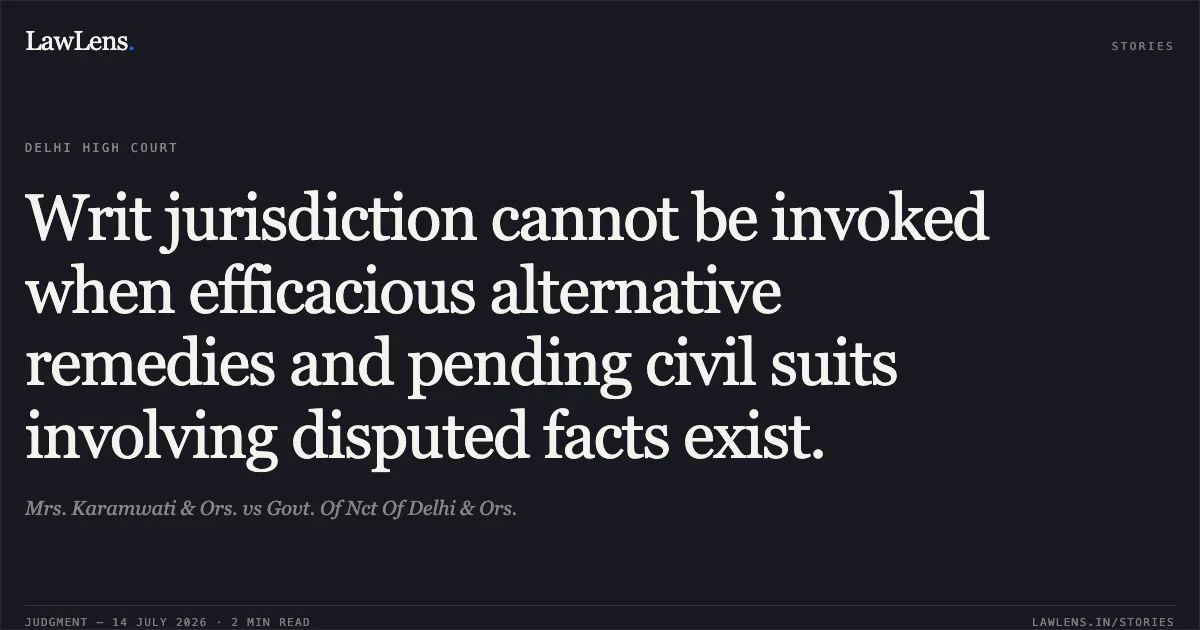
1. Whether the High Court should exercise its writ jurisdiction under Article 226 of the Constitution to direct an independent investigation when alternative statutory remedies are available.
Source reference: paras. 9, 112. Whether a writ petition is the appropriate forum to resolve grievances involving disputed questions of fact and pending civil litigation.
Source reference: para. 12Law Applied
The court applied the principle of "alternative efficacious remedy," holding that a petitioner must exhaust statutory remedies before invoking writ jurisdiction under Article 226 of the Constitution.
Source reference: para. 11The court referenced the procedural framework of the Bharatiya Nagarik Suraksha Sanhita (BNSS), specifically the right to approach a Metropolitan Magistrate for redressal of grievances.
Source reference: para. 11The court adhered to the judicial policy that writ courts should refrain from adjudicating "disputed questions of fact," particularly when parallel civil proceedings regarding the same property are pending to avoid impacting the outcome of such suits.
Source reference: para. 12Reasoning
The Court observed that the petitioners "jumped the gun" by moving the High Court directly without utilizing the specific legal machinery provided under the BNSS.
Source reference: para. 11It reasoned that the petitioners have an equally efficacious remedy by approaching the Metropolitan Magistrate, and further, a statutory right of revision if dissatisfied with the Magistrate's order.
Source reference: para. 11The Court emphasized that the allegations of dispossession and fraud involve complex factual disputes already under consideration in a pending civil suit (Ashil Kumar Anr. v. Suresh Goyal Anr.).
Source reference: paras. 4, 12The Court concluded that passing any orders in the writ petition could prejudice or indirectly sway the ongoing civil litigation between the parties.
Source reference: para. 12Holding
The Court answered the issues in the negative and declined to exercise its writ jurisdiction.
The petition and pending applications were disposed of, with the Court holding that the petitioners must first exhaust the appropriate remedies available before the competent lower forum.
Source reference: paras. 13-15The petitioners were granted liberty to avail themselves of the statutory remedies under the law.
Source reference: para. 13Acts & Sections Cited
1 provisions across 1 statute referred to in this judgment. Each provision opens on LawLens.
Bharatiya Nagarik Suraksha Sanhita, 20231
Original Court PDF
Mrs. Karamwati & Ors.vsGovt. Of Nct Of Delhi & Ors.
Click to open original judgment
Original judgment, available to read, download and summarize on LawLens.in