Facts
The Petitioner, a partnership firm engaged in manufacturing, exporting and distributing flanged pipes and fittings, was registered under the CGST Act.
Source reference: para. 8The Respondents initiated a GST audit under Section 65 for the period July 2017 to March 2022 by issuing Form GST ADT-01 on 15 December 2023.
Source reference: para. 9After issuing audit memos and receiving the Petitioner’s replies and supporting documents, the Respondents issued Form GST ADT-02 on 26 June 2024, alleging tax liability of approximately ₹78,53,548, excluding interest.
Source reference: paras. 10–12Form GST DRC-01A was subsequently issued, followed by a show-cause notice dated 26 July 2024 under Section 74(1), alleging suppression of facts with intent to evade tax.
Source reference: paras. 13–14The Petitioner challenged the SCN under Article 226, contending, inter alia, that Section 74 was wrongly invoked, a consolidated SCN could not cover multiple financial years, the audit process was defective, and the proposed demands were factually unsustainable.
Source reference: paras. 15–16, 21During the pendency of the writ petition, the adjudicating authority passed Order-in-Original No. 62/AY/AC/NP/2024-25 dated 3 February 2025, confirming tax, interest and penalty.
Source reference: paras. 1, 17The Petitioner thereafter challenged the findings in the adjudication order, including the alleged non-consideration of its replies, DRC-03s, reconciliations, invoices, bank statements and export documents.
Source reference: para. 18Issues
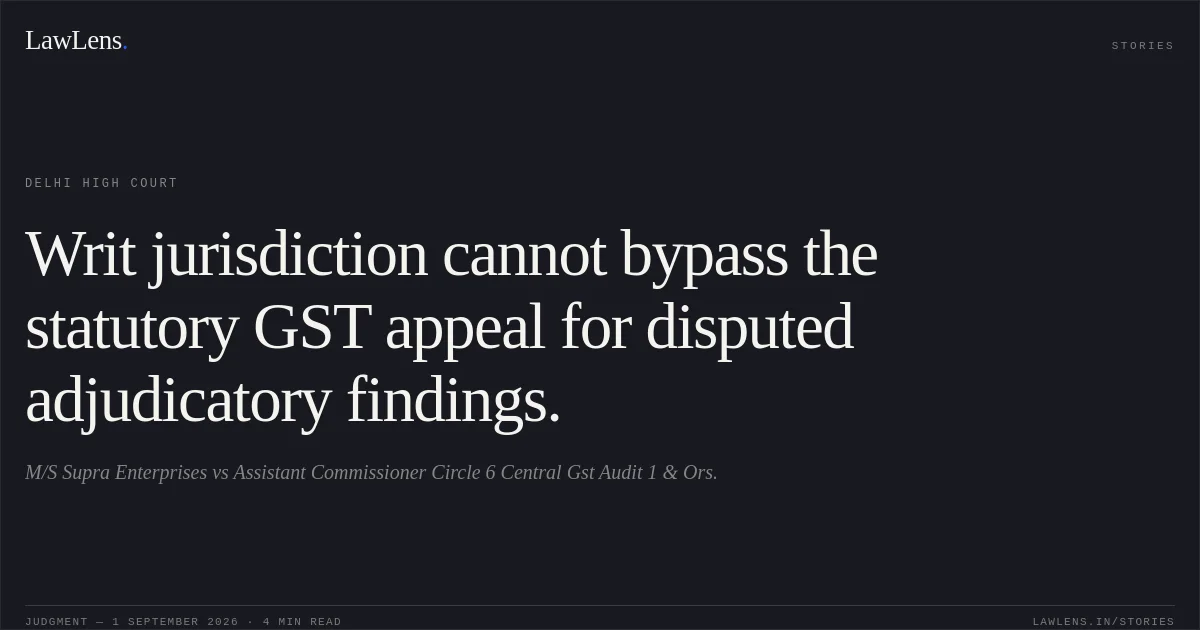
Whether the High Court should entertain the writ petition under Article 226 despite the availability of an efficacious statutory appeal under Section 107 of the CGST Act?
Source reference: paras. 2–6, 25–26Whether the invocation of Section 74 was without jurisdiction because the SCN allegedly failed to establish fraud, wilful misstatement or suppression of facts with intent to evade tax?
Source reference: paras. 27–30Whether issuance of a consolidated SCN covering multiple financial years was legally impermissible and constituted a jurisdictional defect?
Source reference: paras. 31–32Whether the audit proceedings and Form GST ADT-02 were vitiated by non-consideration of the Petitioner’s replies and documents, amounting to a violation of natural justice?
Source reference: paras. 33–35Whether the adjudication order’s treatment of the Petitioner’s documents and the individual heads of demand warranted interference under Article 226?
Source reference: paras. 36–44Law Applied
The Court applied the principle that although Article 226 jurisdiction is wide, constitutional courts ordinarily refrain from entertaining writ petitions where the statute provides an efficacious alternative remedy.
Source reference: paras. 2–4Section 107 of the CGST Act provides a comprehensive appellate remedy against adjudication orders, including examination of questions of fact and law.
Source reference: paras. 2–4Relying on Assistant Commissioner of State Tax v. Commercial Steel Limited, (2022) 16 SCC 447, the Court reiterated that the alternative-remedy rule is one of judicial restraint and does not constitute an absolute jurisdictional bar; writ jurisdiction may nevertheless be exercised in cases involving breach of fundamental rights, violation of natural justice, lack of jurisdiction, or challenge to the vires of legislation, subject to the Court independently assessing whether exceptional circumstances exist.
Source reference: para. 5With respect to consolidated notices, the Court relied on Ambika Traders through Proprietor Gaurav Gupta v. Additional Commissioner, Adjudication, DGGSTI, CGST Delhi North, 2025:DHC:6181-DB, which held that Sections 73(3) and 74(3) contemplate notices for “any period” or “such periods,” and do not prohibit a consolidated SCN covering more than one financial year; the financial-year limitation under Sections 73(10) and 74(10) concerns the time for passing the order.
Source reference: paras. 31–32The Court distinguished Vardhaman Gold v. State of Andhra Pradesh, 2023 SCC OnLine AP 3833, where the audit and consequential notice were set aside for a mandatory procedural violation resulting in denial of a proper opportunity of hearing.
Source reference: para. 35Reasoning
The Court held that the Petitioner’s objections to Section 74 concerned the sufficiency of the evidence and the correctness of the adjudicating authority’s conclusion, rather than a patent absence of jurisdiction. The objection had been raised before, considered by, and adjudicated upon by the competent authority after the Petitioner was given an opportunity to defend itself.
Source reference: paras. 27–30The challenge to the consolidated SCN also did not disclose a jurisdictional defect, since Ambika Traders recognised that a notice may cover multiple periods; any question regarding limitation for a particular financial year could be examined in the statutory appeal.
Source reference: paras. 31–32Similarly, the allegations concerning defects in the audit process required examination of the audit record and the material considered by the authorities. The Petitioner was subsequently given an opportunity to respond to the SCN and participate in adjudication, so its complaint was about the manner in which its material was evaluated, not denial of an opportunity to be heard.
Source reference: paras. 33–35The challenges concerning DRC-03 payments, ITC eligibility, RCM liability, export documents, GSTR-2A/GSTR-3B discrepancies, Section 17(5) and Rule 96A involved appreciation of evidence, computation of liability and factual findings, all of which fell within the appellate authority’s jurisdiction under Section 107.
Source reference: paras. 36–40The Court distinguished a complete denial of hearing from a case where the party was heard but disputed the manner in which its defence was assessed; the latter ordinarily constitutes a merits challenge suitable for statutory appeal.
Source reference: paras. 41–44Holding
The Court held that the Petitioner had not established any exceptional circumstance—such as patent lack of jurisdiction or manifest violation of natural justice—justifying exercise of writ jurisdiction despite the remedy of appeal under Section 107 of the CGST Act.
The writ petition and pending applications were accordingly dismissed.
Source reference: para. 47The Petitioner was granted liberty to pursue the statutory appeal under Section 107.
Source reference: para. 48The Court further clarified that, in such appeal, the Petitioner could seek exclusion of the period spent prosecuting the writ proceedings, and that the appellate authority should determine limitation in accordance with law and uninfluenced by the observations in the judgment.
Source reference: para. 49Acts & Sections Cited
7 provisions across 2 statutes referred to in this judgment. Each provision opens on LawLens.
Central Goods and Services Tax Act, 20175
Andhra Pradesh Goods and Services Tax Act, 20172
Original Court PDF
M/S Supra EnterprisesvsAssistant Commissioner Circle 6 Central Gst Audit 1 & Ors.
Click to open original judgment
Original judgment, available to read, download and summarize on LawLens.in