Facts
The petitioners challenged the order dated 24.08.2026 passed by the Sub-Divisional Officer (Revenue), Mahagaon, in Case No. 0002/A-74/2026-27 concerning demarcation of Survey No. 23 at Village Khokhipura, Tehsil Gormi, District Bhind.
Source reference: p.1The private respondents had applied for demarcation before the Tehsildar on 09.04.2026. The Revenue Inspector and Patwari allegedly conducted demarcation on 29.04.2026 without notice to the petitioners, prepared a Panchnama and demarcation field book without their signatures, and thereafter an order dated 05.05.2026 was passed in favour of the private respondents.
Source reference: p.1The petitioners challenged the order before the competent revenue authority and also sought protection under Section 52 of the Madhya Pradesh Land Revenue Code. They relied upon an order dated 11.05.2026 directing the parties to maintain status quo.
Source reference: p.2During the pendency of the revenue proceedings, the SDO passed the impugned order dated 24.08.2026. The petitioners alleged violation of natural justice and sought writ intervention under Article 226 of the Constitution.
Source reference: pp.2–3The Court noted that the statutory appellate proceedings had culminated in an order dated 31.08.2026, which was also under challenge, while another appeal concerning the order dated 30.06.2025 was stated to be pending before the Collector.
Source reference: p.3Issues
Whether the High Court should exercise its writ jurisdiction under Article 226 where the petitioners had already invoked the statutory appellate remedy under the Madhya Pradesh Land Revenue Code.
Source reference: pp.3–4Whether the allegations of absence of notice, irregularity in the demarcation proceedings, defective Panchnama and demarcation field book, and violation of natural justice warranted interference with the impugned revenue order in writ jurisdiction.
Source reference: pp.3–4Whether the pending statutory proceedings could be bypassed in the absence of exceptional circumstances justifying such interference.
Source reference: p.4Law Applied
Article 226 of the Constitution confers extraordinary writ jurisdiction, but such jurisdiction is not ordinarily exercised where the statute provides an efficacious alternative remedy.
Source reference: pp.3–4Disputed questions concerning the correctness of revenue demarcation, evidentiary material, procedural compliance, and the effect of revenue orders should ordinarily be examined by the competent statutory appellate authority under the Madhya Pradesh Land Revenue Code.
Source reference: pp.3–4Allegations of denial of notice or breach of natural justice may also be considered by the appellate authority on the basis of the record. A writ petition may nevertheless be entertained in exceptional circumstances, but no such circumstance was established in the present case.
Source reference: pp.3–4Reasoning
The Court treated the petitioners’ principal grievances—want of notice, allegedly behind-the-back demarcation, preparation of the Panchnama and field book, and violation of natural justice—as matters requiring factual and evidentiary examination.
Source reference: p.3Since the petitioners had already pursued the statutory appellate remedy and the revenue authorities were seized of the dispute, simultaneous adjudication under Article 226 was considered inappropriate.
Source reference: p.3The Court found no exceptional circumstance warranting bypass of the statutory remedy. It therefore declined to examine the merits or correctness of the demarcation proceedings and left those questions to the competent revenue authority.
Source reference: p.4Holding
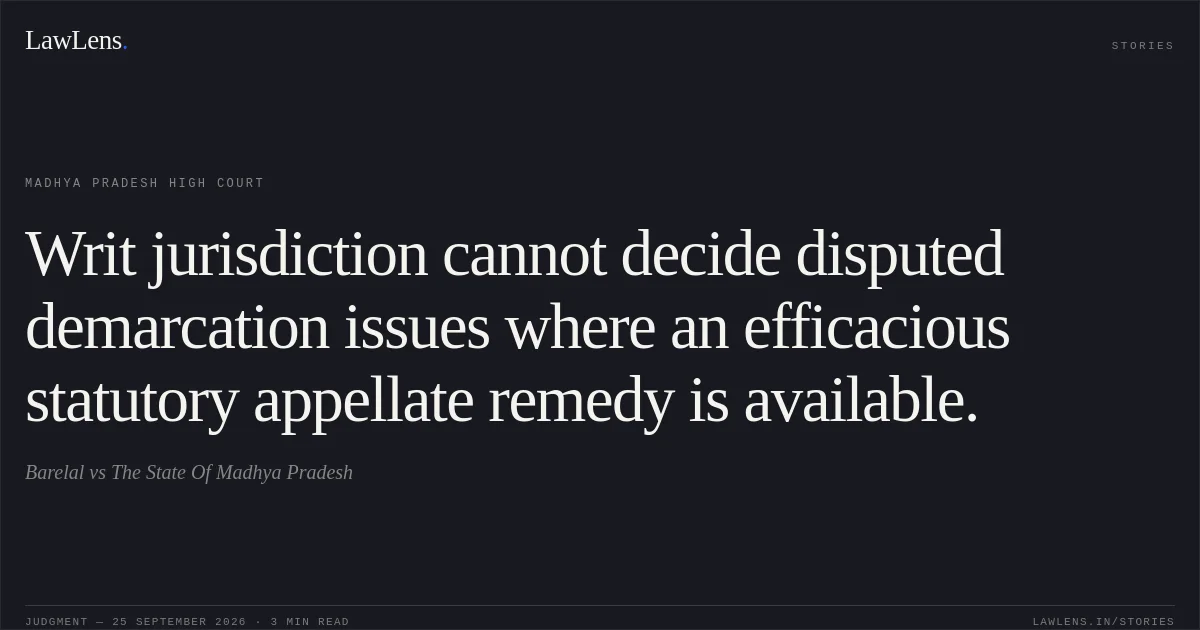
The High Court dismissed the writ petition, holding that no ground for interference under Article 226 had been established where an efficacious statutory remedy was already being pursued.
The Court expressed no opinion on the merits of the parties’ rival claims or on the validity of the demarcation proceedings.
Source reference: p.4It clarified that dismissal of the writ petition would not prevent the petitioners from pursuing any statutory remedy available in law, and directed the competent revenue authority to decide the pending proceedings independently, strictly in accordance with law and uninfluenced by the observations in the judgment.
Source reference: pp.4–5Acts & Sections Cited
1 provisions across 1 statute referred to in this judgment. Each provision opens on LawLens.
MP Land Revenue Code 19591
Original Court PDF
BarelalvsThe State Of Madhya Pradesh
Click to open original judgment
Original judgment, available to read, download and summarize on LawLens.in