Facts
The petitioners were employees of VIT University, a deemed university.
Source reference: p. 3–4Some sought subsistence allowance during suspension under the Tamil Nadu Payment of Subsistence Allowance Act, 1981; others sought to quash disciplinary proceedings or related orders.
Source reference: p. 3–4Taking W.P. No. 1129 of 2015 as the representative petition, the petitioner said that he had been suspended pending enquiry, that his request for subsistence allowance had not been met, and that the enquiry had subsequently been set aside in an earlier writ petition.
Source reference: p. 5–8The respondent filed no counter-affidavit and did not appear at the hearing.
Source reference: p. 8Issues
Whether the University was an “establishment” under Section 2(c) of the 1981 Act, so that the petitioners could claim subsistence allowance under that Act.
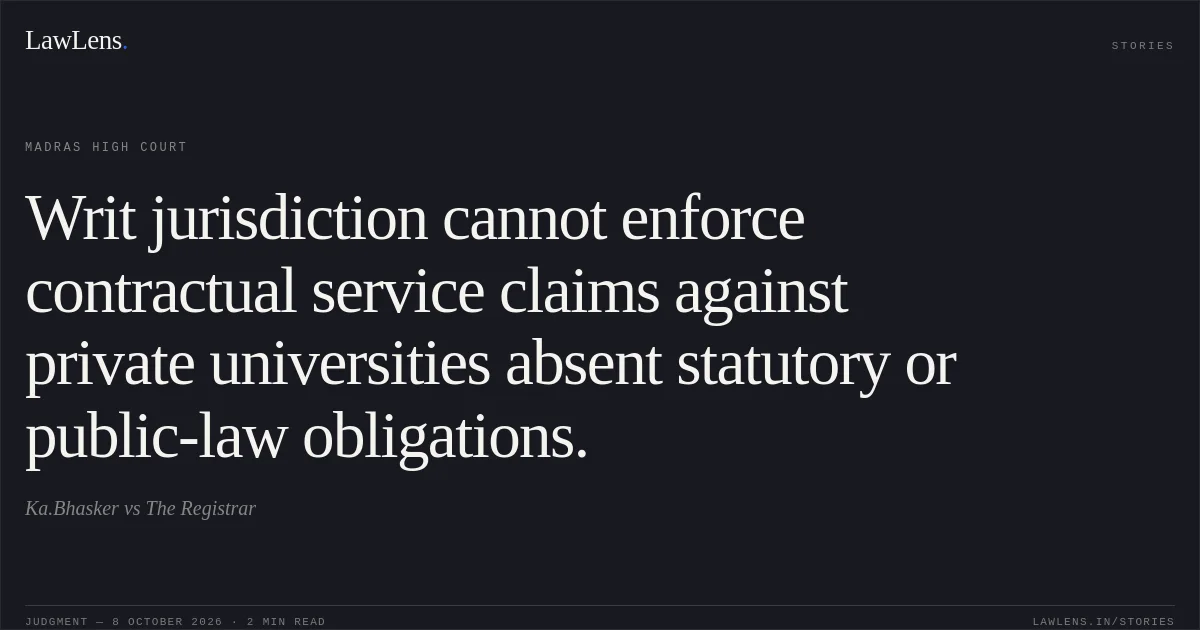
Source reference: p. 9–12Whether the petitioners could invoke Article 226 to enforce employment-related rights against the University, which the Court treated as a private institution, in the absence of an applicable statutory or regulatory service obligation.
Source reference: p. 12–16Law Applied
Section 2(a) of the Tamil Nadu Payment of Subsistence Allowance Act, 1981 defines the employees covered by the Act, while Section 2(c) defines an “establishment” to include specified activities only where the executive power of the State extends to them; Section 3 provides for subsistence allowance within the Act’s scope.
Source reference: p. 9–11Under Article 226, a body discharging a public function may be amenable to judicial review, but an employee’s individual service dispute is not thereby actionable in writ jurisdiction unless it has a public-law element, is governed by statutory provisions, or otherwise falls within the recognised grounds for writ review.
Source reference: p. 13–15The Court relied on St. Mary’s Education Society v. Rajendra Prasad Bhargava, (2023) 4 SCC 498, for that distinction, and referred to Army Welfare Educational Society v. Sunilkumar Sharma, 2024 SCC OnLine SC 1683.
Source reference: p. 13–15; p. 15Reasoning
The Court held that the University’s location in Tamil Nadu did not, by itself, bring it within Section 2(c) of the 1981 Act.
Source reference: p. 11–12It noted that the University received no financial aid or assistance from the State and was not affiliated to a State university, and concluded that the State’s executive power did not extend to its activities for the purposes of the Act.
Source reference: p. 11–12It further found that the petitioners had identified no applicable University rule or regulation with statutory or regulatory force governing subsistence allowance.
Source reference: p. 12–16The claims therefore concerned employment obligations in the private realm, rather than an enforceable public-law duty; the University’s educational function did not, without a direct nexus to the act complained of, make these service disputes amenable to Article 226.
Source reference: p. 12–16Holding
The Court held that the 1981 Act did not apply to the University and that the petitions were not maintainable under Article 226.
It dismissed all the writ petitions, leaving the petitioners at liberty to approach the competent forum for appropriate relief; connected miscellaneous petitions were closed, with no order as to costs.
Source reference: p. 16–17Acts & Sections Cited
4 provisions across 2 statutes referred to in this judgment. Each provision opens on LawLens.
University Grants Commission Act, 19562
Original Court PDF
Ka.BhaskervsThe Registrar
Click to open original judgment
Original judgment, available to read, download and summarize on LawLens.in