01Facts
The petitioner, an Indian national, arrived at Indira Gandhi International Airport from Doha on 1 July 2024 and was intercepted after crossing the Green Channel. Customs authorities recovered from him a 117-gram gold bar of 998 purity, which had not been declared.
¶ 4–6 · pp. 2–3In his statement under Section 108 of the Customs Act, 1962, the petitioner admitted ownership and non-declaration of the gold and stated that he did not require a show cause notice or personal hearing.
¶ 6–7 · pp. 3–4The Department asserted that an oral show cause notice was given on 1 July 2024 and that a personal hearing was granted on 21 May 2025.
¶ 8 · p. 4By Order-in-Original dated 28 May 2025, the Adjudicating Authority permitted re-export of the gold upon payment of customs duty, redemption fine and penalty.
¶ 9 · p. 4In departmental appeal, the Commissioner of Customs (Appeals), by order dated 21 January 2026, set aside that relief and directed absolute confiscation of the gold.
¶ 10–11 · p. 4The petitioner challenged the appellate order under Article 226, alleging non-compliance with Section 124 and violation of natural justice.
¶ 2 · p. 202Issues
i.Whether the High Court should exercise its writ jurisdiction under Article 226 against the Order-in-Appeal when an efficacious statutory revision remedy was available under Section 129DD of the Customs Act, 1962.
¶ 17–20 · pp. 9–10ii.Whether the alleged absence of a valid written or oral show cause notice under Section 124, and the petitioner’s disputed waiver of notice and hearing, justified bypassing the statutory remedy.
¶ 20–27 · pp. 10–12iii.Whether the requirements of Sections 110(2) and 124 of the Customs Act, including the statutory time limit for issuance of notice and the legal effect of the alleged oral notice, had been complied with.
¶ 28–30 · pp. 12–13iv.Whether the Commissioner of Customs (Appeals) was legally justified in ordering absolute confiscation of the gold bar.
¶ 34(ix) · p. 1503Law Applied
Section 129DD of the Customs Act provides a statutory revision remedy before the Central Government against specified appellate orders concerning imported baggage.
¶ 17 · p. 9The rule of alternative remedy is a rule of policy, convenience and discretion, and ordinarily restricts exercise of writ jurisdiction where an efficacious statutory remedy exists, although recognised exceptions include enforcement of fundamental rights, violation of natural justice, lack of jurisdiction and challenge to legislative validity, as reiterated in Radha Krishan Industries v. State of Himachal Pradesh, (2021) 6 SCC 771.
¶ 19 · p. 10Section 124 requires notice before confiscation or imposition of penalty; its first proviso permits an oral notice and oral representation in the prescribed circumstances, but a mere waiver cannot, by itself, substitute the statutory notice, as held in Ms. Shubhangi Gupta v. Commissioner of Customs, W.P.(C) 10772/2024, decided on 4 November 2024.
¶ 21, 26 · pp. 10–12Sections 110(2) and 124 operate in distinct fields, and the consequences of failure to comply with the statutory scheme must be considered in accordance with Union of India v. Jatin Ahuja, decided on 11 September 2025.
¶ 28–30 · pp. 12–13The Court also relied on Rikhab Chand Jain v. Union of India for the principle that an equally efficacious statutory remedy should ordinarily be pursued.
¶ 14.7 · p. 8Provisions in the judgment · 3 · Linked ones open on LawLens
Customs Act,1962 Section 108Section 110Section 124
04Reasoning
The Court held that the impugned order was a statutory appellate order for which Section 129DD provided a specific and efficacious remedy.
¶ 16–18 · pp. 9–10Although violation of natural justice may constitute an exception to the alternative-remedy rule, the present case involved disputed factual questions: whether an oral show cause notice was actually given; whether it was given pursuant to a request under the first proviso to Section 124; whether its contents adequately communicated the proposed confiscation; whether the Section 108 statement was voluntary or coerced; and what significance attached to the petitioner’s representative participating in the adjudication and to the subsequent hearing.
¶ 22–27 · pp. 11–12The Court clarified that it was not accepting that the petitioner’s alleged waiver, by itself, satisfied Section 124.
¶ 26 · p. 12However, because the Department specifically asserted that an oral notice had been given on the date of seizure and that a hearing had subsequently been granted, the Court considered evidentiary examination of those matters inappropriate in writ proceedings.
¶ 27–31 · pp. 12–14The earlier writ proceedings, which had allowed the departmental appellate process to continue, also weighed against entertaining a fresh writ challenge to the resulting appellate order.
¶ 32 · p. 14No jurisdictional defect, statutory-vires challenge or other exceptional circumstance was established.
¶ 35–36 · pp. 15–1605Holding
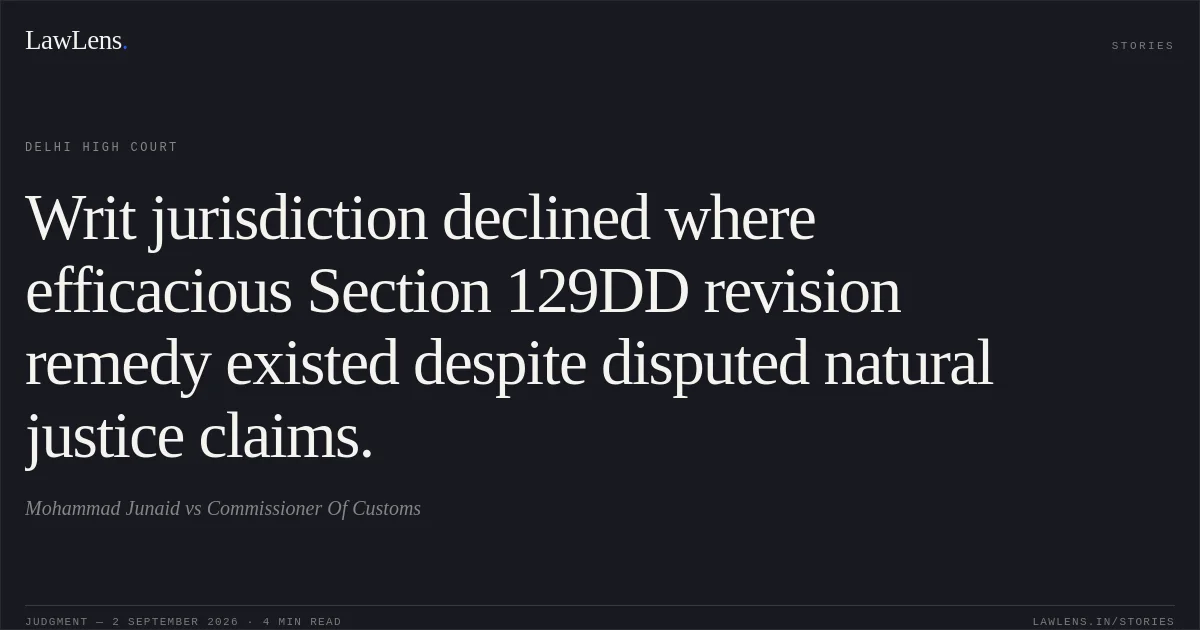
The High Court declined to exercise its discretionary jurisdiction under Article 226 and dismissed the writ petition on the ground that the petitioner had an efficacious statutory remedy under Section 129DD of the Customs Act.
¶ 38–39 · p. 16The petitioner was left at liberty to raise before the Revisional Authority all grounds concerning the alleged non-issuance or invalidity of the show cause notice, the Section 108 statement and alleged waiver, Sections 110(2) and 124, the hearing and participation of his authorised representative, and the legality of absolute confiscation.
¶ 34 · pp. 14–15All such questions were expressly left open, with no final opinion being expressed on the merits.
¶ 40 · p. 17Original Court PDF
Mohammad JunaidvsCommissioner Of Customs
Click to open original judgment
Original judgment, available to read, download and summarize on LawLens.in