Facts
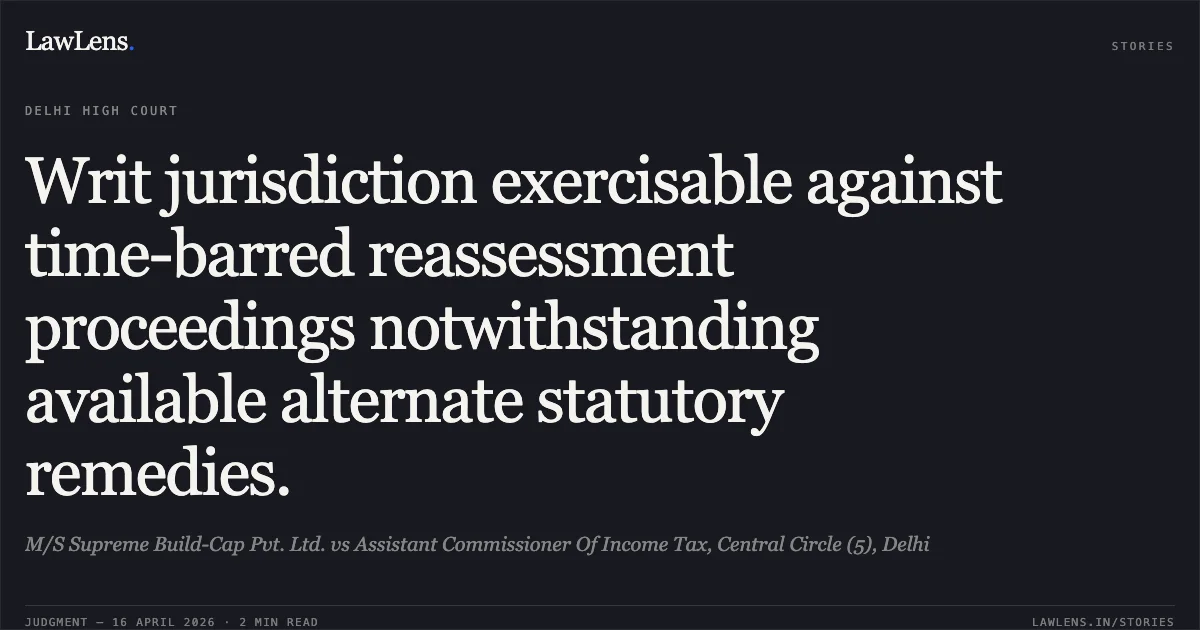
The petitioner challenged an assessment order dated 29.03.2026
Source reference: p. 1The primary grievance was that the reassessment proceedings initiated via notice dated 30.08.2024 under Section 148 of the Income Tax Act, 1961, for Assessment Year (AY) 2016-17, were time-barred under the then-applicable six-year limitation period
Source reference: p. 1Although the petitioner raised this jurisdictional objection in response to a show-cause notice dated 21.03.2026, the Assessing Officer (AO) failed to consider the plea in the final assessment order
Source reference: p. 2The Respondent raised a preliminary objection regarding maintainability, arguing the petitioner should exhaust the statutory appellate remedy instead of invoking writ jurisdiction
Source reference: p. 2Issues
1. Whether the writ petition is maintainable under Article 226 despite the availability of an alternative statutory remedy under the Income Tax Act, 1961
Source reference: p. 2 / para. 22. Whether the notice dated 30.08.2024 issued under Section 148 of the Act was void for being beyond the prescribed period of limitation
Source reference: p. 2 / para. 5Law Applied
The court primarily applied Section 148 of the Income Tax Act, 1961, regarding the limitation period for reassessment
Source reference: p. 1It relied on the precedent Manju Somani v. ITO (2024:DHC:5411-DB) to determine the expiry of limitation for AY 2016-17
Source reference: p. 2Regarding writ jurisdiction, the court applied the principles from M/S Magadh Sugar Mills and Energy Limited vs. State of Bihar (2021 SCC OnLine SC 801), Whirlpool Corporation v. Registrar of Trademarks, and Harbanslal Sahni v. Indian Oil Corporation Ltd., which establish that an alternative remedy is not a bar if the proceedings are wholly without jurisdiction or violate natural justice
Source reference: p. 3-4It further cited Executive Engineer v. Seetaram Rice Mill (2012) 2 SCC 108, affirming that courts should not relegate parties to statutory remedies when the exercise of such jurisdiction by the lower authority is ex-facie a futility (lex nil frustra facit)
Source reference: p. 5Reasoning
The court observed that the reassessment notice dated 30.08.2024 was "fundamentally void" as it was issued beyond the six-year limitation period prescribed for AY 2016-17
Source reference: p. 3It rejected the Respondent's argument on maintainability, noting that the petitioner had specifically raised the jurisdictional objection before the AO, which remained unheeded
Source reference: p. 3The court reasoned that requiring the petitioner to undergo the "rigmarole" of appellate proceedings for an order that is "without jurisdiction on the face of it" would be iniquitous
Source reference: p. 3Applying the Magadh Sugar Mills criteria, the court held that since the challenge pertained to an order passed "wholly without jurisdiction," the exhaustion of statutory remedies was not required
Source reference: p. 4-5Holding
The court held that the initiation of reassessment was time-barred and the subsequent orders were void
It quashed the impugned notice dated 30.08.2024 issued under Section 148 and the consequential assessment order dated 29.03.2026
Source reference: p. 6The writ petition was allowed, and all pending applications were dismissed
Source reference: p. 6Acts & Sections Cited
1 provisions across 1 statute referred to in this judgment. Each provision opens on LawLens.
Electricity Act, 20031
Original Court PDF
M/S Supreme Build-Cap Pvt. Ltd.vsAssistant Commissioner Of Income Tax, Central Circle (5), Delhi
Click to open original judgment
Original judgment, available to read, download and summarize on LawLens.in