Facts
The petitioner challenged NHIDCL’s notice dated 25 September 2026, issued under Clause 23.1(ii) of the EPC contract, contending that he had already terminated the contract after issuing a notice of intention to terminate on 15 September 2026. He sought to restrain consequential action, including encashment of his Performance Bank Guarantee, and to prevent NHIDCL from engaging another contractor or creating third-party rights in respect of the works.
Source reference: p. 2NHIDCL argued that the dispute was contractual and should be resolved through the contract’s dispute-resolution mechanism, including arbitration. The parties did not dispute that the issues were arbitrable.
Source reference: p. 2Issues
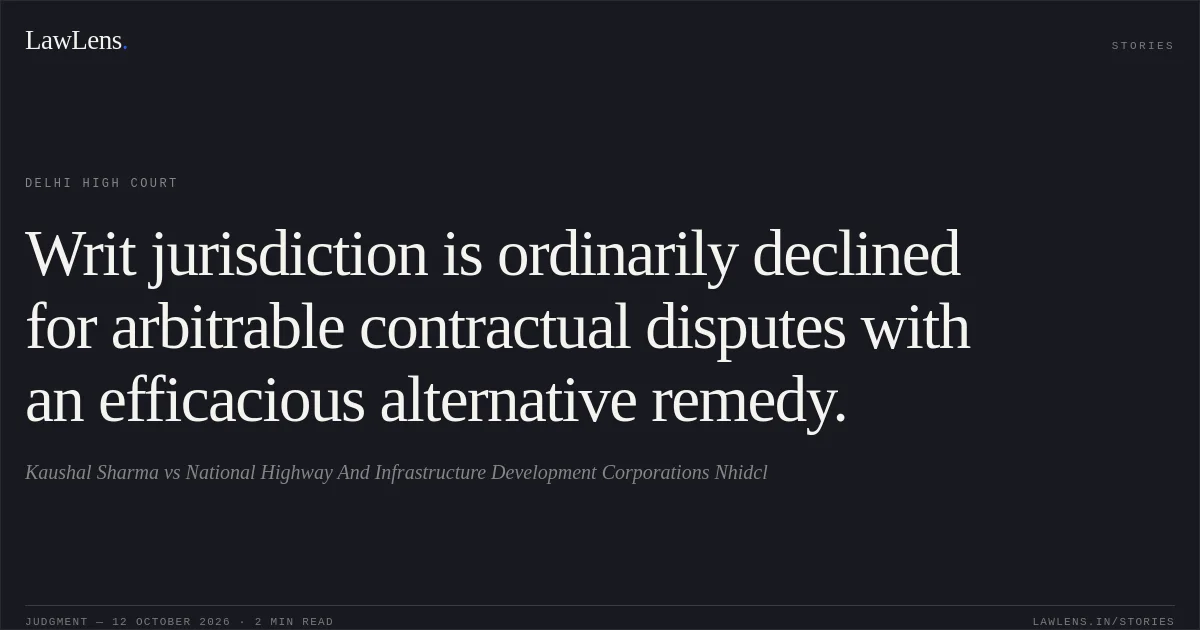
1. Whether the Court should exercise its jurisdiction under Article 226 to determine a contractual dispute that the parties accept is arbitrable.
Source reference: pp. 2–32. Whether the petitioner’s requested interim relief concerning the Performance Bank Guarantee and the works should instead be pursued through the available arbitral remedies.
Source reference: p. 3Law Applied
Article 226 confers discretionary jurisdiction, which the High Court would ordinarily decline to exercise in a contractual dispute where the parties have agreed to a specific dispute-resolution mechanism, particularly arbitration.
Source reference: pp. 3–5Under Joshi Technologies International Inc. v. Union of India, (2015) 7 SCC 728, contractual disputes without a public-law element, disputes involving serious contested facts, and contractual monetary claims will normally be left to the remedies provided by contract or ordinary law; the existence of an alternative remedy is not an absolute bar, but may warrant refusal of writ relief.
Source reference: pp. 3–5The Court also noted that interim relief concerning the Performance Bank Guarantee could be sought in proceedings under Section 9 of the Arbitration and Conciliation Act, 1996.
Source reference: p. 3Reasoning
The central dispute—whether the petitioner had validly terminated the EPC contract before NHIDCL issued its notice—required determination of contractual rights and was accepted by both parties as arbitrable.
Source reference: p. 2The Court found no exceptional circumstance requiring it to intervene under Article 226. Because an alternative arbitral remedy was available, including an application under Section 9 for interim protection concerning the Performance Bank Guarantee, the contractual nature of the dispute weighed against exercising writ jurisdiction.
Source reference: pp. 3, 6Holding
The Court declined to exercise its discretionary jurisdiction under Article 226.
The Court disposed of the petition, leaving the petitioner at liberty to pursue remedies available in law, including the appropriate arbitral remedies. It did not determine the validity of either party’s termination or grant the substantive relief sought.
Source reference: p. 6Acts & Sections Cited
1 provisions across 1 statute referred to in this judgment. Each provision opens on LawLens.
Arbitration and Conciliation Act, 19961
Original Court PDF
Kaushal SharmavsNational Highway And Infrastructure Development Corporations Nhidcl
Click to open original judgment
Original judgment, available to read, download and summarize on LawLens.in