Facts
The petitioner, a Class-I government contractor, was awarded a contract in 2007 for construction of a high-level bridge across the Dabua River on NH-62, Meghalaya, for ₹3,00,35,800.
Source reference: para. 2The work was completed in 2014 and a completion certificate was issued, but the petitioner alleged that its final bill and other dues remained unpaid.
Source reference: paras. 3–6The petitioner claimed an outstanding principal amount of ₹1,66,47,165 and additionally sought ₹1,19,83,919 towards cost escalation, making a total claim of ₹2,86,31,084.
Source reference: paras. 8–10, 26It also referred to supplementary work valued at ₹4,31,000 undertaken pursuant to a 2017 work order.
Source reference: paras. 5, 25After issuing several representations and a legal notice, the petitioner invoked Article 226 of the Constitution seeking payment of its contractual dues and interest.
Source reference: paras. 6–7, 11–14The State respondents contended that the claim arose from a contractual relationship, that no funds had been released by the Ministry of Road Transport and Highways, and that the contract contained an arbitration clause.
Source reference: paras. 15–19Respondent No. 4 additionally disputed the claim for price escalation and raised the objection of delay and laches.
Source reference: paras. 20–22Issues
Whether a writ petition under Article 226 is maintainable for enforcement of disputed monetary claims arising out of a non-statutory works contract containing an arbitration clause.
Source reference: paras. 17–18, 28–30Whether the petitioner’s claim could be adjudicated in writ proceedings despite disputed questions concerning the amount payable, running bills, final bills, price escalation, and contractual entitlement.
Source reference: paras. 24–29Whether the petition was liable to be rejected on the ground of delay and laches, having been filed years after the alleged dues arose.
Source reference: para. 19Whether the petitioner should be relegated to the civil court or other agreed contractual forum for determination of its claims.
Source reference: paras. 28–31Law Applied
Article 226 confers wide discretionary jurisdiction, but courts ordinarily do not entertain writ petitions involving pure contractual disputes, particularly monetary claims requiring adjudication of disputed facts.
Source reference: no citationIn Joshi Technologies International Inc. v. Union of India, (2015) 7 SCC 728, the Supreme Court held that writ jurisdiction may be declined where the dispute is governed by private contractual rights, an agreed dispute-resolution mechanism such as arbitration exists, or complex factual issues and monetary claims require evidence.
Source reference: para. 29The Court also relied on Union of India v. Puna Hinda, (2021) 10 SCC 690, which held that disputes regarding whether an amount is payable and the quantum payable are ordinarily matters for the agreed forum and not for determination in writ proceedings.
Source reference: para. 28The principle of judicial self-restraint in entertaining disputed contractual claims was also drawn from Smti. Priyanchi R. Marak and the authorities referred to therein.
Source reference: para. 30Although limitation as such does not strictly govern the exercise of Article 226 jurisdiction, delay and laches remain relevant to the Court’s discretionary relief; however, the Court may protect the petitioner by excluding the time spent bona fide in writ proceedings when permitting recourse to an alternative remedy.
Source reference: paras. 13, 19, 31Reasoning
The Court found that the petitioner’s claim was not a simple admitted debt.
Source reference: no citationThe pleadings and arguments disclosed inconsistencies concerning the total bill, payments already made, the final bill, deductions, the supplementary work, and the separate claim for price escalation.
Source reference: paras. 24–27In particular, the price-escalation claim was not clearly pleaded in the petition and was introduced through argument, preventing its adjudication in writ proceedings.
Source reference: para. 27The respondents disputed both the petitioner’s entitlement to escalation and the amount payable, while the contract contained an arbitration clause.
Source reference: paras. 18, 21–22Applying Puna Hinda and Joshi Technologies, the Court held that determination of the petitioner’s contractual entitlement would require examination of documents, measurements, accounts, and possibly evidence—functions inappropriate for the writ court.
Source reference: paras. 28–30Since the petitioner had an adequate remedy before the competent civil court or the agreed contractual forum, and had approached the Court several years after the dues allegedly arose, the Court declined to exercise its discretionary jurisdiction under Article 226.
Source reference: paras. 19, 30–31Holding
The Court declined to adjudicate the petitioner’s disputed contractual monetary claims in writ proceedings and held that the grievance was appropriately remediable before a competent civil court or the forum prescribed by the contract.
The writ petition was accordingly disposed of without costs.
Source reference: no citationHowever, if the petitioner approached the competent civil court within 60 days from the date of the order, the period spent pursuing the writ proceedings was directed to be condoned for purposes of limitation.
Source reference: paras. 31–32Original Court PDF
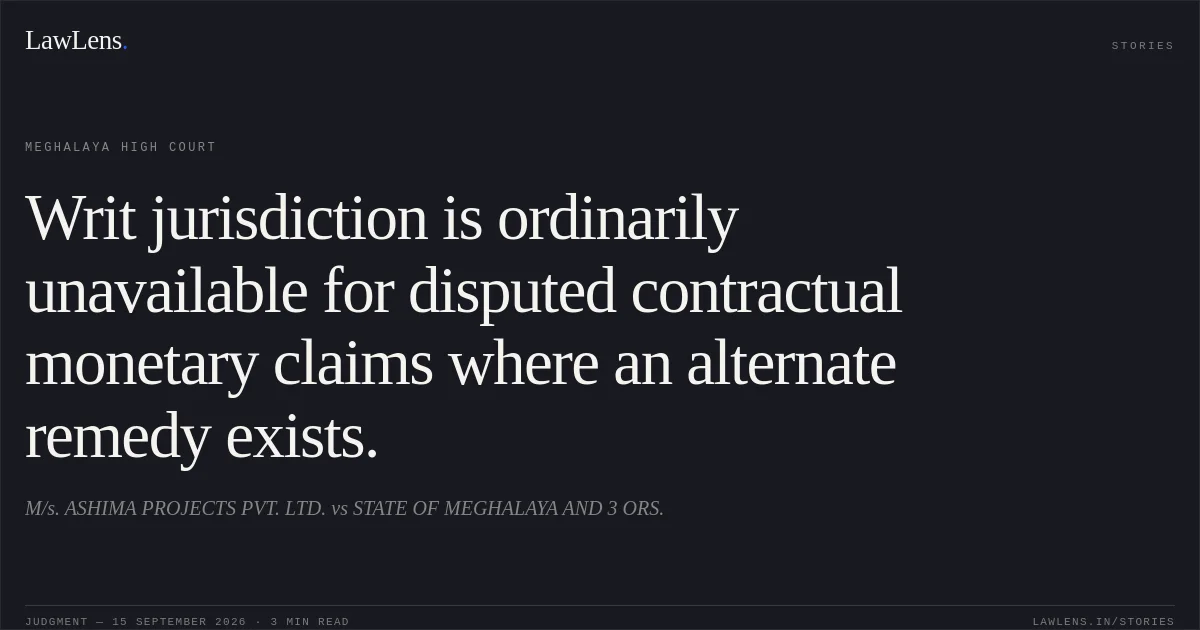
M/s. ASHIMA PROJECTS PVT. LTD.vsSTATE OF MEGHALAYA AND 3 ORS.
Click to open original judgment
Original judgment, available to read, download and summarize on LawLens.in


