Facts
The eight petitioners, residents of Villages Bhairotaal and Kuchena in District Korba, had their lands acquired for the construction of the Katghora-Hardibazar-Baloda-Akaltara Road under the Right to Fair Compensation and Transparency in Land Acquisition, Rehabilitation and Resettlement Act, 2013
Source reference: para. 6The petitioners challenged the compensation awards dated 30/08/2024 and 30/09/2004, asserting that the compensation was neither appropriate nor adequate and failed to comply with the statutory formulas prescribed under Sections 26 to 30 of the 2013 Act
Source reference: para. 5, 6They filed a writ petition under Article 226 of the Constitution of India seeking a mandamus for reassessment and payment of fair compensation, including statutory benefits like solatium and interest
Source reference: para. 5Issues
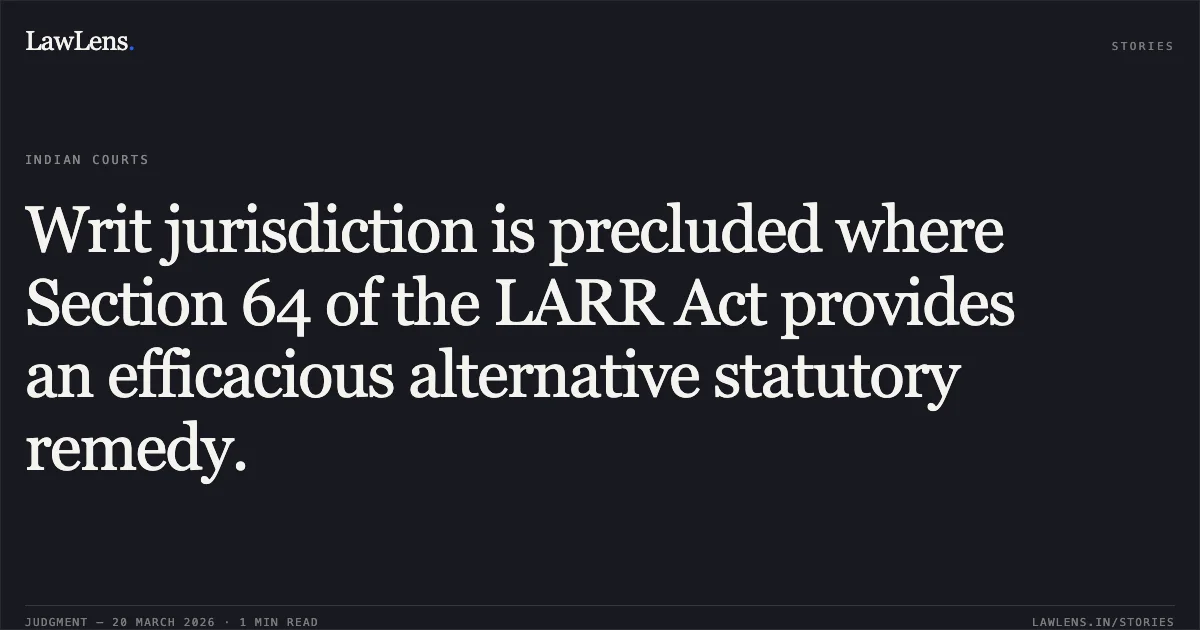
Whether a writ petition under Article 226 is maintainable when an efficacious alternative remedy is available under the 2013 Act
Source reference: para. 7, 10Whether the petitioners are entitled to a fresh determination of compensation through the High Court’s extraordinary jurisdiction
Source reference: para. 5, 10Law Applied
The court primarily applied Section 64 of the Right to Fair Compensation and Transparency in Land Acquisition, Rehabilitation and Resettlement Act, 2013, which mandates that any interested person who has not accepted an award may, by written application to the Collector, require the matter to be referred to the "Authority" for determination regarding land measurement, compensation amount, or apportionment
Source reference: para. 9The court also applied the judicial principle that extraordinary jurisdiction under Article 226 of the Constitution of India should not be exercised when an efficacious alternative statutory remedy exists
Source reference: para. 10Reasoning
The court examined the petitioners' grievances, which pertained specifically to the assessment of the quantum of compensation and the alleged failure to apply statutory benefits under the 2013 Act
Source reference: para. 6, 7The respondents argued that the petition was not maintainable because Section 64 of the 2013 Act provides a specific legal mechanism for such disputes
Source reference: para. 7The court agreed, noting that Section 64 is the proper statutory avenue for objections regarding the "amount of the compensation"
Source reference: para. 9Consequently, the court reasoned that because a specialized statutory remedy is available, it would not be appropriate to entertain the matter under its extraordinary writ jurisdiction
Source reference: para. 10To ensure justice, the court balanced this procedural dismissal by granting the petitioners liberty to approach the correct forum
Source reference: para. 10Holding
The High Court disposed of the writ petition, declining to entertain it on the grounds of an available alternative remedy
The Court granted the petitioners liberty to file an application under Section 64 of the 2013 Act before the concerned Collector
Source reference: para. 10Furthermore, the Court directed that if such an application is filed, the Collector shall not insist upon the period of limitation
Source reference: para. 10No orders were made as to costs
Source reference: para. 12Acts & Sections Cited
8 provisions across 1 statute referred to in this judgment. Each provision opens on LawLens.
Right to Fair Compensation and Transparency in Land Acquisition, Rehabilitation and Resettlement Act, 20138
Original Court PDF
HADARAN SINGHvsSTATE OF CHHATTISGARH
Click to open original judgment
Original judgment, available to read, download and summarize on LawLens.in


