Facts
Cloud 9 Projects Private Limited filed a writ petition challenging orders passed by a single-member Bench of the National Consumer Disputes Redressal Commission (NCDRC), including the NCDRC order dated 7 May 2024 and subsequent execution-related orders dated 31 July 2025 and 29 October 2025.
Source reference: p. 3–4, paras. 9–11The appellant contended that the NCDRC order was void for coram non judice, violated natural justice, reflected non-application of mind, granted uniform relief to differently situated respondents, ignored alleged payment defaults and force majeure circumstances, and contained calculation errors.
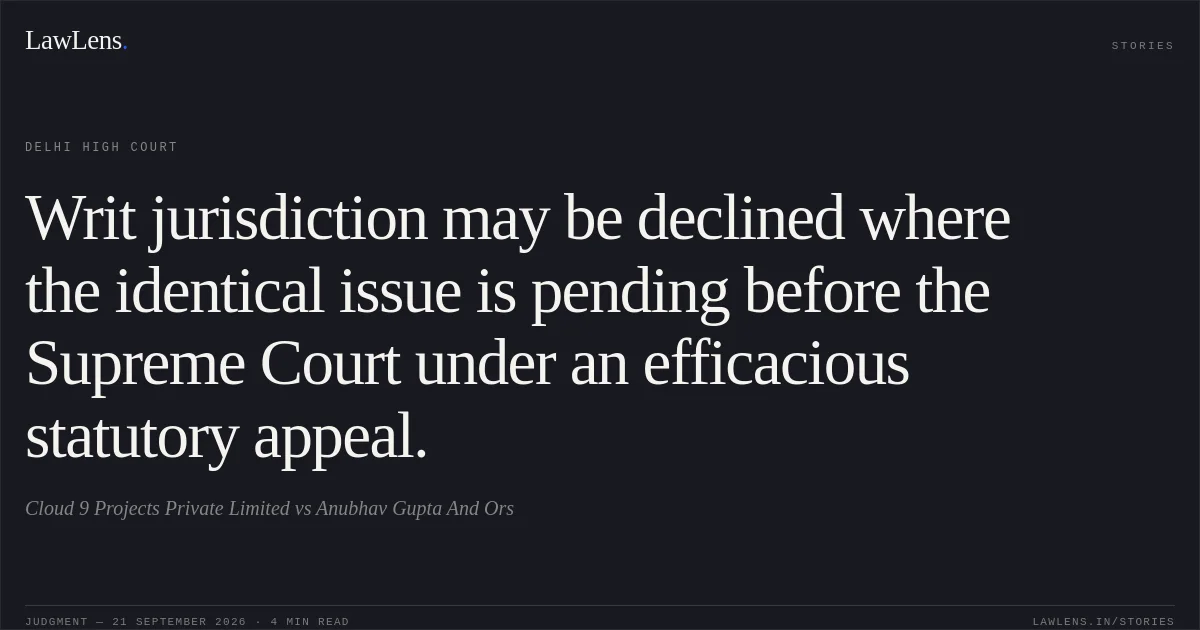
Source reference: p. 3–4, paras. 9–11The learned Single Judge dismissed the writ petition, holding that the question whether a single-member NCDRC Bench could validly adjudicate the matter was pending before the Supreme Court in statutory appeals under Section 67 of the Consumer Protection Act, 2019.
Source reference: p. 2, para. 6The Single Judge also held that judicial propriety required the High Court to refrain from deciding the issue, notwithstanding its jurisdiction under Articles 226 and 227 of the Constitution.
Source reference: p. 2, para. 6The appellant challenged that dismissal in the present intra-court appeal and argued that the writ petition should have been tagged with other pending matters before the High Court concerning the same issue.
Source reference: p. 2–3, paras. 7–10Issues
Whether the pendency before the Supreme Court of the identical question concerning the validity of orders passed by a single-member NCDRC Bench on the ground of coram non judice justified the High Court’s refusal to exercise its writ jurisdiction under Articles 226 and 227 of the Constitution.
Source reference: p. 5–6, paras. 17–20Whether the availability of a statutory appellate remedy under Section 67 of the Consumer Protection Act, 2019 precluded the appellant from invoking the writ jurisdiction of the High Court, particularly where allegations of nullity and violation of natural justice were raised.
Source reference: p. 3, para. 9; p. 6, para. 20Whether the writ petition ought to have been tagged with the pending batch of petitions before the learned Single Judge concerning the same issue.
Source reference: p. 6, para. 21Law Applied
The Court applied the principle that the jurisdiction of the High Court under Articles 226 and 227 of the Constitution is not automatically ousted by the existence of an alternative remedy or by the pendency of a similar issue before the Supreme Court; however, the exercise of that jurisdiction is discretionary, and judicial restraint may be appropriate to avoid parallel or conflicting determinations.
Source reference: p. 6, para. 18Section 67 of the Consumer Protection Act, 2019 provides a specific statutory appellate remedy against orders of the NCDRC before the Supreme Court.
Source reference: p. 6, paras. 19–20The recognised exceptions to the alternate-remedy rule, including cases involving breach of natural justice or a challenge to the jurisdiction or legal validity of the impugned action, were acknowledged with reference to Whirlpool Corporation v. Registrar of Trade Marks, Mumbai, (1998) 8 SCC 1, and Harbanslal Sahnia v. Indian Oil Corporation Ltd., (2003) 2 SCC 107; however, the Court held that those authorities did not govern a case where the identical legal question was already pending before the Supreme Court under the same statutory scheme.
Source reference: p. 6, para. 20Procedural tagging of matters was treated as a matter of convenience and not as a substantive right.
Source reference: p. 6, para. 21Reasoning
The Court held that although the High Court retained constitutional jurisdiction, the precise issue of whether a single-member NCDRC Bench acted coram non judice was already pending before the Supreme Court in statutory appeals under Section 67 of the Act.
Source reference: p. 6, para. 19Since the Act provided a specific appellate forum capable of examining the validity of the NCDRC orders, the learned Single Judge was justified in declining to undertake a parallel adjudication.
Source reference: p. 6, para. 20The Court distinguished Whirlpool and Harbanslal Sahnia because the present case involved both an efficacious statutory remedy and the Supreme Court’s seisin of the identical legal issue.
Source reference: p. 6, para. 20The appellant’s additional objections—including alleged non-service, denial of natural justice, factual differences among the respondents, suppression of facts, calculation errors, and force majeure—were matters that could appropriately be examined in the statutory appeal, particularly because they required scrutiny of the NCDRC record.
Source reference: p. 4, para. 10; p. 5, para. 15The pending High Court batch did not alter the position, as no final view had been expressed in those proceedings and tagging was merely procedural.
Source reference: p. 6, para. 21Holding
The Division Bench dismissed the appeal and upheld the learned Single Judge’s refusal to adjudicate the writ petition on merits.
It held that judicial restraint was justified because the identical coram non judice issue was pending before the Supreme Court and an efficacious statutory remedy under Section 67 of the Consumer Protection Act, 2019 was available.
Source reference: p. 7, paras. 23–25The Court expressly stated that it had not expressed any opinion on the merits and left the appellant at liberty to pursue the statutory remedy under Section 67, if so advised.
Source reference: p. 7, para. 24There was no order as to costs, and the pending application was disposed of.
Source reference: p. 7, para. 25Acts & Sections Cited
1 provisions across 1 statute referred to in this judgment. Each provision opens on LawLens.
Consumer Protection Act, 20191
Original Court PDF
Cloud 9 Projects Private LimitedvsAnubhav Gupta And Ors
Click to open original judgment
Original judgment, available to read, download and summarize on LawLens.in