Facts
The petitioner operated iron-ore mines under subsisting mining leases at Village Tikariya and Village Pratappur, District Jabalpur. The State constituted an Investigation Committee on 23 April 2025 to examine allegations of excess mineral extraction during 2004–2017. The Committee’s report was forwarded to the Collector on 6 June 2025. Relying on the report, the Collector issued show-cause notices dated 10 November 2025 under Section 21(5) of the Mines and Minerals (Development and Regulation) Act, 1957, proposing recovery of approximately ₹1,13,81,94,280 for Tikariya and ₹1,20,69,41,910 for Pratappur. Final-opportunity letters were subsequently issued on 18 March 2026.
Source reference: para. 2The petitioner challenged the constitution of the Investigation Committee, the inquiry report, and the consequential show-cause proceedings, alleging lack of jurisdiction, improper delegation, violation of natural justice, and reliance on undisclosed material. The State opposed the petition on the ground that the proceedings before the Collector were pending, no final liability had been determined, and the petitioner had already been granted multiple opportunities to submit its defence.
Source reference: paras. 3–5Issues
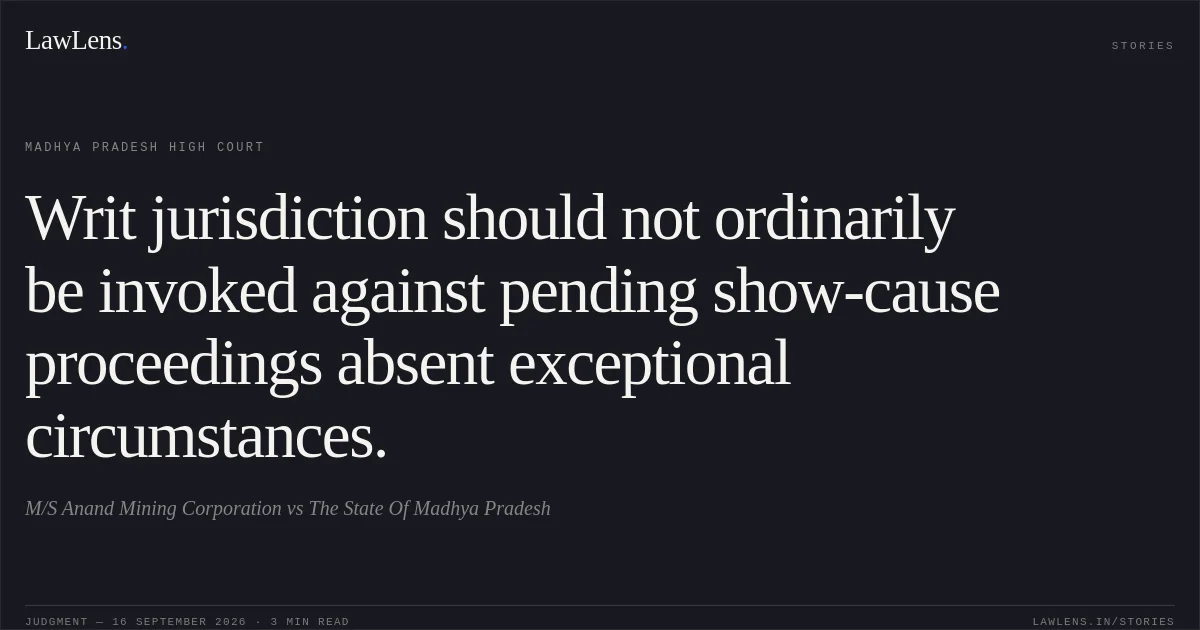
Whether the writ petition was maintainable under Article 226 while proceedings pursuant to the show-cause notices under Section 21(5) of the MMDR Act, 1957, remained pending before the Collector and no final order had been passed?
Source reference: paras. 7–9Whether the Investigation Committee’s report constituted a binding direction or final determination requiring the Collector to recover the amount alleged to be payable by the petitioner?
Source reference: paras. 10–11Whether the petitioner could invoke violation of natural justice when it had been granted several opportunities to file its reply and participate in the proceedings before the Collector?
Source reference: para. 8Law Applied
The Court applied Article 226 of the Constitution, under which writ jurisdiction is discretionary and ordinarily should not be exercised to interrupt pending statutory proceedings, particularly where an efficacious statutory remedy is available after a final order.
Source reference: paras. 7–9Section 21(5) of the MMDR Act, 1957 empowers recovery of the price of minerals, royalty, or tax in cases of unauthorised extraction, subject to determination by the competent authority.
Source reference: paras. 7–9The Court applied the principle that a show-cause notice does not by itself determine liability and that disputed factual and legal issues should ordinarily be adjudicated first by the statutory authority.
Source reference: paras. 7–9, 11–12It further applied the principles of natural justice, observing that a meaningful opportunity of hearing is sufficient where the authority considers the affected party’s objections before passing a reasoned order.
Source reference: paras. 7–9, 11–12Reasoning
The Court held that the Collector was still seized of the proceedings and had not passed any final order determining the petitioner’s liability. Allegations concerning excess extraction, computation of the recoverable amount, applicability of statutory provisions, and the evidentiary value of the inquiry report were disputed matters requiring initial examination by the Collector.
Source reference: para. 7The petitioner had been granted eight and nine opportunities, respectively, in the two proceedings, but had not filed a complete or final reply. Consequently, it could not bypass the pending adjudicatory process or allege denial of natural justice while seeking direct adjudication of disputed facts by the High Court.
Source reference: para. 8The Court also rejected the contention that the inquiry report compelled the Collector to recover the entire amount. The report merely stated that deposit of ₹4,43,04,86,890, together with GST, would be appropriate pursuant to the Supreme Court’s order dated 2 August 2017; it did not constitute a final recovery order or bind the Collector.
Source reference: paras. 10–11The Collector therefore remained obliged to independently consider the petitioner’s objections, the report, and the relevant records before making a determination.
Source reference: para. 11Holding
The High Court dismissed the writ petition as premature, holding that no exceptional circumstance warranted interference under Article 226 during the pendency of the show-cause proceedings.
The Collector, Jabalpur, was directed to independently and expeditiously decide the proceedings in accordance with law, after considering the petitioner’s objections and providing an adequate and effective hearing, preferably within four months from receipt of the certified copy of the order.
Source reference: para. 12The Court clarified that it had expressed no opinion on the merits or the petitioner’s actual liability, and that the Collector must remain uninfluenced by the observations in the judgment.
Source reference: para. 12Acts & Sections Cited
1 provisions across 1 statute referred to in this judgment. Each provision opens on LawLens.
Mines and Minerals (Development and Regulation) Act, 19571
Original Court PDF
M/S Anand Mining CorporationvsThe State Of Madhya Pradesh
Click to open original judgment
Original judgment, available to read, download and summarize on LawLens.in