Facts
The petitioners, claiming to be heirs of Wadhawa Singh, challenged a compromise decree recorded in an earlier writ petition (OWP No. 823/1986).
Source reference: para 2, 3In the earlier litigation, a dispute regarding land partition and mutations under the Agrarian Reforms Act, 1976, was settled via compromise on 01.03.1991.
Source reference: para 2, 3The petitioners alleged they were not heard, and that the signatures of Wadhawa Singh (who was a party to the 1991 compromise) were obtained through impersonation and fraud.
Source reference: para 4, 6They initially approached agrarian authorities to declare the compromise void, but after being redirected by the Special Tribunal, they filed the present writ under Article 226 seeking to declare the 1991 compromise violative of the Agrarian Reforms Act.
Source reference: para 1, 4Issues
1. Whether a writ petition under Article 226 is maintainable to challenge or set aside a compromise order passed by the High Court in a previous exercise of its writ jurisdiction.
Source reference: para 10, 132. Whether the availability of alternative remedies like a Review Petition or a Letters Patent Appeal (LPA) precludes the exercise of discretionary writ jurisdiction.
Source reference: para 11, 16Law Applied
The Court applied the principle of "Self-Imposed Limitations" on discretionary jurisdiction under Article 226 of the Constitution of India.
Source reference: no citationIt relied on Thana Singh v. A. Mazid, which established that writ jurisdiction is not an alternative remedy for relief obtainable through prescribed statutory modes or other jurisdictions of the High Court.
Source reference: para 11It further applied the rule from Rikhab Chand Jain v. Union of India, holding that when the alternative forum is the High Court itself (in another capacity), refusal to entertain a fresh writ should be the rule and entertaining it an exception.
Source reference: para 12The court also noted the availability of Clause 12 of the Letters Patent for intra-court appeals.
Source reference: para 13Reasoning
The Court reasoned that the petitioners were essentially seeking to upset a final order passed by a coordinate bench in OWP No. 823/1986.
Source reference: para 10It observed that the High Court, while exercising writ jurisdiction, does not act as a court of appeal against its own prior decisions.
Source reference: para 11Since the petitioners alleged fraud in a compromise recorded by the Court and sought to strike down a prior judicial order, the appropriate legal avenues were either a Review Petition before the same bench or a Letters Patent Appeal (LPA) before a Division Bench.
Source reference: para 13The Court found no exceptional circumstances to bypass these established procedural routes, especially as another related writ (OWP No. 245/2009) had already reaffirmed the validity of the 1991 compromise.
Source reference: para 15, 16Holding
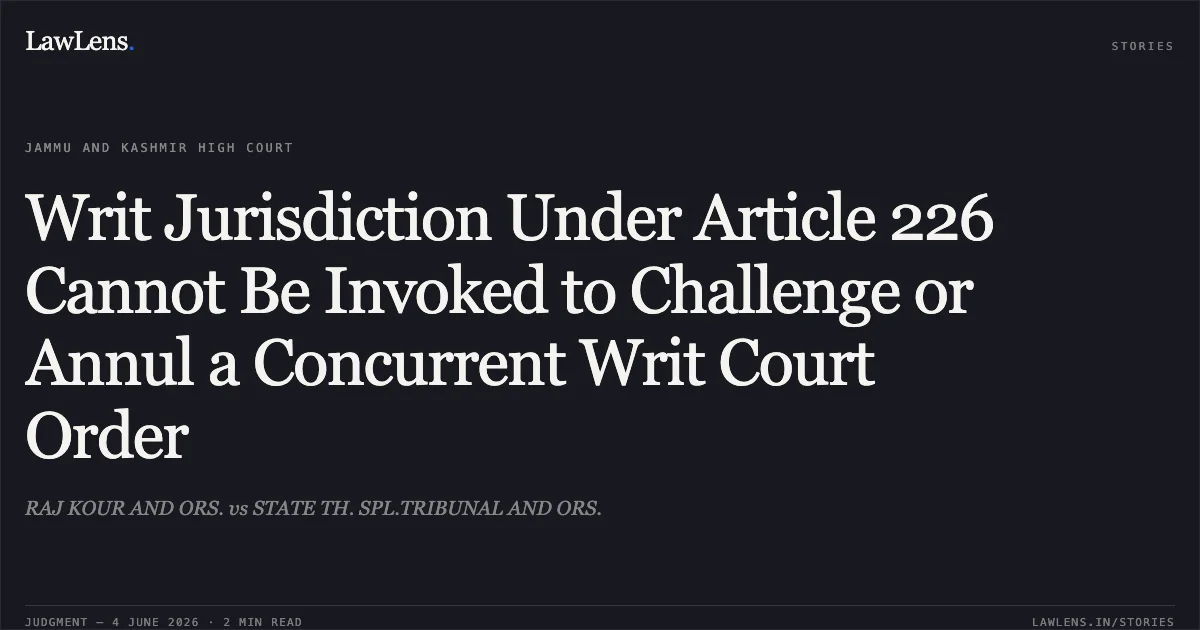
The Court held that the writ petition was not maintainable.
It ruled that an order passed by the High Court in the exercise of its writ jurisdiction cannot be challenged or upset through a fresh writ petition under Article 226.
Source reference: para 16The petitioners must resort to alternative statutory remedies such as a Review or an LPA.
Source reference: para 13Consequently, the petition was dismissed without an adjudication on the merits of the fraud allegations.
Source reference: para 17Acts & Sections Cited
1 provisions across 1 statute referred to in this judgment. Linked provisions open on LawLens.
Agrarian Reforms Act, 19761
Original Court PDF
RAJ KOUR AND ORS.vsSTATE TH. SPL.TRIBUNAL AND ORS.
Click to open original judgment
Original judgment, available to read, download and summarize on LawLens.in


