Facts
The petitioner obtained a United Bharat Laghu Udyam Suraksha Policy from the respondent-insurer covering its factory premises at Dewas for a total sum insured of ₹31.70 crores. A major fire occurred at the premises on 5 May 2023, following which the insurer appointed M/s Kunjal Shah & Company as surveyor.
Source reference: paras. 3–4The petitioner submitted claim forms and supporting documents, ultimately estimating its loss at ₹7,64,04,285. The surveyor’s final report dated 15 January 2024 recommended closure of the claim for alleged non-compliance, while simultaneously assessing the maximum probable gross loss at ₹5.47 crores.
Source reference: paras. 3–4, 7The petitioner subsequently supplied further documents, including forensic and statutory reports, and sought reassessment of the claim. The insurer asked the surveyor to reconsider the matter, but the surveyor maintained the “no claim” position, referring, inter alia, to alleged stock discrepancies and an email suggesting possible deliberate arson.
Source reference: paras. 4, 7The insurer thereafter issued the repudiation letter dated 11 April 2025. The petitioner challenged the repudiation under Article 226 of the Constitution, alleging arbitrariness, non-application of mind, disregard of expert reports, and violation of IRDAI norms.
Source reference: paras. 4, 7, 12–13Issues
Whether the writ petition under Article 226 was maintainable and entertainable despite the availability of alternative remedies under the insurance and consumer-protection laws?
Source reference: paras. 5, 7–11, 14–15Whether the insurer’s repudiation of the fire-insurance claim was arbitrary, unreasonable, unsupported by adequate reasons, and violative of Article 14?
Source reference: paras. 7, 12–13, 15Whether the insurer was entitled to reject the claim on the grounds of non-submission of documents, stock discrepancy, and alleged arson?
Source reference: paras. 12–13Whether the petitioner was entitled to reassessment and payment of the assessed loss with interest?
Source reference: para. 15Law Applied
The Court applied the principle that a writ petition against a State instrumentality may be entertained in contractual matters where the decision is arbitrary, unreasonable, mala fide, or violative of Article 14, as recognised in ABL International Ltd. v. Export Credit Guarantee Corporation of India.
Source reference: para. 10The rule of alternative remedy is a self-imposed rule of discretion and does not oust the High Court’s jurisdiction under Article 226; however, writ jurisdiction is ordinarily declined where disputed facts require detailed evidentiary adjudication, subject to exceptions such as breach of natural justice, lack of jurisdiction, or patent arbitrariness, as explained in M/s Radha Krishan Industries v. State of Himachal Pradesh and M.S. Godrej Sara Lee Ltd. v. Excise and Taxation Officer-cum-Assessing Authority.
Source reference: paras. 5, 10, 14The Court also relied on Neeta Vij v. LIC, holding that an insurance claim may be enforced under Article 226 where material facts are undisputed.
Source reference: para. 11Under the insurance-settlement principles stated in Gurmel Singh v. Branch Manager, National Insurance Co. Ltd., insurers must not adopt an excessively technical approach while processing claims.
Source reference: para. 12The Court further relied on Orion Conmerx Pvt. Ltd. v. National Insurance Co. Ltd. for the principle that, once fire is established, an insurer alleging arson, fraud, or wilful misconduct bears the burden of proving it through cogent evidence, rather than suspicion or unverified allegations.
Source reference: para. 13The Court additionally referred to IRDAI’s Master Circular on General Insurance Business dated 11 June 2024, which provides that claims should not be rejected merely for want of documents and that insurers may call only for documents directly related to claim settlement.
Source reference: para. 12Reasoning
The Court held that the respondent was a public-sector insurer and therefore subject to the constitutional obligation to act fairly, reasonably, and without arbitrariness in discharging its contractual functions.
Source reference: para. 7Although an alternative remedy existed, the Court found the case appropriate for writ review because the material facts were substantially documentary and the repudiation appeared prima facie arbitrary.
Source reference: paras. 7, 10–11, 15The surveyor’s report was internally inconsistent: it recommended closure for non-compliance but nevertheless quantified the maximum probable gross loss at ₹5.47 crores.
Source reference: paras. 12–13The insurer’s own communications indicated that the documents were sufficient for assessment, undermining its subsequent reliance on non-cooperation and non-submission of documents.
Source reference: para. 12The Court found that the surveyor had improperly insisted on customised formats and disregarded GST returns, accounting data, audited balance sheets, and other records.
Source reference: para. 13It further held that the alleged arson was based only on an unverified third-party email received long after the fire, whereas the electrical authorities’ report, FSL report, and the surveyor’s own observations supported accidental electrical short circuit as the probable cause.
Source reference: para. 13Reliance on the alleged shortage of 648 paper rolls was also held to be unjustified in the circumstances of a prolonged fire in which the rolls could have been completely destroyed.
Source reference: para. 13The insurer’s acceptance of the “no claim” recommendation without independent application of mind therefore rendered the repudiation arbitrary and legally unsustainable.
Source reference: paras. 12–15Holding
The Court allowed the writ petition, holding that the repudiation letter dated 11 April 2025 was arbitrary, illegal, and unsustainable.
The respondent was directed to reconsider and process the petitioner’s claim on the basis of the complete documents already submitted, and to complete the exercise preferably within 30 days, followed by payment within a further 15 days.
Source reference: para. 15The Court directed payment of the initially assessed amount of ₹5.47 crores with interest at 18% per annum from 15 January 2024 until actual payment. Any further amount finally determined on reassessment was directed to carry interest from the date of repudiation until payment.
Source reference: para. 15Original Court PDF
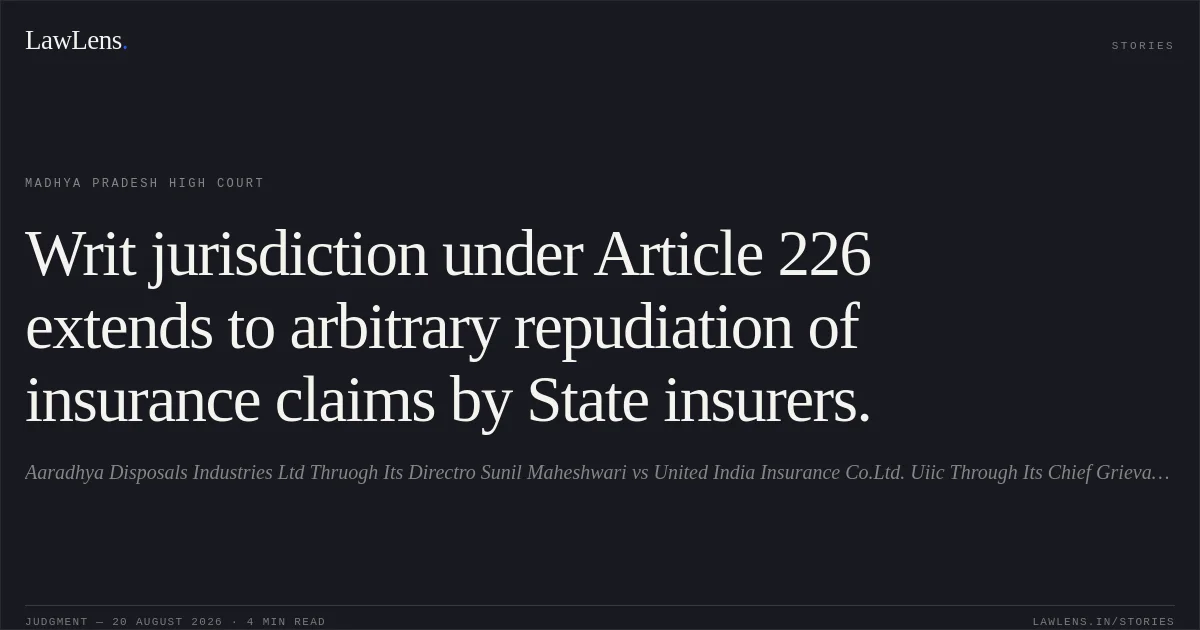
Aaradhya Disposals Industries Ltd Thruogh Its Directro Sunil MaheshwarivsUnited India Insurance Co.Ltd. Uiic Through Its Chief Grievance Redresal Officer
Click to open original judgment
Original judgment, available to read, download and summarize on LawLens.in