Facts
The petitioner sought a writ to set aside an order dated 05.01.2021 passed by the Naib Tahsildar (Respondent No. 2) and to direct the mutation of his name in revenue records for land bearing Khasra No. 382.
Source reference: para 1-2The petitioner claimed title over the land based on a compromise award dated 08.12.2018 passed by the National Lok Adalat.
Source reference: para 2However, the Naib Tahsildar rejected the mutation application, recording a finding that the subject land was Government grazing land.
Source reference: para 2The petitioner challenged this as an illegal exercise of jurisdiction, while the State raised a preliminary objection regarding the maintainability of the writ petition due to the availability of an alternative statutory remedy under the Chhattisgarh Land Revenue Code.
Source reference: para 3Issues
1. Whether the High Court should exercise its extraordinary jurisdiction under Article 226 of the Constitution when an efficacious alternative statutory remedy is available under the Chhattisgarh Land Revenue Code.
Source reference: para 4-52. Whether the petitioner is entitled to direct relief regarding the mutation of land records in a writ proceeding despite the revenue authority's findings on the nature of the land.
Source reference: para 5-6Law Applied
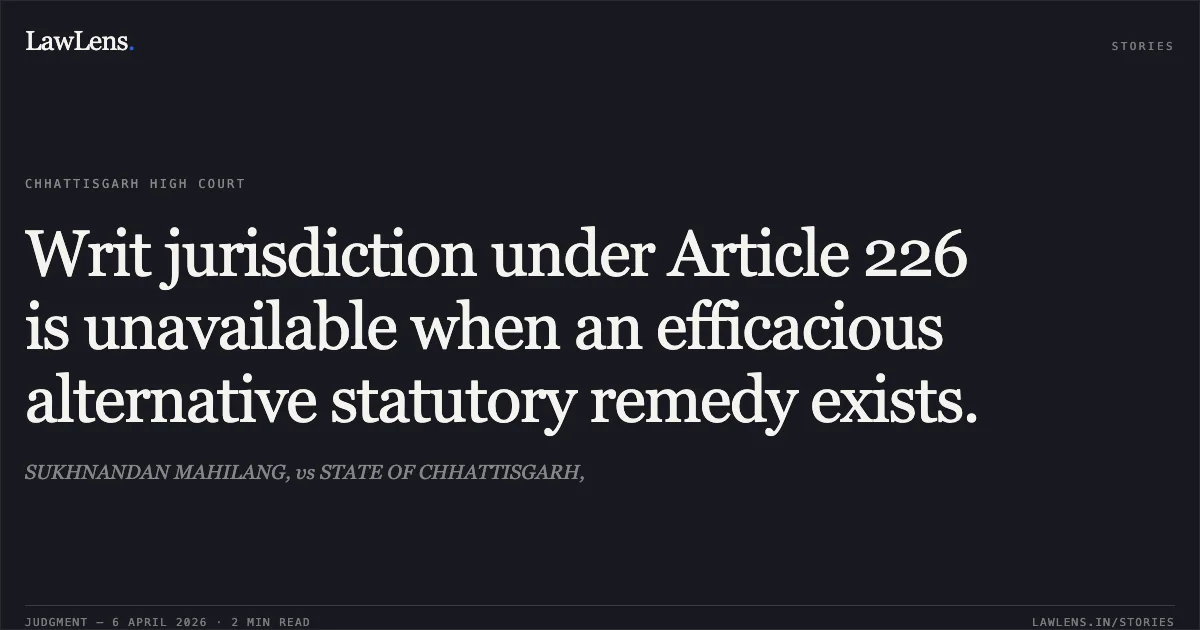
The Court applied the settled legal principle that the extraordinary jurisdiction under Article 226 of the Constitution of India should not be invoked if an effective statutory remedy is available.
Source reference: para 5It specifically referenced the provisions of the Chhattisgarh Land Revenue Code, which provide for appeal and revision against orders passed by revenue officers such as the Naib Tahsildar.
Source reference: para 3, 5Reasoning
The Court observed that the impugned order dated 05.01.2021 was passed by the Naib Tahsildar in his capacity as a revenue officer. Under the Chhattisgarh Land Revenue Code, such orders are amenable to challenge before a competent appellate or revisional authority.
Source reference: para 5The Court reasoned that the issues raised—including the determination of land category (grazing vs. private) and the implementation of the Lok Adalat decree—involve questions that are more appropriately adjudicated by the statutory authorities provided under the Code.
Source reference: para 5Consequently, the Court found no justification for bypassing the established legal machinery to exercise writ jurisdiction at this stage.
Source reference: para 4Holding
The petition was not maintainable at this stage due to the availability of an alternative remedy.
The Court disposed of the writ petition without interfering with the impugned order and the petitioner was granted liberty to approach the competent statutory authority under the Chhattisgarh Land Revenue Code.
Source reference: para 4, 6, 8The Court clarified that it expressed no opinion on the merits of the case and that all contentions remain open for independent consideration by the lower authority.
Source reference: para 6-7Original Court PDF
SUKHNANDAN MAHILANG,vsSTATE OF CHHATTISGARH,
Click to open original judgment
Original judgment, available to read, download and summarize on LawLens.in


![Subsequent exoneration does not retrospectively invalidate a finalized promotion select list.. UNNIKRISHNAN M vs M/o Environment And Forests. CAT - ['Ernakulam']. LawLens](/stories/thumbnails/subsequent-exoneration-does-not-retrospectively-invalidate-a-finalized-promotion-select-li-ce80a0e84f2f4887857271e8b4341c42.webp)