Facts
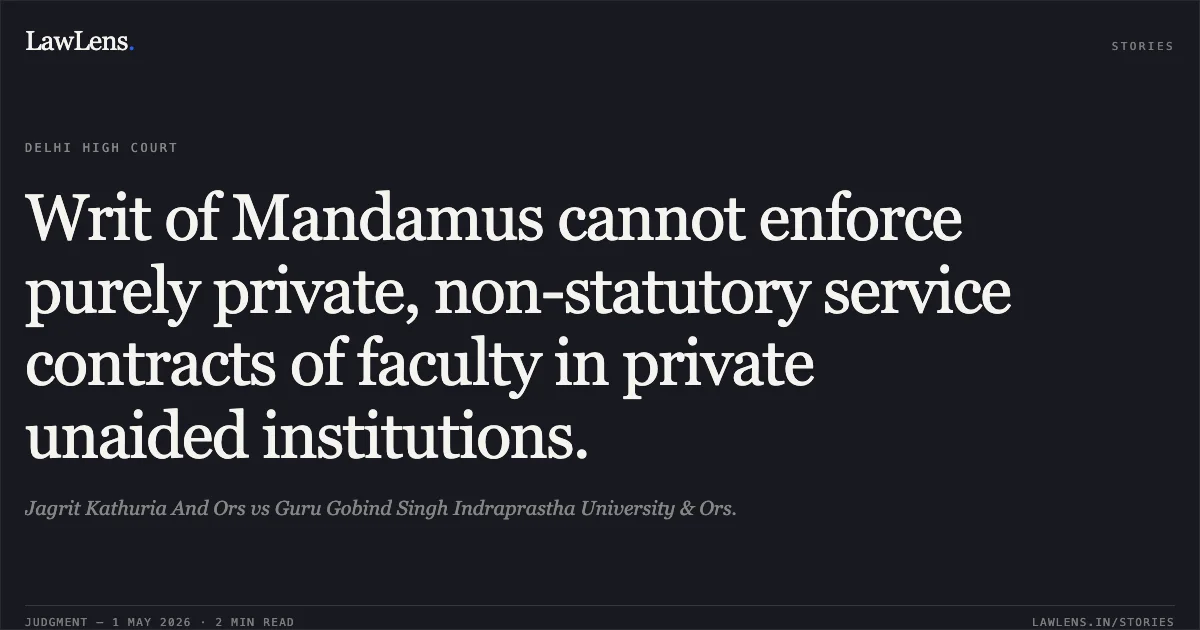
The Petitioners were teaching faculty members at the HMR Institute of Technology & Management (Respondent No. 2), a private unaided college affiliated with Guru Gobind Singh Indraprastha University (Respondent No. 1).
Source reference: p. 1-2Engaged between 2011 and 2015, their appointment letters contained a clause allowing termination via one month’s notice or salary in lieu thereof.
Source reference: p. 2Following the Petitioners' grievances regarding pay fixation and complaints to the AICTE regarding institutional non-compliance, Respondent No. 2 issued termination notices on September 16, 2022.
Source reference: p. 2-3The notices effected termination simpliciter under the contractual clause without alleging misconduct.
Source reference: p. 3The Petitioners challenged these notices, seeking reinstatement and alleging the action was arbitrary and retaliatory.
Source reference: p. 4Issues
1. Whether the writ petition is maintainable under Article 226 against a private unaided affiliated educational institution regarding termination of faculty?
Source reference: p. 8 / para. 23(i)2. Whether the impleadment of statutory authorities (University, AICTE, GNCTD) introduces a public law element to a private employment dispute?
Source reference: p. 8 / para. 23(ii)3. Whether the termination notices suffer from arbitrariness, mala fides, or breach of natural justice/statutory obligations?
Source reference: p. 9 / para. 23(iii)Law Applied
The Court relied on St. Mary’s Education Society v. Rajendra Prasad Bhargava, which establishes that service disputes in private unaided institutions lack a public law character unless governed by statutory provisions.
Source reference: p. 10Article 226 is not a remedy for enforcing private contracts of personal service unless a public duty is involved, as held in Binny Ltd. v. V. Sadasivan and K.K. Saksena v. International Commission on Irrigation and Drainage.
Source reference: p. 9-10The Court also referenced Executive Committee of Vaish Degree College, Shamli v. Lakshmi Narain regarding the limited exceptions (statutory body breach, industrial law, or constitutional protection) where reinstatement in personal service is permissible.
Source reference: p. 18-19Reasoning
The Court found the petition non-maintainable as Respondent No. 2 is a private body not constitutes "State" under Article 12, and the termination did not involve a "public law" element.
Source reference: p. 9The mere fact of affiliation to a university or regulation by AICTE does not transform private employment into statutory service; Statute 24 of the University does not regulate the termination of staff in affiliated colleges.
Source reference: p. 11-12On merits, the Court observed the terminations were "simpliciter," involving no stigma or misconduct findings, thus negating the requirement for a prior hearing or natural justice as seen in disciplinary cases.
Source reference: p. 14While the Petitioners alleged the timing was retaliatory (mala fide), the Court held that chronology alone is insufficient proof of malice in the absence of a clear nexus.
Source reference: p. 16The contractual notice clause was validly invoked, and the Court declined to rewrite the contract despite the Petitioners' long tenure.
Source reference: p. 15, 18Holding
The High Court dismissed the writ petition, holding that it is not maintainable under Article 226 as the dispute is a private contractual matter.
Even on merits, the Court held the termination was a valid exercise of the contractual notice clause and did not violate any statutory rules.
Source reference: p. 19The High Court concluded that reinstatement into personal service cannot be compelled against a private employer outside specific legal exceptions.
Source reference: p. 19Petitioners were granted liberty to pursue remedies in civil or other competent fora.
Source reference: p. 19Acts & Sections Cited
2 provisions across 2 statutes referred to in this judgment. Linked provisions open on LawLens.
Guru Gobind Singh Indraprastha University Act, 19981
Societies Registration Act, 18601
Original Court PDF
Jagrit Kathuria And OrsvsGuru Gobind Singh Indraprastha University & Ors.
Click to open original judgment
Original judgment, available to read, download and summarize on LawLens.in