Facts
The appellant/writ petitioner challenged a charge memo dated 25.06.2021 issued by the Director of Municipal Administration
Source reference: p.2The charges related to alleged delinquencies committed between 2017 and 2021
Source reference: p.2The appellant sought to quash the memo on grounds of delay, merits, and the exoneration of other officials
Source reference: p.2The Writ Court dismissed the petition, finding no mala fide intention and noting the ongoing nature of the delinquencies
Source reference: p.2The appellant subsequently filed this Intra-Court Appeal, arguing further that the seizure of files by investigating authorities in related criminal cases involving other officials hindered the process
Source reference: p.3Issues
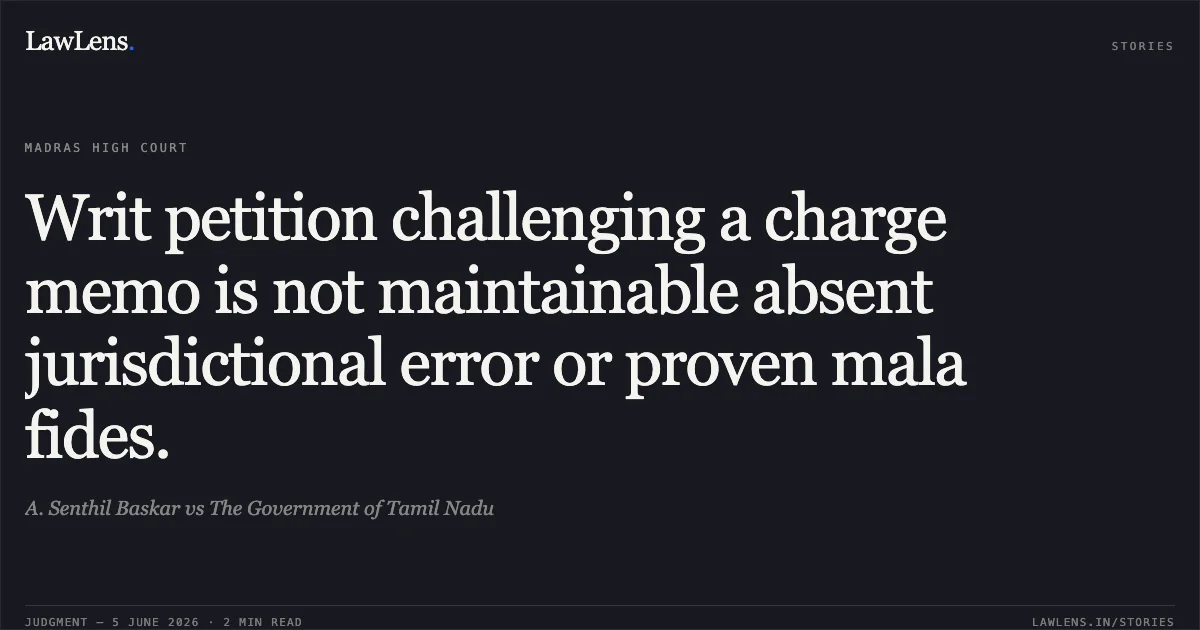
1. Whether a writ petition challenging a charge memo is maintainable under Article 226 of the Constitution of India in the absence of jurisdictional error or proven mala fide?
Source reference: p.2-32. Whether the pendency of a criminal case against other delinquent officials acts as a bar to the continuation of departmental proceedings against the appellant?
Source reference: p.3-4Law Applied
A writ against a charge memo is generally not maintainable unless issued by an incompetent authority or tainted by mala fide
Source reference: p.2Disputed facts and the merits of allegations cannot be adjudicated under Article 226, as judicial review does not extend to performing the functions of a departmental inquiry
Source reference: p.3Departmental and criminal proceedings are distinct: the former aims to maintain administrative discipline, while the latter seeks to punish offenders
Source reference: p.4Acquittal in a criminal case does not automatically debar disciplinary action under Service Rules
Source reference: p.4Reasoning
The court reasoned that the appellant failed to prove any mala fide intention or jurisdictional incompetence that would warrant judicial interference at the charge-memo stage
Source reference: p.2-3The Court held that the Disciplinary Authority is empowered to proceed using certified copies and that the pendency of criminal cases against other officials is legally irrelevant to the appellant’s domestic inquiry
Source reference: p.3-4The court emphasized that the standard of proof and objectives of the two proceedings are entirely different
Source reference: p.4It concluded that quashing a charge memo on factual grounds is impermissible as such matters require a trial-like adjudication through a departmental inquiry to cull out the truth
Source reference: p.3, 5Holding
The High Court dismissed the Writ Appeal, upholding the decision to let the departmental proceedings continue
The challenge to the charge memo lacked merit as no jurisdictional error or personal mala fide was established
Source reference: p.3, 5The Division Bench vacated this specific time limit, noting that the inquiry's conclusion depends on the appellant’s cooperation, though it directed the Disciplinary Authority to dispose of the matter as expeditiously as possible to avoid affecting service prospects
Source reference: p.5The Court dismissed the Writ Appeal and awarded no costs
Source reference: p.6Original Court PDF
A. Senthil BaskarvsThe Government of Tamil Nadu
Click to open original judgment
Original judgment, available to read, download and summarize on LawLens.in