01Facts
The petitioner challenged lock-and-seal notices and de-occupation notices issued by the competent authority under Sections 56(2-A) and 57 read with Section 85 of the Tamil Nadu Town and Country Planning Act, 1971 ("the Act").
¶ 1The Greater Chennai Corporation, during inspection and survey, identified buildings constructed wholly without building plan permission and reported them as wholly unauthorised, to be demolished under the Act.
¶ 2The petitioner's property is a farm house at No. 19, TVS Avenue, Akkarai Village, Sholinganallur.
The petitioner sought to quash the State Government's order dated 04.07.2002 (T.No.536), which dismissed his appeal against the CMDA's order dated 17.11.2000, and sought a direction to the CMDA to consider his claim for approval of the construction.
The petitioner sought a writ restraining enforcement or challenging the notices directly.
¶ 3The order does not record the underlying factual findings on whether the construction was authorised, deviated, or wholly unauthorised.
02Issues
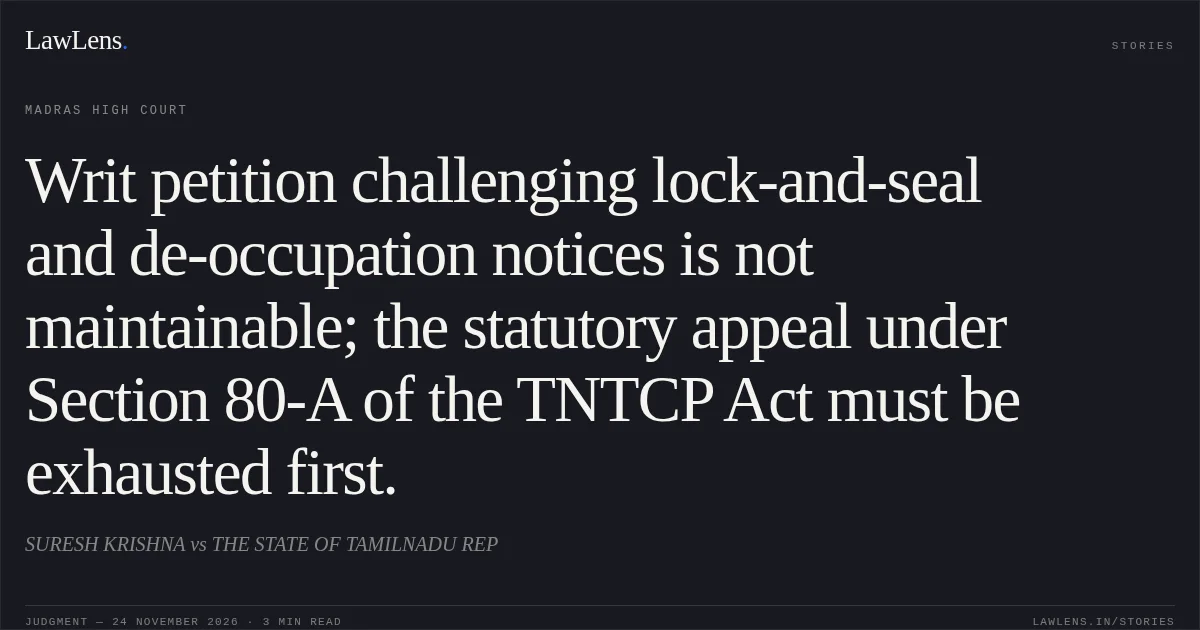
i.1. Whether a writ petition under Article 226 is maintainable against lock-and-seal and de-occupation notices where an alternative statutory remedy under Section 80-A of the Act is available.
¶ 3ii.2. Whether disputed questions of fact relating to unauthorised construction or deviation from sanctioned plans can be adjudicated by the writ court in judicial review.
¶ 4iii.3. Whether the petitioner should be relegated to the statutory appeal, and, if no appeal is preferred, whether enforcement action should proceed.
¶ 5–703Law Applied
Sections 56(2-A), 57 and 85 of the Tamil Nadu Town and Country Planning Act, 1971 govern lock-and-seal and de-occupation action against unauthorised development.
¶ 1Section 80-A of the Act provides a statutory appeal to the Appellate Authority/Government against such orders, as the efficacious alternative remedy that must ordinarily be exhausted before writ relief.
¶ 3, 5Writ jurisdiction under Article 226 of the Constitution is not the forum for resolving disputed questions of fact, which must instead be decided on original records and evidence before the statutory authorities, whose findings assist the High Court in later judicial review.
¶ 4No precedent is cited in the order.
Provisions in the judgment · 4
Tamil Nadu Town and Country Planning Act, 1971 Section 56Section 57Section 85Section 80A
04Reasoning
The writ petition was filed prematurely because the petitioner had not exhausted the statutory appeal under Section 80-A.
¶ 5Whether buildings are unauthorised, deviate from sanctioned plans, or are wholly unauthorised involves disputed facts that cannot be resolved through a roving enquiry in writ proceedings, as this may cause miscarriage of justice or prejudice to parties.
¶ 4The statutory appellate process was treated as paramount, not merely as a formality. Rather than dismissing the petition outright, the Court granted the petitioner liberty to appeal and fixed a time frame to protect his interests.
¶ 5–6To prevent indefinite delay, the Court directed that enforcement proceed if no appeal was filed.
¶ 7The order does not examine the merits of the petitioner's approval claim or the 2000 and 2002 orders.
05Holding
The writ petition was not maintainable in view of the alternative statutory remedy under Section 80-A, and disputed factual questions must be decided by the statutory authorities.
¶ 3–4The writ petition was disposed of without costs, and the connected miscellaneous petition was closed. The petitioner was granted liberty to file an appeal before the Appellate Authority/Government within two weeks of receiving the order. On timely filing, the Appellate Authority/Government must entertain the appeal without reference to limitation, afford hearing to parties, and decide on merits within three months from the expiry of the two-week period. If no statutory appeal is preferred, the official respondents must initiate enforcement and demolish the unauthorised buildings expeditiously under the Act.
¶ 6–8The Court expressed no view on the merits of the petitioner's claim.
Original Court PDF
SURESH KRISHNAvsTHE STATE OF TAMILNADU REP
Click to open original judgment
Original judgment, available to read, download and summarize on LawLens.in