01Facts
The petitioner, a resident of Bengaluru, challenged various posts on social media platforms and cable TV network broadcasts.
The petitioner sought a writ of mandamus directing Union respondents 1 and 2 to direct private respondents 3 to 14 (news publishers, broadcasters, and digital portals) to remove articles, videos, clips, and shorts from respondents 15 to 17 (Google/YouTube, Meta, and X), and to remove related search results, and to restrain further publication of "private investigation reports" concerning him.
p. 6The petitioner's case is that he is being wrongly linked to criminal proceedings that were the subject of investigation, although he was only summoned as a witness in those proceedings.
¶ 2 · ¶ 3The learned Additional Solicitor General for respondents 1 and 2 submitted that the Cable Television Networks (Regulation) Act, 1995 and the Cable Television Network Rules, 1994, as amended in 2021, prescribe a mandatory Programme Code (Rule 6), and a complaint redressal structure for its violation.
¶ 402Issues
i.1. Whether a writ petition under Articles 226 and 227 of the Constitution seeking removal of, and restraint on, media and social media content is maintainable where a statutory Programme Code and complaint redressal mechanism exist under the Cable Television Networks (Regulation) Act, 1995 and the Cable Television Network Rules, 1994.
¶ 4 · ¶ 503Law Applied
The statutory framework relied upon is the Cable Television Networks (Regulation) Act, 1995 and the Cable Television Network Rules, 1994, as amended in 2021. Under Rule 6 of the Rules, a Programme Code must be followed by broadcasters, and the Rules provide a complaint redressal structure for violations of that Code.
¶ 4The court's reasoning rests on the doctrine of alternate remedy, which requires a litigant to exhaust an efficacious statutory remedy before invoking the High Court's writ jurisdiction under Articles 226 and 227.
¶ 5No precedent is cited in the order.
04Reasoning
The court accepted the Union's submission that the Programme Code and complaint mechanism under the 1994 Rules provide a structured avenue for redressing content-related complaints.
¶ 4Because alternate remedies were available to the petitioner, the court held it "expedient" not to entertain the writ petition.
¶ 5The court's reasoning turns on the availability of the statutory redressal route, not on the substance of the petitioner's claim that he was wrongly linked to criminal proceedings. The court did not examine the merits of the petitioner's grievance about defamatory or inaccurate content, nor the content's legality. The dismissal was therefore procedural, and the court did not decide whether the content complained of was actionable.
¶ 3 · ¶ 505Holding
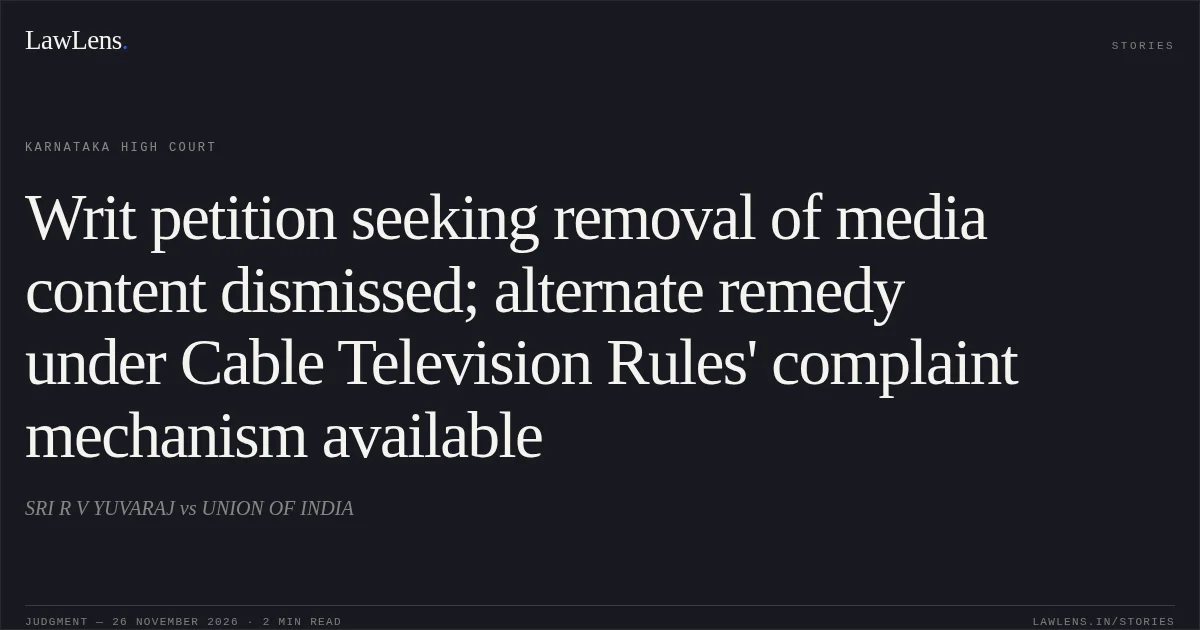
Given the availability of alternate remedies under the Cable Television Networks (Regulation) Act, 1995 and the Cable Television Network Rules, 1994, the writ petition should not be entertained.
¶ 5The writ petition is dismissed. The order expressly does not preclude the petitioner from pursuing appropriate remedies in accordance with law. No substantive relief, direction for removal of content, or restraint order was granted, and the merits of the petitioner's claims against respondents 3 to 17 remain undecided.
¶ 5 · ¶ 6Original Court PDF
SRI R V YUVARAJvsUNION OF INDIA
Click to open original judgment
Original judgment, available to read, download and summarize on LawLens.in