Facts
The petitioner invoked the jurisdiction of the High Court under Article 226 of the Constitution, alleging harassment and pressure by respondents Nos. 4 to 8 in connection with a family property dispute and an alleged attempt to compel an illegal division of the property.
Source reference: para. 1–2He claimed to have submitted an application to the Superintendent of Police, Chhatarpur, but alleged that no action had been taken.
Source reference: para. 1–2The petition sought directions to the police authorities to consider his application and to restrain the private respondents from interfering with, harassing, or pressurising the petitioner and his family without a court order.
Source reference: para. 1–2The State opposed the petition on the ground that the petitioner had an efficacious alternative remedy before the competent Magistrate under Sections 156(3), 200 and 202 of the CrPC.
Source reference: para. 3Issues
1. Whether the High Court should entertain a writ petition under Article 226 seeking police action in relation to alleged non-registration of an FIR or failure to act on a police complaint when statutory remedies under the CrPC/BNSS are available?
Source reference: para. 3, 5–92. Whether the petitioner should be relegated to the remedy of approaching the competent Magistrate under Section 156(3) of the CrPC, or the corresponding provision of the BNSS, for registration of an FIR and proper investigation?
Source reference: para. 5–9Law Applied
The Court applied the principle that although the existence of an alternative remedy is not an absolute bar to writ jurisdiction, the High Court ordinarily should not entertain a petition where an efficacious statutory remedy exists.
Source reference: para. 5Under Section 154(3) of the CrPC, an aggrieved person may approach the Superintendent of Police where the police fail to register an FIR; thereafter, Section 156(3) empowers the Magistrate to direct registration of an FIR, order proper investigation, and monitor the investigation.
Source reference: para. 5–6A criminal complaint may also be filed under Section 200 of the CrPC.
Source reference: para. 5–6Relying principally on Sakiri Vasu v. State of U.P. , (2008) 2 SCC 409, and Sudhir Bhaskarrao Tambe v. Hemant Yashwant Dhage , (2016) 6 SCC 277, as reiterated in M. Subramaniam v. S. Janaki , the Court held that the ordinary remedy for non-registration of an FIR or defective investigation is before the police authorities and the Magistrate, not directly under Article 226.
Source reference: para. 5–7The Court also relied on Shweta Bhadoriya v. State of M.P. , (2017) 1 MPLJ (Cri) 338, and the statutory framework discussed in Ashwini Kumar Upadhyay v. Union of India , 2026 LiveLaw (SC) 437, including the corresponding remedies under Sections 173 and 175 of the BNSS.
Source reference: para. 8Reasoning
The petitioner’s grievance essentially concerned alleged inaction by the police on his complaint and alleged harassment by private parties.
Source reference: para. 5–9The Court found that such grievances fell within the statutory mechanism governing registration of offences and supervision of investigation.
Source reference: para. 5–9Since the petitioner had not demonstrated that he had exhausted the available remedy before the competent Magistrate under Section 156(3) of the CrPC or the corresponding provision of the BNSS, the extraordinary jurisdiction under Article 226 was not warranted.
Source reference: para. 5–9Applying Sakiri Vasu and the subsequent authorities, the Court held that the Magistrate possesses adequate powers to direct registration of an FIR, order a proper investigation, and monitor the investigation; consequently, the petitioner was not required to approach the High Court at the initial stage.
Source reference: para. 5–8The Court therefore declined to examine the factual allegations concerning the family property dispute or harassment on merits.
Source reference: no citationHolding
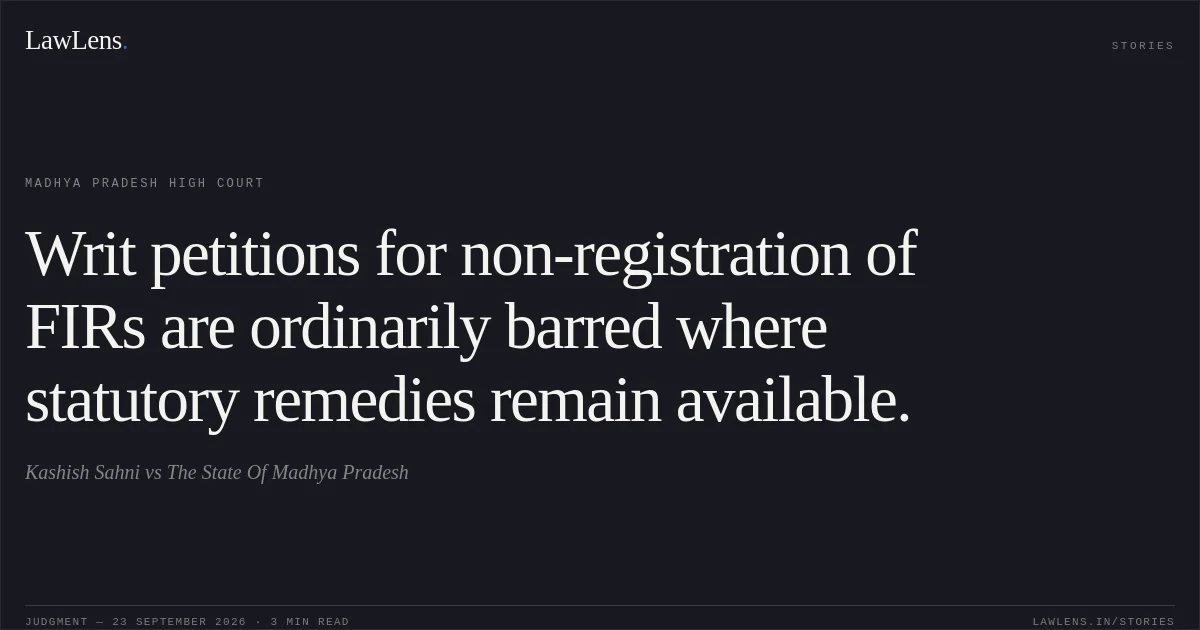
The High Court held that the writ petition was not maintainable at that stage because the petitioner had an efficacious alternative remedy under the CrPC/BNSS.
The petition was accordingly dismissed, with liberty to the petitioner to approach the competent Magistrate under the applicable provisions of the CrPC/BNSS for redressal of his grievance, including appropriate relief concerning registration and investigation of any cognizable offence.
Source reference: para. 9–10Acts & Sections Cited
18 provisions across 2 statutes referred to in this judgment. Each provision opens on LawLens.
Code of Criminal Procedure, 1973
Bharatiya Nagarik Suraksha Sanhita, 20237
Original Court PDF
Kashish SahnivsThe State Of Madhya Pradesh
Click to open original judgment
Original judgment, available to read, download and summarize on LawLens.in