Facts
The petitioner, a practising advocate and member of the Oudh Bar Association, claimed to have represented the State of Uttar Pradesh/Basic Education Department as Special Counsel in special appeals and other matters concerning the districts of Sitapur, Lucknow, Hardoi and Raebareli.
Source reference: para. 6Relying principally on Government Orders dated 23 April 2009 and 2 March 2011, he claimed professional fees at the maximum rate of ₹5,00,000 per case for 30 cases in Sitapur, 17 cases in Lucknow, 41 cases in Hardoi and 8 cases in Raebareli, aggregating approximately ₹4.80 crore, together with penal interest.
Source reference: para. 8; p. 4The petitioner alleged that his fee bills had been submitted and accepted but remained unpaid.
Source reference: paras. 10–12The petitioner filed the four writ petitions under Article 226 of the Constitution seeking mandamus for payment of the claimed fees and interest.
Source reference: para. 5Issues
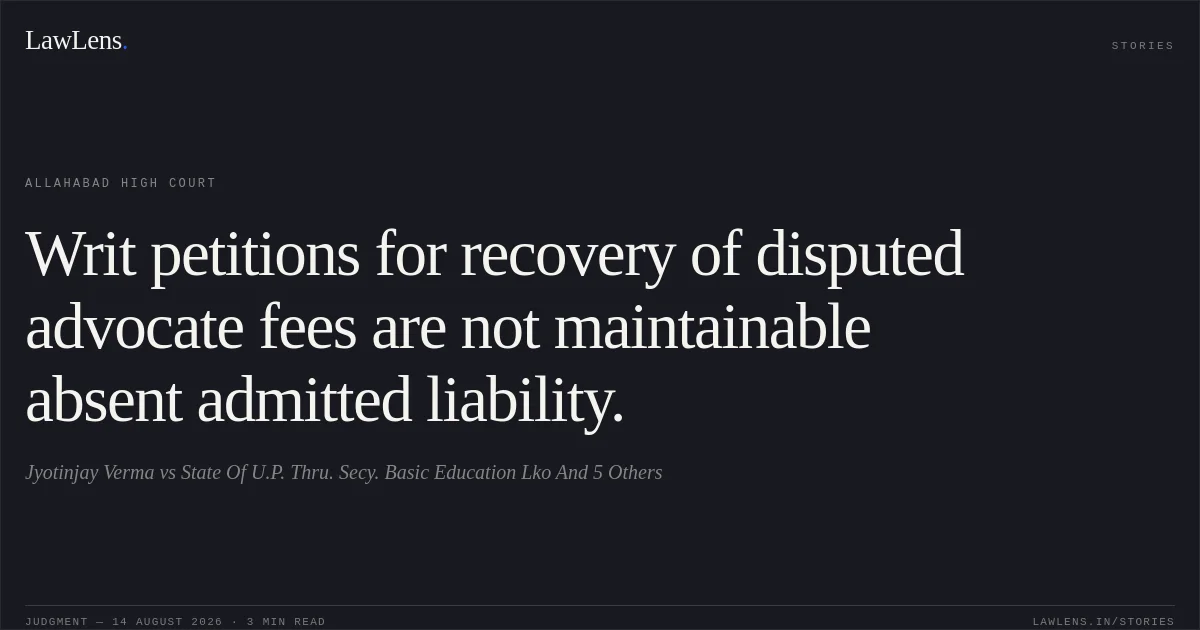
Whether a writ petition under Article 226 of the Constitution is maintainable for recovery of professional fees claimed by an advocate from the State or a government department under a contractual engagement?
Source reference: paras. 16–24Whether the petitioner’s claim could be enforced through a writ of mandamus on the ground that the fee bills constituted admitted or undisputed dues?
Source reference: para. 25Whether the disputed questions concerning the petitioner’s engagement, applicability of the Government Orders, entitlement to the maximum fee and the period for which fees were payable could be adjudicated in writ jurisdiction?
Source reference: paras. 26–27Law Applied
The Court applied the principle that a writ petition is ordinarily not maintainable for recovery of disputed contractual or professional dues where the claimant has an adequate civil remedy and adjudication requires evidence.
Source reference: para. 21It relied on Improvement Trust, Ropar v. S. Tejinder Singh Gujral, 1995 Supp (4) SCC 577, and Vijay Kumar Shukla v. State of Uttar Pradesh, W.P. (C) No. 217 of 2018, to hold that an advocate cannot ordinarily invoke writ jurisdiction for recovery of disputed professional fees.
Source reference: para. 21Relying on State of Punjab v. Rafiq Masih, (2014) 8 SCC 883, the Court reiterated that directions issued under Article 142 to do complete justice do not, by themselves, constitute binding law under Article 141.
Source reference: para. 18A mandamus may nevertheless be considered where the liability is statutory, admitted or undisputed; however, disputed monetary claims involving contractual rights and unresolved factual questions must ordinarily be pursued before a competent civil court.
Source reference: para. 25Reasoning
The Court held that the petitioner’s claim arose from an essentially contractual advocate–client relationship and was not based on any admitted statutory liability.
Source reference: para. 25Although the petitioner asserted that his bills had been accepted, he produced no documentary admission or acknowledgment of the alleged dues and did not annex the relevant fee bills showing receipt or acceptance by the respondents.
Source reference: para. 25Further, the parties disputed the nature and duration of his engagement, including whether he was a panel lawyer or Special Counsel, whether the Government Order dated 2 March 2011 applied to him, whether the fee had to be fixed case-by-case, and whether he was entitled to ₹5,00,000 per case.
Source reference: paras. 11–14, 26The Court interpreted the Government Order as prescribing only a permissible range of ₹15,000 to ₹5,00,000, not as automatically awarding every Special Counsel the maximum amount in every case.
Source reference: para. 26These issues required pleadings, documentary evidence, examination and cross-examination of witnesses, which could not appropriately be undertaken in proceedings under Article 226.
Source reference: para. 26Since the Court found the petitions non-maintainable on these grounds, it declined to decide the respondents’ limitation objection, observing that limitation could involve mixed questions of law and fact.
Source reference: paras. 28–29Holding
The Court answered the maintainability issues against the petitioner.
It held that the four writ petitions seeking recovery of disputed professional fees were not maintainable because the alleged liability was contractual, not admitted or undisputed, and involved substantial disputed questions of fact.
Source reference: paras. 25–27All four writ petitions were accordingly dismissed, without costs.
Source reference: para. 31The petitioner was granted liberty to pursue his professional-fee claim before a competent civil court, where the parties could lead evidence in a regular trial.
Source reference: para. 30If such a civil suit was filed, the petitioner would be entitled to claim the benefit of Section 14 of the Limitation Act in accordance with law.
Source reference: para. 30Acts & Sections Cited
1 provisions across 1 statute referred to in this judgment. Each provision opens on LawLens.
Limitation Act, 19631
Original Court PDF
Jyotinjay VermavsState Of U.P. Thru. Secy. Basic Education Lko And 5 Others
Click to open original judgment
Original judgment, available to read, download and summarize on LawLens.in