Facts
The petitioner’s husband, Sanjay, died from electrocution on 2 October 2020 after coming into contact with a stay wire near an electric pole in a field.
Source reference: para. 2; p. 1The petitioner alleged that the accident resulted from negligence by M.P. Poorv Kshetra Vidyut Vitaran Company Limited and sought directions for expeditious investigation and payment of compensation under Article 226 of the Constitution.
Source reference: para. 1; p. 1The electricity company’s report referred to leakage current in the stay wire, allegedly caused by a defective cable, which resulted in the deceased coming into contact with the electrified wire.
Source reference: paras. 4–5; pp. 2–3The respondents opposed the petition on the ground that disputed questions of fact required evidentiary examination before a competent civil forum.
Source reference: para. 3; p. 2Issues
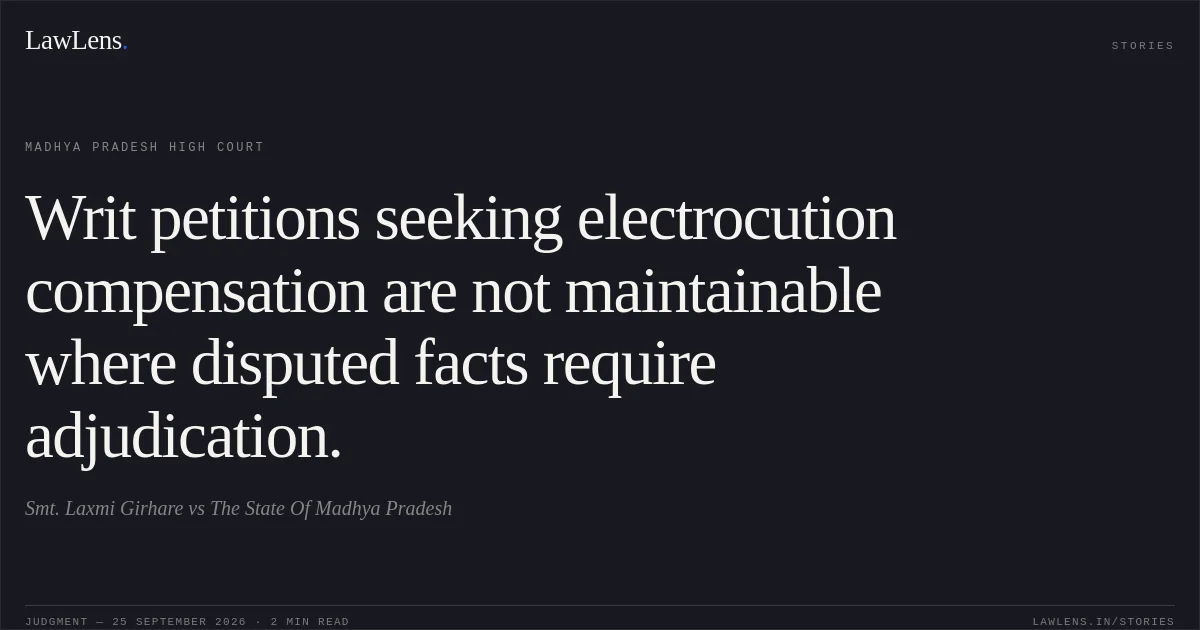
Whether the High Court should exercise writ jurisdiction to award compensation for death by electrocution where the parties dispute the facts relating to negligence and causation.
Source reference: paras. 3, 6–7; pp. 2–5Whether compensation in an electrocution case can be assessed by applying the multiplier method under the law governing motor accident claims.
Source reference: para. 6; pp. 3–5Whether the petitioner should be relegated to an alternate legal remedy for claiming compensation.
Source reference: para. 7; p. 5Law Applied
The Court relied on Karnataka Power Transmission Corporation Limited v. Rekha & Others, SLP (Civil) Nos. 24849 and 24854 of 2025, which held that writ proceedings for compensation are not maintainable where disputed questions of fact require adjudication through evidence.
Source reference: para. 6; pp. 3–5The Supreme Court further held that the multiplier method applicable to motor accident claims cannot be automatically applied to electrocution cases; instead, compensation must be just, reasonable and fair, having regard to the deceased’s income and other relevant circumstances.
Source reference: para. 6; pp. 3–4The Court also noted the principles in Raman v. Uttar Haryana Bijli Vitran Nigam Ltd. and Balram Prasad v. Kunal Saha, and Section 57 of the Electricity Act, 2003, which recognises liability in specified circumstances but does not prescribe a method for calculating compensation.
Source reference: para. 6; p. 3The petitioner’s reliance on M.P. Electricity Board v. Shail Kumari, (2002) 2 SCC 162, and G. Sendhattikalaipandian v. The Inspector of Police, W.P. (MD) No. 15166 of 2020, was not accepted as sufficient to warrant writ-based adjudication in the present case.
Source reference: para. 2; p. 2Reasoning
Although the electricity company’s report indicated that leakage current in the stay wire may have caused the fatal accident, determination of negligence, causation and the extent of the electricity company’s liability would require factual examination and evidence.
Source reference: paras. 4–5; pp. 2–3In light of the Supreme Court’s subsequent ruling that disputed electrocution claims should not ordinarily be adjudicated in writ proceedings, the High Court declined to determine compensation under Article 226.
Source reference: para. 6; pp. 3–5The Court also clarified that the motor-accident multiplier method could not be mechanically applied to the petitioner’s claim.
Source reference: para. 6; p. 3Holding
The Court held that the writ petition was not appropriate for adjudicating the petitioner’s compensation claim because disputed questions of fact were involved.
The petition was accordingly disposed of without awarding compensation, while granting the petitioner liberty to pursue such alternate remedies as may be available in law against the respondents.
Source reference: paras. 7–8; p. 5Acts & Sections Cited
1 provisions across 1 statute referred to in this judgment. Each provision opens on LawLens.
Electricity Act, 20031
Original Court PDF
Smt. Laxmi GirharevsThe State Of Madhya Pradesh
Click to open original judgment
Original judgment, available to read, download and summarize on LawLens.in