Facts
The petitioner and respondent No. 4 were elected directors of the respondent Co-operative Bank in an election held on 27 September 2026.
Source reference: p. 3–5The petitioner alleged that respondent No. 4 was a loan defaulter when he filed his nomination and on the date of that election; respondent No. 4 reportedly paid the outstanding dues on 29 September 2026.
Source reference: p. 3–5The petitioner sought a writ of prohibition to prevent respondent No. 4 from contesting the Bank’s President and Vice-President elections scheduled for 9 October 2026.
Source reference: p. 3–5The petition was considered at the preliminary hearing.
Source reference: p. 7Issues
Whether the writ petition could be entertained to prevent respondent No. 4 from contesting the elections for President and Vice-President on the ground of alleged disqualification as a defaulter.
Source reference: p. 5–6Whether the record disclosed a basis to restrain respondent No. 4 under Section 29-C of the Karnataka Co-operative Societies Act, 1959.
Source reference: p. 6Law Applied
Article 226 jurisdiction to issue a writ of prohibition is limited to preventing a subordinate court or tribunal from exceeding its jurisdiction or acting beyond the jurisdiction vested in it.
Source reference: p. 6Under the Court’s reasoning, an objection that a candidate is disqualified from contesting an election must be raised before the Election Officer at the scrutiny of nominations or pursued thereafter through appropriate proceedings, including an election petition, in accordance with law.
Source reference: p. 6The Court also considered Section 29-C of the Karnataka Co-operative Societies Act, 1959, noting that the record did not show proceedings under that provision had been initiated against respondent No. 4.
Source reference: p. 6Reasoning
The petitioner’s allegations of default and the asserted disqualification raised an election-related objection, but the requested prohibition did not concern a subordinate court or tribunal acting beyond its jurisdiction.
Source reference: p. 6–7The Court therefore held that Article 226 was not the appropriate means to restrain respondent No. 4 from contesting the election; the objection had to be pursued through the election process or appropriate subsequent proceedings.
Source reference: p. 6–7Further, no proceedings under Section 29-C against respondent No. 4 were shown on the record.
Source reference: p. 6–7Holding
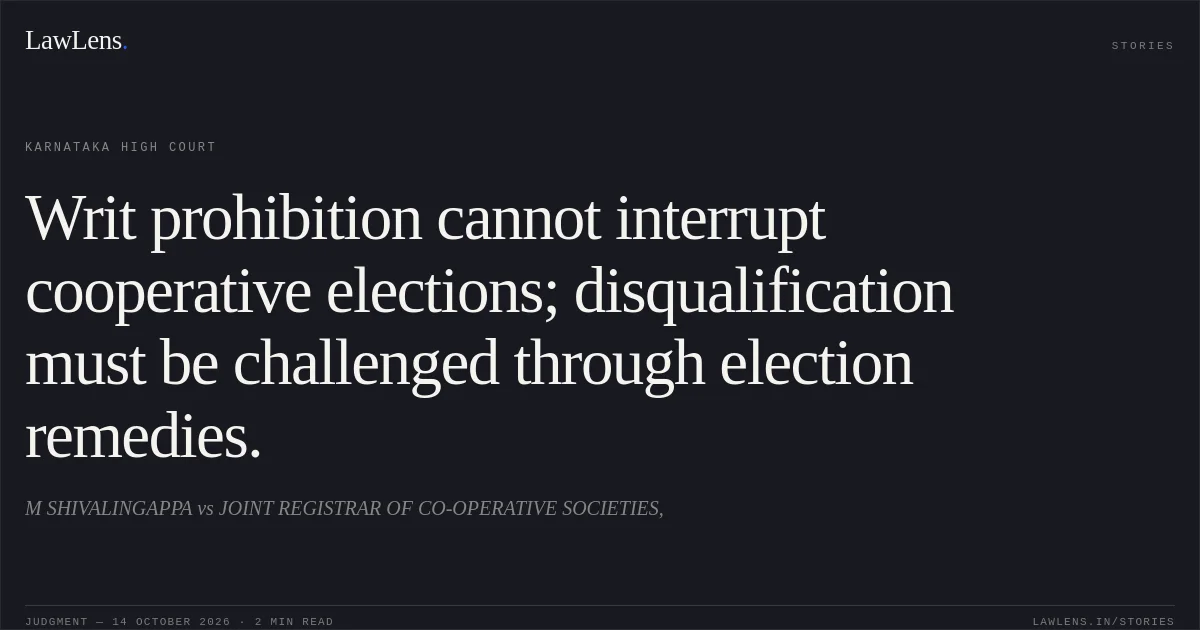
The Court rejected the request to restrain respondent No. 4 from contesting the President and Vice-President elections and dismissed the writ petition as devoid of merit.
The petition was rejected at the preliminary stage, and the Court found it unnecessary to issue notice to respondent Nos. 3 and 4.
Source reference: p. 7Acts & Sections Cited
1 provisions across 1 statute referred to in this judgment. Linked provisions open on LawLens.
Karnataka Co-Operative Societies Act, 19591
Original Court PDF
M SHIVALINGAPPAvsJOINT REGISTRAR OF CO-OPERATIVE SOCIETIES,
Click to open original judgment
Original judgment, available to read, download and summarize on LawLens.in
![Non-inclusion in railway pass or medical records cannot alone defeat compassionate appointment consideration.. YADVENDRA vs NORTH EASTERN RAILWAY. CAT - ['Allahabad']. LawLens](/stories/thumbnails/non-inclusion-in-railway-pass-or-medical-records-cannot-alone-defeat-compassionate-appoint-e186bad941e646b9b28be0fa75663d2f.webp)
![Ten years’ qualifying service is not required for family pension after one year of continuous railway service.. ANJANA DEVI vs NORTH EASTERN RAILWAY. CAT - ['Allahabad']. LawLens](/stories/thumbnails/ten-years-qualifying-service-is-not-required-for-family-pension-after-one-year-of-continuo-21aef602d06c48fbabbee8c57d854298.webp)
![Back-wage claims require merits-based assessment; absence of an earlier direction alone cannot defeat them.. MANNO LAL SAROJ vs NORTH CENTRAL RAILWAY. CAT - ['Allahabad']. LawLens](/stories/thumbnails/back-wage-claims-require-merits-based-assessment-absence-of-an-earlier-direction-alone-can-62ea890f59a24aa499e6a8a6e1f6bf69.webp)