Facts
The petitioner claimed payment of outstanding dues for eight PWD road works allegedly completed in 2002 and 2003.
Source reference: pp. 3–6, para. 2The respondents opposed the petition, stating that the petitioner had not furnished original bills, completion certificates, agreements, formal work orders, photographs, inspection reports and other documents required for processing the demand proposal.
Source reference: pp. 7–8, para. 5They further alleged that the completion certificates relied upon by the petitioner appeared to be fake or fabricated because the prescribed certificates at the relevant time were to be signed only by the Executive Engineer, not the Accounts Officer.
Source reference: pp. 7–8, para. 5The writ petition was filed in 2025, approximately 22 years after the alleged dues arose.
Source reference: p. 8, para. 6Issues
Whether the High Court should exercise jurisdiction under Article 226 of the Constitution to direct payment of alleged dues arising from works completed approximately 22 years earlier.
Source reference: pp. 8–9, paras. 6–8Whether the writ petition was maintainable where the respondents disputed the authenticity of the completion certificates and asserted that material supporting documents necessary for processing the claim had not been produced.
Source reference: pp. 7–9, paras. 5, 7 and 9Whether the petitioner could be granted liberty to pursue an appropriate civil remedy, with exclusion of the period spent prosecuting the writ petition for limitation purposes.
Source reference: pp. 9–10, paras. 11–12Law Applied
The Court applied the discretionary and equitable jurisdiction under Article 226 of the Constitution, including the principle that extraordinary writ relief may be refused where a claim is brought after inordinate and unexplained delay or laches, particularly when the delay prejudices the respondent’s ability to investigate and defend the claim.
Source reference: pp. 8–10, paras. 6–12The Court also applied the principle that disputed questions concerning the genuineness of documents and completion of contractual works are ordinarily unsuitable for adjudication in writ proceedings.
Source reference: pp. 8–10, paras. 6–12It further recognised that refusal of writ relief does not necessarily extinguish a legally available civil remedy; however, exclusion of the period spent in writ proceedings for limitation purposes does not amount to an extension of limitation.
Source reference: pp. 8–10, paras. 6–12Reasoning
The Court found that the petitioner approached it in 2025 in respect of alleged payment obligations arising from works completed in 2002 and 2003, resulting in a delay of approximately 22 years.
Source reference: p. 8, para. 6Such delay impaired the respondents’ ability to verify the works, locate records and prepare an effective defence.
Source reference: p. 8, para. 7The respondents had specifically stated that essential documents required for preparing a demand proposal were unavailable or had not been submitted.
Source reference: p. 8, para. 7In addition, the authenticity of the completion certificates—the principal documents relied upon by the petitioner—was directly disputed, with the respondents alleging that they did not conform to the prescribed form applicable at the relevant time.
Source reference: pp. 7–9, paras. 5, 7 and 9In these circumstances, issuing a payment direction under Article 226 would be inequitable and would prejudice the respondents; the Court therefore declined to adjudicate the disputed claim in writ jurisdiction.
Source reference: p. 9, para. 8Holding
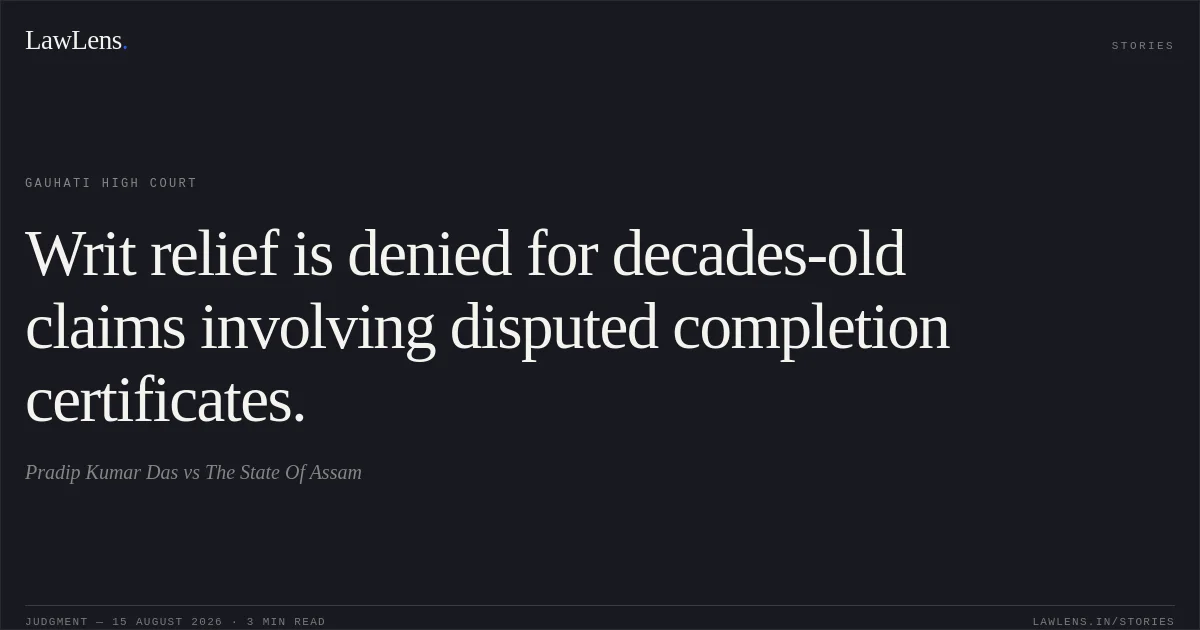
The writ petition was dismissed because the petitioner’s claim was brought after an inordinate delay and involved disputed completion certificates and other factual and documentary issues unsuitable for determination under Article 226.
The dismissal did not preclude or prejudice the petitioner from approaching the competent civil court, if permissible in law.
Source reference: p. 10, para. 11The period from 17 February 2025 until 11 August 2026, during which the writ proceedings remained pending, was directed to be excluded while computing limitation; the Court clarified that this exclusion did not constitute an extension of the limitation period.
Source reference: p. 10, para. 12Original Court PDF
Pradip Kumar DasvsThe State Of Assam
Click to open original judgment
Original judgment, available to read, download and summarize on LawLens.in