Facts
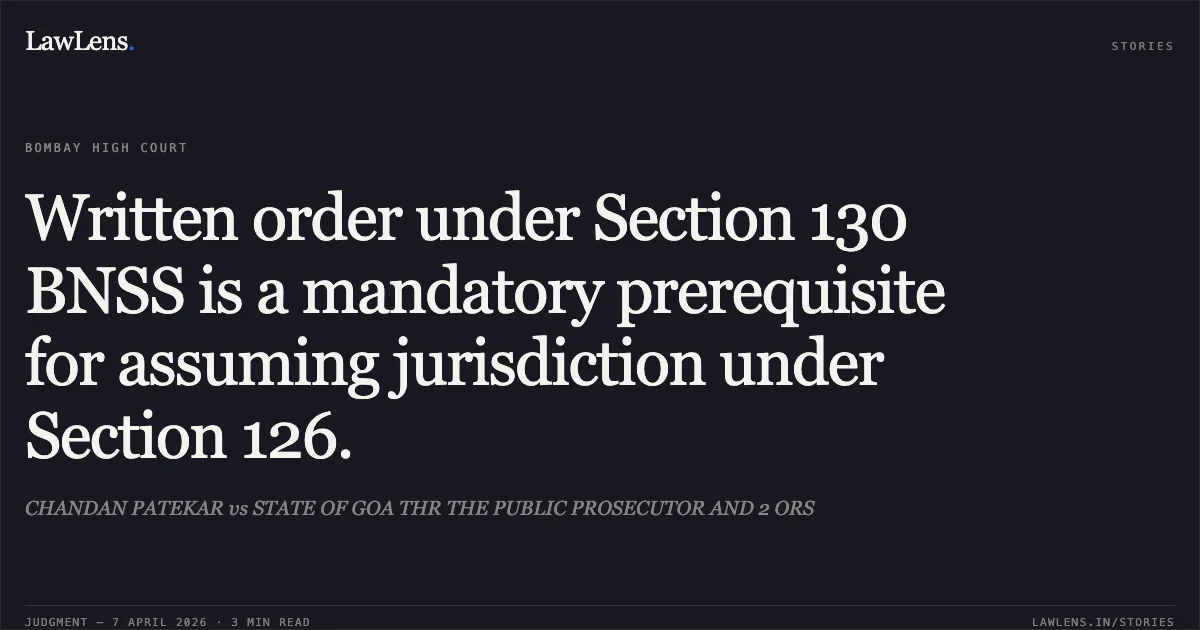
Several petitioners approached the High Court challenging show-cause notices issued by various Deputy Collectors and Sub-Divisional Magistrates (SDMs) across Goa under Section 126 of the Bharatiya Nagarik Suraksha Sanhita, 2023 (BNSS).
Source reference: p. 7The Magistrates had initiated these preventive proceedings to require the petitioners to execute bonds for keeping the peace.
Source reference: p. 7-8The petitioners contended that the Magistrates issued these notices mechanically using cyclostyled forms without passing a preliminary written order as required by Section 130 of the BNSS.
Source reference: p. 8, 22They argued that the failure to record a reasoned opinion or set forth the substance of information received rendered the proceedings jurisdictionaly flawed.
Source reference: p. 8Issues
1. Whether the passing of a written order under Section 130 of the BNSS, setting forth the substance of information received, is a mandatory condition precedent for exercising jurisdiction under Section 126 of the BNSS.
Source reference: p. 8, 202. Whether a show-cause notice issued under Section 126 of the BNSS can be legally construed as a substitute for the mandatory written order required under Section 130.
Source reference: p. 21, 23Law Applied
The Court primarily applied Section 126 of the BNSS (Security for keeping peace) and Section 130 of the BNSS (Requirement of a written order).
Source reference: p. 18-19It relied on the principle that when a statute requires an act to be done in a particular manner, it must be done in that manner or not at all.
Source reference: p. 21The Court followed the precedents established in Jitendra R. Deshprabhu v. Executive Magistrate (1992), which held that the Magistrate must reach an opinion on sufficient grounds before proceeding.
Source reference: p. 9-11The Court followed Rajesh s/o Suryabhan Nayak v. State of Maharashtra (2006), which condemned the use of printed/cyclostyled orders in preventive proceedings as a lack of application of mind.
Source reference: p. 12-14Reasoning
The Court observed that Section 126(1) of the BNSS empowers a Magistrate to act only when they are of the "opinion that there is sufficient ground for proceeding".
Source reference: p. 18-19This power is restricted by Section 130, which mandates a written order setting forth the "substance of the information received," the bond amount, and the term of force.
Source reference: p. 19The Court reasoned that this order is sine qua non for assuming jurisdiction because, under Sections 131 and 133, this specific order must be read over to the person or accompany the summons.
Source reference: p. 20-21In the present cases, the Court found the impugned notices to be "practically cyclostyled," with identical contents and no specific reflection of the information received or the Magistrate's independent judicial satisfaction.
Source reference: p. 16, 22The Court emphasized that since these proceedings affect personal liberty, strict compliance with the statutory procedure is mandatory and cannot be reduced to a "mere formality" or a mechanical exercise.
Source reference: p. 21Holding
The High Court held that the Executive Magistrates failed to comply with the mandatory requirements of Sections 126 and 130 of the BNSS.
It clarified that a notice issued under Section 126 cannot be treated as a valid order under Section 130.
Source reference: p. 21Consequently, the Court quashed and set aside the impugned notices and all subsequent proceedings initiated against the petitioners.
Source reference: p. 23The Rule was made absolute in all six writ petitions, directing the Magistrates to strictly follow the statutory scheme and avoid mechanical, cyclostyled orders in the future.
Source reference: p. 21, 23Acts & Sections Cited
12 provisions across 2 statutes referred to in this judgment. Each provision opens on LawLens.
Bharatiya Nagarik Suraksha Sanhita, 20237
Code of Criminal Procedure, 19735
Original Court PDF
CHANDAN PATEKARvsSTATE OF GOA THR THE PUBLIC PROSECUTOR AND 2 ORS
Click to open original judgment
Original judgment, available to read, download and summarize on LawLens.in