Facts
The applicants, belonging to the Economically Weaker Section (EWS) category, applied for the post of ‘Fire Operator’ (Post Code 18/19) under the Delhi Fire Service
Source reference: para 1.1, 1.4The recruitment advertisement dated 24.09.2019 notified 706 total vacancies, out of which only 21 posts were reserved for the EWS category
Source reference: para 1.3The applicants, having cleared the written and physical tests, challenged the allocation, contending that per the 10% EWS reservation policy, approximately 70-71 posts should have been reserved
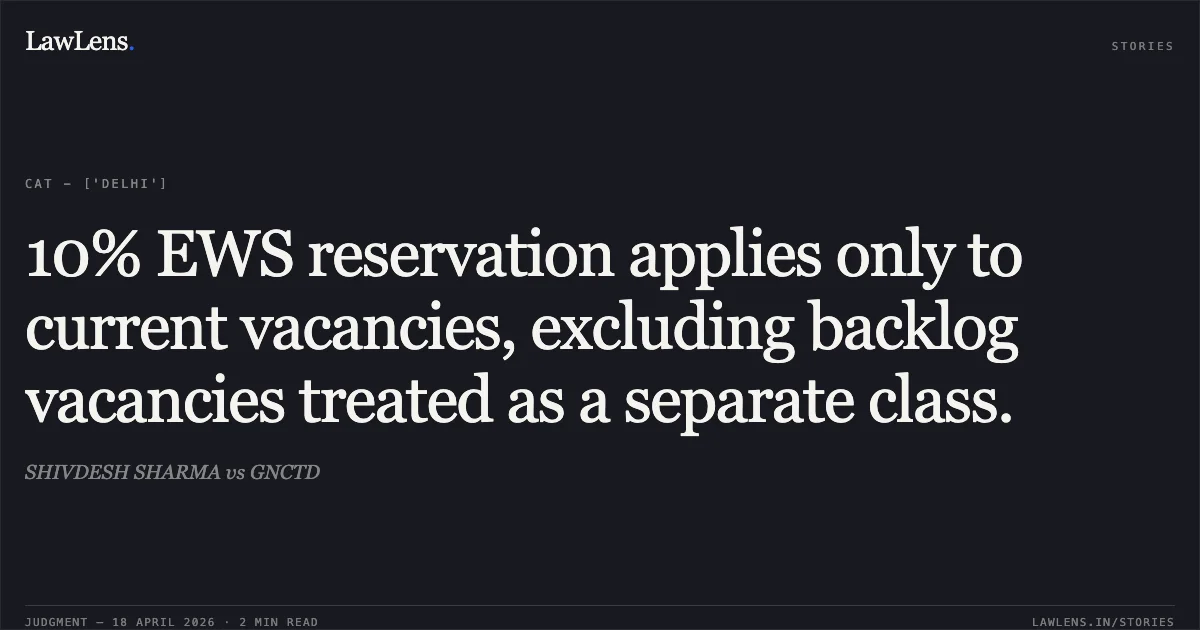
Source reference: para 1.1, 2The respondents contended that the 706 vacancies included 495 backlog vacancies for SC/ST/OBC categories, which must be treated as a separate class under the Constitution. Consequently, they calculated the 10% EWS reservation only on the 211 "current" vacancies
Source reference: para 12Issues
1. Whether the respondents correctly implemented the 10% EWS reservation policy by earmarking 21 posts instead of 70-71 posts for Post Code 18/19
Source reference: para 82. Whether the applicants are barred from challenging the advertisement after participating in the selection process without protest
Source reference: para 17, 18Law Applied
The Tribunal relied on the 103rd Constitutional Amendment, which inserted Articles 15(6) and 16(6) to enable up to 10% reservation for EWS in addition to existing reservations
Source reference: para 7It emphasized Article 16(4B) of the Constitution, which mandates that backlog vacancies be treated as a distinct class and excluded from the ceiling of reservation for the current year
Source reference: para 13This principle was upheld by the Supreme Court in M. Nagraj v. Union of India (2006) 8 SCC 212
Source reference: para 13the Tribunal applied the doctrine of estoppel from Om Prakash Shukla v. Akhilesh Kumar Shukla (1986), which holds that candidates who participate in a selection process without protest cannot challenge it after becoming unsuccessful or at the final stage
Source reference: para 17Reasoning
The Tribunal found that of the 706 total vacancies, approximately two-thirds (492-495) were backlog vacancies for SC, ST, and OBC categories
Source reference: para 10, 12Relying on Article 16(4B) and the M. Nagraj precedent, the Tribunal reasoned that backlog vacancies cannot be clubbed with current vacancies for the purpose of calculating the EWS quota, as they represent a separate class of "unfilled vacancies" from previous years
Source reference: para 13, 14By deducting the 495 backlog posts from the 706 total, only 211 current vacancies remained. The allocation of 21 posts (10% of 211) was therefore mathematically and legally sound
Source reference: para 14, 19The Tribunal distinguished the applicants' reliance on Gaurav Sharma v. GNCTD, noting that in that case, the department had admitted to a notification error, whereas here, the respondents provided a legally valid roster-based justification
Source reference: para 15the Tribunal noted that the applicants challenged the advertisement only at the "fag end" of the process, which is impermissible after voluntary participation
Source reference: para 18Holding
The Tribunal dismissed the Original Application, holding that the respondents correctly applied the 10% EWS reservation to the current vacancies
The direct answer to the issue was that backlog vacancies under Article 16(4B) must be excluded when determining the base for EWS reservation
Source reference: para 14The Tribunal refused to grant any relief or direct the creation of additional EWS posts, confirming that the requirement of the EWS reservation policy stood fully satisfied
Source reference: para 19, 20No orders were made as to costs
Source reference: para 22Acts & Sections Cited
1 provisions across 1 statute referred to in this judgment. Each provision opens on LawLens.
Administrative Tribunals Act, 19851
Original Court PDF
SHIVDESH SHARMAvsGNCTD
Click to open original judgment
Original judgment, available to read, download and summarize on LawLens.in


