Facts
The claimant suffered serious injuries, including amputation of his right leg below the knee and left hand above the wrist, in a road accident involving a lorry.
Source reference: no citationThe Tribunal found the lorry driver negligent and awarded ₹18,00,425, applying a 70% disability assessment and fixing monthly income at ₹9,000; it also ordered the insurer to pay first and recover from the vehicle owner because the driver lacked the required licence.
Source reference: pp. 4–5The claimant appealed under Section 173 of the Motor Vehicles Act, 1988, seeking enhancement, contending that his income and functional disability had been understated.
Source reference: pp. 1, 5–6Issues
1. Whether the Tribunal’s assessment of the claimant’s income and permanent or functional disability adequately compensated his loss of earning capacity.
Source reference: pp. 8–92. Whether the amounts awarded under the other heads of compensation, including transport expenses, pain and suffering, and future medical expenses, required enhancement.
Source reference: pp. 9–103. Whether the Tribunal’s pay-and-recover direction should be maintained in view of the driver’s lack of a valid licence to drive the transport vehicle.
Source reference: pp. 7, 11Law Applied
Section 173 of the Motor Vehicles Act, 1988, provides for an appeal against a Motor Accident Claims Tribunal award.
Source reference: p. 1Under Rajkumar v. Ajay Kumar, compensation for loss of earning capacity should reflect the claimant’s functional disability and its impact on his work, rather than mechanically adopt the medical disability percentage.
Source reference: p. 8National Insurance Co. v. Pranay Sethi governs the addition of future prospects to income, while Sarla Verma v. Delhi Transport Corporation supplies the appropriate multiplier based on age.
Source reference: p. 9The Court also relied on Anant v. Pratap in considering future medical expenses associated with an artificial limb.
Source reference: p. 10Where the vehicle’s driver lacks the required driving licence, the insurer may be directed to satisfy the award first and recover the amount from the vehicle owner.
Source reference: pp. 4, 11Reasoning
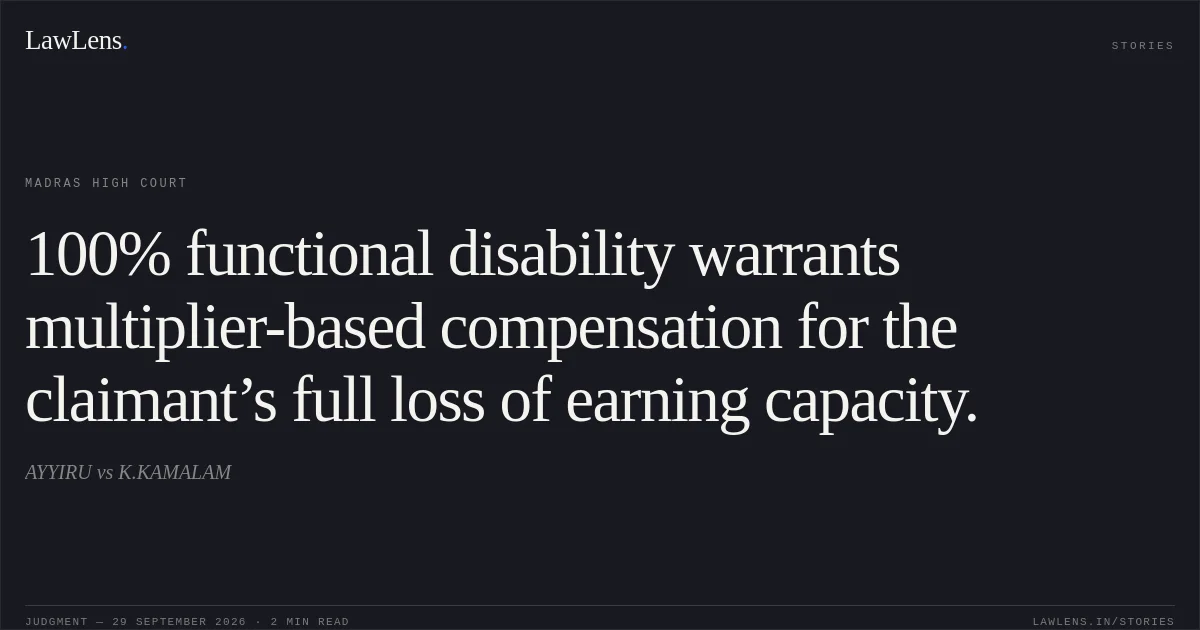
The Court treated the claimant’s functional disability as 100%, considering the doctor’s evidence, the amputations, and the resulting loss of earning capacity in his work as a loadman, notwithstanding the Medical Board’s 70% assessment.
Source reference: p. 8It accepted the employer’s testimony and salary slip as support for monthly income of ₹15,000, added 25% for future prospects, and applied a multiplier of 14, resulting in ₹31,50,000 for loss of earning capacity.
Source reference: p. 9It further enhanced or allowed compensation under other heads, including ₹50,000 for transport expenses, ₹2,00,000 for pain and suffering, and ₹1,00,000 for future medical expenses.
Source reference: pp. 10–11The Court found no basis to disturb the pay-and-recover direction because the driver lacked a valid licence to drive the transport vehicle.
Source reference: pp. 7, 11Holding
The appeal was partly allowed, and total compensation was enhanced from ₹18,00,425 to ₹37,10,425, carrying interest at 7.5% per annum.
The insurer was directed to deposit the award, less any amount already deposited, within eight weeks and then recover it from the vehicle owner; the claimant may withdraw the amount upon application, subject to payment of any court fee due and the direction that no interest is payable for the delay period.
Source reference: pp. 11–12Acts & Sections Cited
1 provisions across 1 statute referred to in this judgment. Each provision opens on LawLens.
Motor Vehicles Act, 19881
Original Court PDF
AYYIRUvsK.KAMALAM
Click to open original judgment
Original judgment, available to read, download and summarize on LawLens.in