Facts
Mohan Gandhi & Company (“the firm”) sued Punjab National Bank (“PNB”) for a declaration that an indenture dated 5 July 1982 concerning the firm’s flat was executed as security for a loan to Argee Textiles Pvt. Ltd., and was not binding as an agreement for sale.
Source reference: para. 3–9, 41PNB separately sued for specific performance of that indenture.
Source reference: para. 3–9, 41PNB maintained that the flat was sold for Rs. 15 lakhs, of which Rs. 14 lakhs was credited to Argee Textiles’ loan account, with Rs. 1 lakh payable on completion.
Source reference: para. 3–9, 41The firm asserted that the document was a security arrangement and that it was entitled to regain possession on repayment of Rs. 14 lakhs.
Source reference: para. 3–9, 41The trial court decreed the firm’s suit and dismissed PNB’s suit; PNB appealed in both matters.
Source reference: para. 1, 13Issues
Whether the indenture dated 5 July 1982 recorded a sale of the flat or was executed as security for Argee Textiles’ loan.
Source reference: para. 40(i)Whether crediting Rs. 14 lakhs to Argee Textiles’ loan account constituted payment of part of the sale consideration to the firm.
Source reference: para. 40(ii)If the indenture was an agreement for sale, whether it was invalid because of the minors’ interests, the manner of execution, or the alleged lack of authority of a partner.
Source reference: para. 40(iii)(a)–(c)Law Applied
Sections 91 and 92 of the Indian Evidence Act, 1872 require the terms of a written contract to be proved by the document and generally bar oral evidence that contradicts, varies, adds to, or subtracts from those terms; they do not bar evidence on whether the parties agreed to contract on the document’s stated terms.
Source reference: para. 89Under Section 36 of the Stamp Act, once an instrument is admitted in evidence, its admission cannot be challenged later in the same proceedings on the ground that it was insufficiently stamped.
Source reference: para. 51, 53Section 14 of the Partnership Act, 1932 concerns property of the firm; a partner cannot treat or deal with partnership property as exclusively their own, but the court found no statutory bar to alienation with the consent of all partners.
Source reference: para. 96–97Section 30(2) recognises a minor admitted to partnership benefits’ share in the firm’s property and profits.
Source reference: para. 97The court also relied on *Addanki Narayanappa v. Bhaskara Krishnappa* for the principle that, during the subsistence of a partnership, a partner cannot deal with a portion of partnership property as their own.
Source reference: para. 96Reasoning
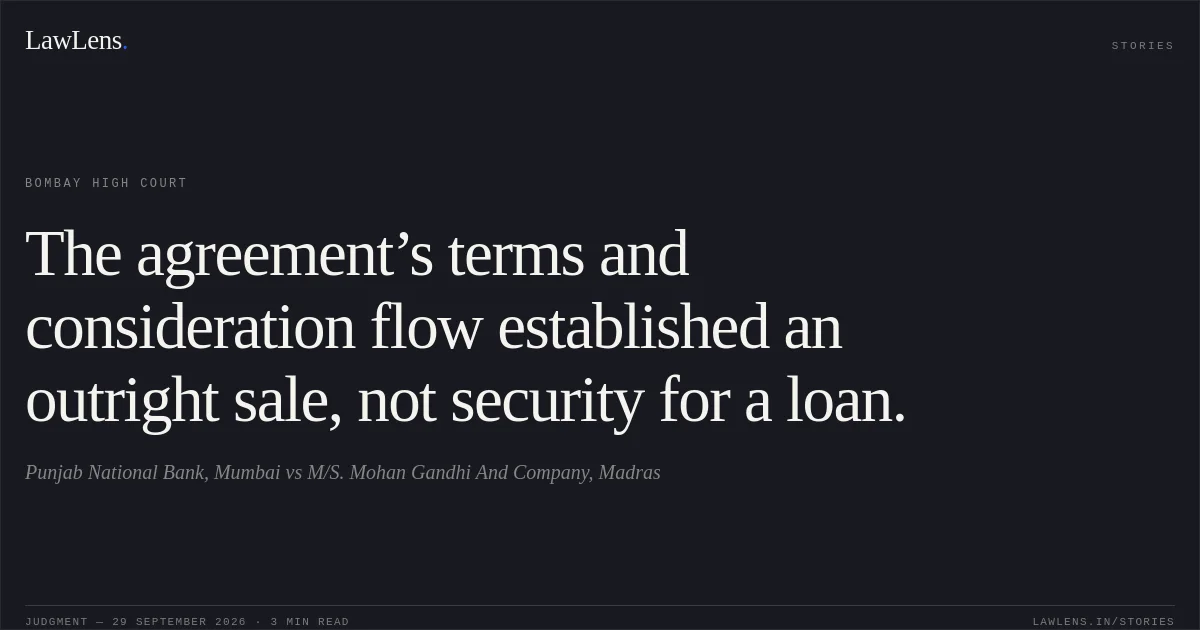
Reading the indenture as a whole, the court found that its provisions for a stated sale price, transfer of possession, completion of sale, society membership and transfer formalities, and PNB’s option to seek specific performance were consistent with a sale, not a security arrangement.
Source reference: para. 90–93The bank records, voucher, and DRT proceedings showed that the Rs. 14 lakhs was credited to Argee Textiles after the agreement and reduced its loan liability; the firm neither effectively disputed the endorsement nor established that the adjustment was unauthorised.
Source reference: para. 60–68, 79The firm’s account of an oral arrangement for return of the flat upon repayment was unsupported by reliable personal-knowledge evidence and was inconsistent with the written agreement and contemporaneous correspondence.
Source reference: para. 86–89The court further found that the agreement was signed on behalf of the firm, including by the minors’ guardian, and that the firm had not established that the alienation was invalid or prohibited.
Source reference: para. 81, 96–97Holding
The High Court held that the indenture was an agreement for sale, that the Rs. 14 lakhs credited to Argee Textiles formed part of the consideration, and that the firm had not proved that the agreement was a security arrangement or invalid.
It allowed both appeals, set aside the trial court’s common judgment, dismissed the firm’s suit, and decreed PNB’s specific-performance suit, directing PNB to pay the balance Rs. 1 lakh with interest at 12% per annum from 30 June 1987 within four weeks.
Source reference: para. 100The interim applications were disposed of as no longer surviving.
Source reference: para. 101Acts & Sections Cited
4 provisions across 2 statutes referred to in this judgment. Each provision opens on LawLens.
Indian Partnership Act, 19322
Bombay Stamp Act, 19582
Original Court PDF
Punjab National Bank, MumbaivsM/S. Mohan Gandhi And Company, Madras
Click to open original judgment
Original judgment, available to read, download and summarize on LawLens.in