Facts
On the night of 11/12 August 1983, five-six miscreants entered the house of Munawwar Hussain (P.W.1) and kidnapped his ten-year-old son, Ashkar (P.W.2).
Source reference: para. 5, 10The victim was recovered the following day from the custody of co-accused Israr.
Source reference: para. 19Appellants Harish Chandra and Nazarul were identified through a Test Identification Parade (TIP) in District Jail, while appellant Dulha (the victim’s maternal uncle) was identified as the conspirator who met the group during the flight.
Source reference: para. 12, 17The Trial Court convicted Harish Chandra and Nazarul under Sections 364/149 and 147 IPC, and Dulha under Section 368 IPC.
Source reference: para. 2The appellants challenged the conviction on grounds of insufficient light for identification, the "child witness" status of the victim, and low identification percentages.
Source reference: para. 25-26Issues
1. Whether the prosecution established the identity of the appellants beyond reasonable doubt despite the absence of names in the FIR and claims of insufficient light at the scene?
Source reference: para. 35, 372. Whether the testimony of a child witness (P.W.2) can be relied upon for conviction without corroboration?
Source reference: para. 443. Whether the Test Identification Parade (TIP) results were vitiated due to low identification percentages by certain witnesses?
Source reference: para. 38Law Applied
The Court applied Section 364 (Kidnapping for murder/ransom), Section 368 (Wrongfully concealing or keeping in confinement, kidnapped person), and Section 147 (Punishment for rioting) of the IPC.
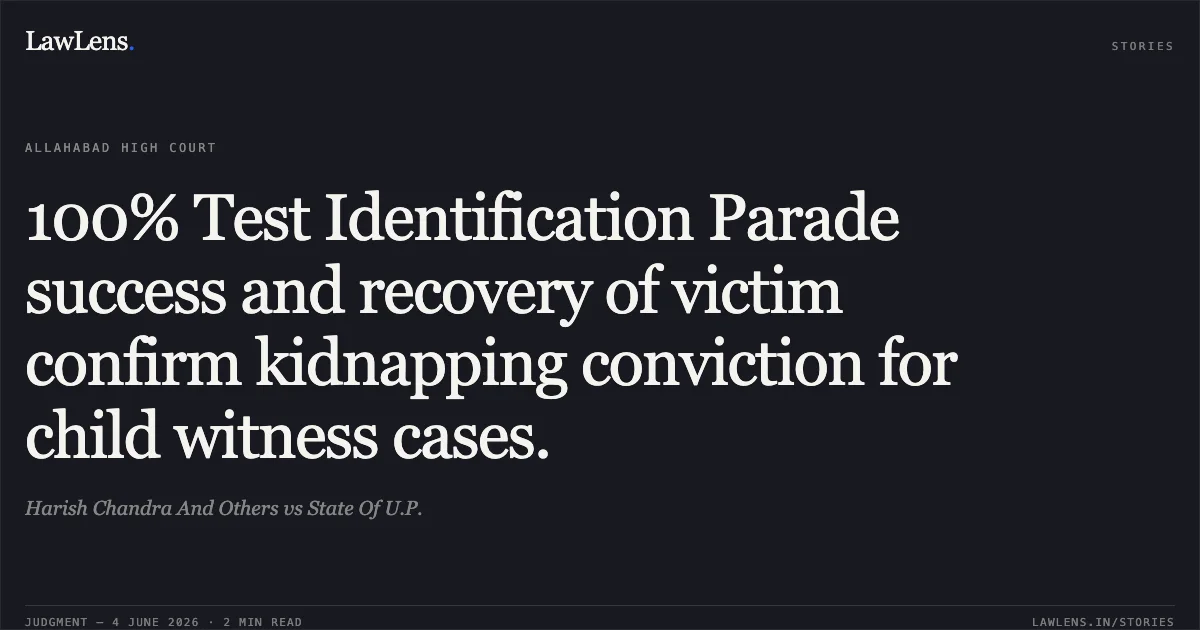
Source reference: para. 1-2While child witness testimony requires circumspection and corroboration to rule out tutoring, a consistent and reliable child witness is a competent witness.
Source reference: para. 44TIP is a tool of investigation to lend assurance to the court, and where witnesses have 100% identification rates for specific accused, the failure of other witnesses does not vitiate the evidence.
Source reference: para. 39-40Motive is immaterial in cases based on direct evidence.
Source reference: para. 49Reasoning
The Court rejected the defense's challenge to the source of light, noting that the presence of a lantern, torches, and a nearby electric bulb provided sufficient illumination for identification, corroborated by the recovery of empty cartridges at the scene.
Source reference: para. 35-36Regarding the child witness (P.W.2), the Court found his testimony "consistent and reliable" because he was the victim who remained in the captors' custody for nearly 24 hours, providing ample opportunity for identification; his version was further corroborated by P.W.3 (an independent witness).
Source reference: para. 41, 44The Court dismissed the "low identifier percentage" argument, clarifying that both the victim (P.W.2) and the independent witness (P.W.3) achieved 100% accuracy in identifying the appellants during the TIP and in court.
Source reference: para. 39-40Procedural integrity was maintained as the appellants were kept bapardah (masked) from arrest until the TIP.
Source reference: para. 21-22, 41The court found the motive—Dulha’s desire to grab the informant’s land—credible, though secondary to the direct evidence.
Source reference: para. 47Holding
The Court answered all issues in the affirmative for the prosecution, holding that the identity and guilt of the appellants were proved beyond reasonable doubt.
The High Court dismissed the appeal and affirmed the conviction and sentences.
Source reference: para. 51Specific orders were issued for the arrest of non-traceable appellants (Harish Chandra and Dulha) to serve their remaining sentences, while Nazarul remained in custody.
Source reference: para. 52The Court also quantified a fee of Rs. 10,000 for the Amicus Curiae.
Source reference: para. 54Acts & Sections Cited
12 provisions across 3 statutes referred to in this judgment. Each provision opens on LawLens.
Code of Criminal Procedure, 19735
Indian Penal Code, 18606
Arms Act, 19591
Original Court PDF
Harish Chandra And OthersvsState Of U.P.
Click to open original judgment
Original judgment, available to read, download and summarize on LawLens.in