Facts
The Petitioner served with NIEPA under the old GPF-cum-Pension Scheme. Upon selection as Registrar of the Central Sanskrit University (“CSU”), his technical resignation from NIEPA was accepted and he joined CSU on 5 July 2013 under a five-year or age-of-62 tenure appointment.
Source reference: pp. 2–3, paras 2–4Clause 7 of the Service Agreement permitted him to continue under the old GPF-cum-Pension Rules and provided for counting of his previous qualifying service towards combined pensionary benefits, subject to transfer of the pro-rata pensionary liability by NIEPA.
Source reference: p. 3, para. 4CSU subsequently recorded that he stood “absorbed” and requested transfer of the pensionary amounts; NIEPA transferred ₹32,32,166 towards pro-rata pensionary benefits and ₹7,72,977 towards GPF, which CSU accepted.
Source reference: pp. 3–4, paras 5–7CSU later terminated the Petitioner’s service on disciplinary charges. In W.P.(C) 3190/2018, the High Court maintained the premature termination but directed that the removal be treated as termination simpliciter, without stigma.
Source reference: p. 4, para. 8Thereafter, CSU released arrears of pay, leave encashment and an amount under the CPF Scheme, but denied pension, gratuity and GPF benefits on the basis that the Petitioner had served CSU for less than five years and was allegedly governed by the CPF Scheme.
Source reference: pp. 4–5, para. 11The Ministry of Education concluded that, once the pensionary liability had been transferred to CSU, the liability rested with CSU and could not be remitted back to NIEPA.
Source reference: pp. 5–6, paras 12–13NIEPA’s subsequent appeal, LPA No. 144/2021, did not determine the inter se pensionary liability and expressly left the Petitioner’s legal rights open.
Source reference: pp. 6–7, paras 14–15Issues
Whether the Petitioner was entitled to remain governed by the old GPF-cum-Pension Scheme and to have his qualifying service with NIEPA clubbed with his CSU service for pensionary purposes, notwithstanding the tenure/contractual nature of his CSU appointment?
Source reference: pp. 11–14, paras 24–32Whether CSU could deny gratuity by calculating only the Petitioner’s CSU service and could retrospectively treat his GPF entitlement as CPF?
Source reference: pp. 15–16, paras 35–36Whether the Petitioner was entitled to notice pay after his removal was directed to be treated as termination simpliciter without stigma?
Source reference: p. 16, para. 37Whether the Petitioner was entitled to transport allowance, personal pay, a notional increment and interest on delayed dues?
Source reference: pp. 16–19, paras 38–42What consequential directions were required regarding pension, gratuity, GPF reconstruction, service certification and inter se accounting between CSU and NIEPA?
Source reference: pp. 19–22, paras 43–46Law Applied
The Court applied Clause 7 of the Service Agreement, which contractually preserved the Petitioner’s old GPF-cum-Pension coverage and required his previous qualifying service to be counted upon transfer of the pro-rata pensionary liability.
Source reference: pp. 11–12, paras 25–26It relied on Rule 2(g) of the CCS (Pension) Rules, 1972, under which contractual employees are generally excluded from the Pension Rules, except where the contract provides otherwise; the Court held that the contractual exception applied in this case.
Source reference: p. 11, para. 26The Court also applied the principle that administrative authorities cannot resile from a pensionary arrangement after accepting the corresponding funds and acting upon it.
Source reference: pp. 11–14, paras 25–32The earlier order converting removal into termination simpliciter without stigma was treated as binding, preventing CSU from relying on the disciplinary removal to deny pensionary consequences or notice pay.
Source reference: pp. 12–13, paras 28–30On delayed retiral benefits, the Court relied on D.D. Tewari v. Uttar Haryana Bijli Vitran Nigam Ltd., (2014) 8 SCC 894, for the principle that delayed payment of pension and gratuity may warrant interest.
Source reference: p. 18, paras 41–42Reasoning
The Court held that the Petitioner’s entitlement flowed primarily from the express terms of Clause 7, independently of whether the reference to “absorption” was legally sustainable for a tenure post.
Source reference: pp. 11–14, paras 25–30The condition attached to the pensionary arrangement—receipt of the pro-rata pensionary liability—was fulfilled when NIEPA transferred the amount and CSU accepted it; CSU therefore could not later rely on the tenure character of the appointment to deny pension or reclassify the Petitioner under CPF.
Source reference: p. 12, para. 26The Memorandum recording absorption and continuation under the old Pension Scheme had never been withdrawn or set aside.
Source reference: p. 12, para. 27The Court further held that CSU’s reliance on alleged misconduct was impermissible because the prior judgment had removed the punitive character of the cessation by directing that it be treated as termination simpliciter without stigma.
Source reference: pp. 12–13, paras 28–29Consequently, past qualifying service had to be verified and clubbed with CSU service; gratuity could not be denied by artificially limiting the calculation to CSU service; and the GPF amount transferred by NIEPA had to be accounted for under the GPF Scheme, subject to adjustment of sums already paid under CPF.
Source reference: pp. 14–16, paras 34–36The Court allowed notice pay under the contractual termination clause, rejected full-month transport allowance and the notional increment claim, directed verification of personal pay, and awarded interest on delayed pension, gratuity, pay and leave benefits.
Source reference: pp. 16–19, paras 37–42Holding
The petition was allowed in substance.
The Court set aside the impugned orders to the extent that they denied pension and gratuity by disregarding the Petitioner’s previous qualifying service, treated him as governed by CPF, denied notice pay on the basis of misconduct, or described his cessation as punitive removal.
Source reference: p. 20, para. 46(i)CSU was directed to treat the Petitioner as governed by the old GPF-cum-Pension Scheme, club his verified NIEPA service with his CSU service, sanction pension, recompute gratuity, reconstruct his GPF account and pay three months’ salary in lieu of notice.
Source reference: pp. 20–22, para. 46(ii)–(vii)Amounts already paid were to be adjusted.
Source reference: pp. 20–22, para. 46(ii)–(vii)Pension arrears were to carry 6% simple interest, gratuity 10% interest, and specified pay and leave-encashment arrears 6% interest; delayed payment beyond the prescribed period would attract 9% interest.
Source reference: p. 22, para. 46(ix)–(xii)CSU was also directed to issue corrected service, vigilance/no-penalty and Last Pay Certificates reflecting termination simpliciter without stigma.
Source reference: p. 23, para. 46(x)The entire computation and payment exercise was to be completed within twelve weeks, with inter se accounting between CSU and NIEPA not being a precondition to payment to the Petitioner.
Source reference: pp. 22–23, para. 46(xi)–(xii)Original Court PDF
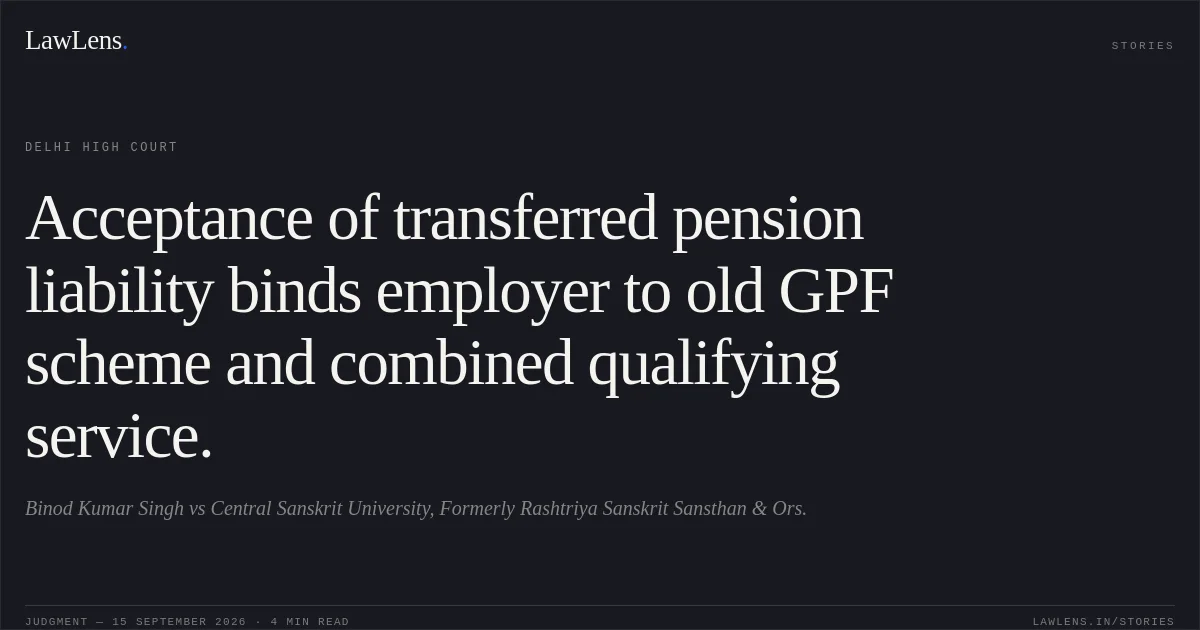
Binod Kumar SinghvsCentral Sanskrit University, Formerly Rashtriya Sanskrit Sansthan & Ors.
Click to open original judgment
Original judgment, available to read, download and summarize on LawLens.in