Facts
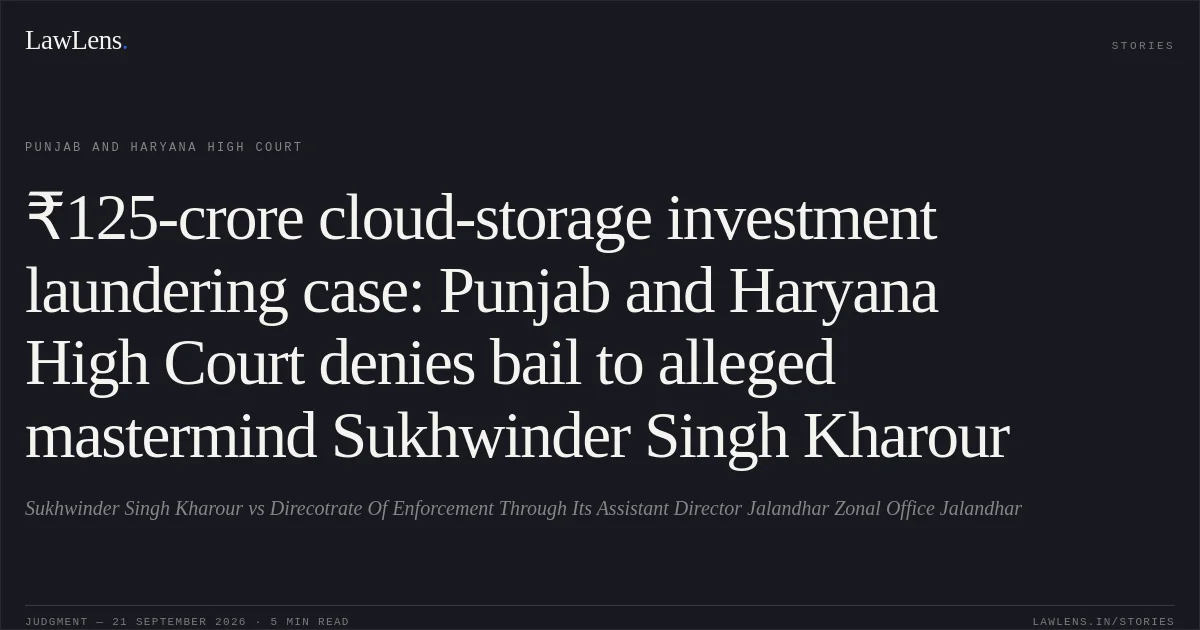
The petitioner sought regular bail in Complaint Case No. COMA 2 of 2025 arising from ECIR/JLZO/26/2024 dated 25 November 2024, registered by the Directorate of Enforcement under the Prevention of Money Laundering Act, 2002 (“PMLA”).
Source reference: pp. 2–3The ECIR originated from allegations concerning Vuenow Marketing Services Ltd., Vuenow Infotech Pvt. Ltd., Zebyte Infotech Pvt. Ltd., Zebyte Rental Planet Pvt. Ltd. and connected entities.
Source reference: pp. 2–3The prosecution alleged that investors were induced to purchase “cloud particles” on representations of assured returns, despite an alleged disparity between the storage capacity sold and the actual operational capacity.
Source reference: pp. 2–3It was further alleged that funds received from subsequent investors were used to pay earlier investors and were layered or diverted through affiliated entities.
Source reference: pp. 2–3The Enforcement Directorate attributed a central role to the petitioner, alleging that he founded the “mycloudparticle” project, controlled the Vuenow Group, participated in investor presentations, and was involved in the generation, concealment, layering, diversion and use of proceeds of crime.
Source reference: pp. 7–11The ED relied upon financial records, statements recorded under Section 50 of the PMLA, alleged use of fake invoices, corporate records and transactions involving the petitioner and the connected entities.
Source reference: pp. 7–11The petitioner had been arrested on 28 February 2025. The prosecution complaint was filed on 24 April 2025, and the petitioner had remained in custody for approximately one year and seven months by the date of decision.
Source reference: pp. 4–7He argued that the evidence was substantially documentary, custodial interrogation was no longer required, the trial would take considerable time, and a co-accused, Dimple Kharour, had been granted bail.
Source reference: pp. 4–7The ED opposed bail, relying on the gravity of the alleged economic offence, the petitioner’s alleged principal role, the financial trail and the statutory restrictions under Section 45 of the PMLA.
Source reference: pp. 7–18Issues
Whether the petitioner was entitled to regular bail under Section 45 of the PMLA in view of the material allegedly showing his active and central role in laundering the proceeds of crime?
Source reference: pp. 18–24Whether the petitioner’s period of custody, filing of the prosecution complaint and the likely delay in conclusion of trial justified release on bail on the ground of Article 21 and the right to speedy trial?
Source reference: pp. 4–7, 23–24Whether the petitioner was entitled to parity with co-accused Dimple Kharour, who had been granted regular bail?
Source reference: p. 25Whether the alleged non-compliance with the safeguards under Section 19 of the PMLA affected the petitioner’s entitlement to regular bail?
Source reference: pp. 6–7Law Applied
The Court applied Sections 3 and 4 of the PMLA, under which involvement in processes connected with proceeds of crime, including concealment, possession, acquisition, use or projection of such proceeds as untainted property, constitutes money-laundering punishable under Section 4.
Source reference: pp. 10–11Section 45 of the PMLA imposes the twin conditions for bail: the Court must have reasonable grounds for believing that the accused is not guilty of the alleged offence and is unlikely to commit any offence while on bail.
Source reference: pp. 18–19The Court also applied the general principles governing regular bail, including the nature and gravity of the accusation, the accused’s specific role, the quality of the material collected, the possibility of absconding or tampering with evidence, the stage of trial, the period of custody and the likelihood of a prolonged pre-trial detention.
Source reference: pp. 19–21In economic-offence cases, allegations involving a structured scheme, multiple entities, numerous investors, substantial financial transactions and a specific documentary and financial nexus require heightened scrutiny at the bail stage.
Source reference: pp. 20–22Parity is not automatic; the role attributed to each accused, the nature of the material against them and the circumstances in which the co-accused obtained bail must be separately examined.
Source reference: p. 25Reasoning
The Court found that the prosecution material did not constitute a vague or omnibus allegation against the petitioner.
Source reference: pp. 22–23Prima facie, it attributed to him a central role in the formulation and implementation of the cloud-particle investment model, mobilisation of investments and movement and utilisation of funds through connected entities.
Source reference: pp. 22–23The alleged mismatch between the cloud-storage capacity sold to investors and the actual operational capacity, together with statements indicating that payments to earlier investors were made from later investments, supported the prosecution’s case that the matter involved a structured financial arrangement rather than a mere commercial dispute.
Source reference: p. 22The financial records, corporate documents, statements and alleged transactions were considered sufficient, at the bail stage, to establish a prima facie nexus between the petitioner and the alleged proceeds of crime.
Source reference: pp. 22–23Although the prosecution complaint had been filed and the petitioner had undergone substantial custody, the Court held that these factors, by themselves, did not satisfy the twin conditions under Section 45.
Source reference: pp. 23–24The complaint cited 52 prosecution witnesses, many material witnesses had not yet been examined, and the trial had not progressed to a stage warranting release solely on the ground of incarceration.
Source reference: pp. 23–24The Court declined to determine conclusively the evidentiary value of the statements and financial records, holding that those matters were for trial.
Source reference: pp. 23–24It further held that the petitioner could not claim parity with Dimple Kharour because the co-accused was a woman and the role and material attributed to her were distinguishable; the grant of bail to one accused did not automatically establish parity for another.
Source reference: p. 25Holding
The Court held that the petitioner failed to demonstrate reasonable grounds for believing that he was not guilty of the alleged money-laundering offence and therefore did not satisfy the statutory requirements of Section 45 of the PMLA.
His prolonged custody, filing of the prosecution complaint, alleged speedy-trial violation and claim of parity did not justify bail in the circumstances of the case.
Source reference: pp. 23–25The regular bail petition was accordingly dismissed for the present.
Source reference: p. 25The Court clarified that its observations would not affect the merits of the trial, and directed the trial court to proceed in accordance with law without being influenced by the observations in the bail order.
Source reference: p. 25Pending applications, if any, were also disposed of.
Source reference: p. 25Acts & Sections Cited
10 provisions across 3 statutes referred to in this judgment. Each provision opens on LawLens.
Prevention of Money-Laundering Act, 20026
Bharatiya Nyaya Sanhita, 20233
Bharatiya Nagarik Suraksha Sanhita, 20231
Original Court PDF
Sukhwinder Singh KharourvsDirecotrate Of Enforcement Through Its Assistant Director Jalandhar Zonal Office Jalandhar
Click to open original judgment
Original judgment, available to read, download and summarize on LawLens.in