Facts
The plaintiff instituted a suit for injunction and damages for alleged defamation arising from social-media posts allegedly made by Defendant Nos. 1 and 2.
Source reference: paras. 2–4; pp. 1–2The defendants pleaded that the posts were true and constituted fair comment, relying principally on a Case Panel Report constituted by the Governing Body Commission of ISKCON, which had been filed with their written statement.
Source reference: paras. 2–4; pp. 1–2The plaintiff denied the Panel Report and asserted in his affidavit of admission/denial and replication that it was not an official ISKCON report and that the website on which it appeared was not an official ISKCON website.
Source reference: para. 5; p. 2Thereafter, Defendant Nos. 1 and 2 filed additional documents to establish the provenance and official character of the Panel Report and the website.
Source reference: paras. 6–9; pp. 2–5The plaintiff declined to include those documents in the Joint Document Schedule without leave under Order VIII Rule 1-A(3) CPC.
Source reference: paras. 6–9; pp. 2–5The defendants consequently sought leave to place the additional documents on record, contending that the need for them arose only after the plaintiff challenged the official status of the report and website.
Source reference: paras. 10–11; p. 5The plaintiff opposed the application as belated, arguing that the documents pre-dated the suit and were within the defendants’ knowledge and possession when the written statement was filed.
Source reference: paras. 12–14; pp. 5–6Issues
Whether Defendant Nos. 1 and 2 had shown sufficient cause for leave under Order VIII Rule 1-A(3) CPC to place additional documents on record after filing their written statement?
Source reference: paras. 15–22; pp. 6–8Whether permitting the additional documents would cause prejudice to the plaintiff or improperly expand the scope of the controversy?
Source reference: paras. 23–24; p. 8Law Applied
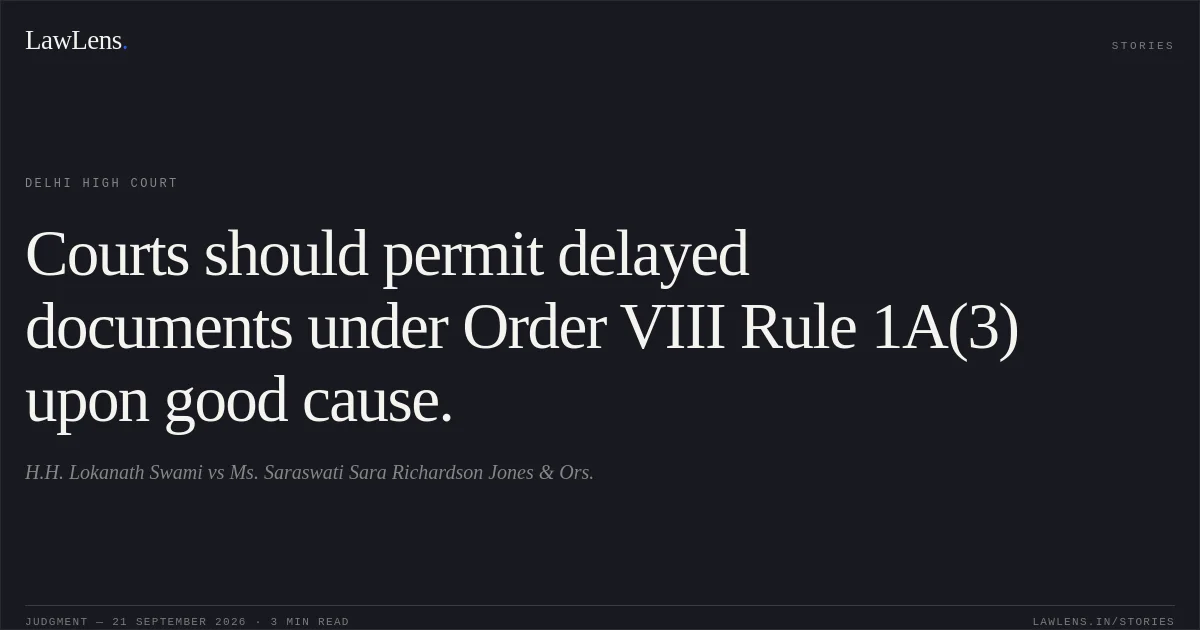
Order VIII Rule 1-A CPC requires a defendant to list and produce documents forming the basis of, or relied upon in support of, the defence along with the written statement; however, sub-rule (3) permits such documents to be received with the leave of the Court.
Source reference: para. 15; p. 6In Sugandhi v. P. Raj Kumar, (2020) 10 SCC 706, the Supreme Court held that leave under the provision should be granted judiciously where good cause is shown, and that procedural requirements should not defeat substantial justice where no serious prejudice is caused.
Source reference: para. 16; pp. 6–7In Levaku Pedda Redamma v. Gottumukkala Venkata Subbamma, SLP (C) No. 7452/2022, decided on 17 May 2022, the Supreme Court held that even delayed production should ordinarily be permitted where relevant, with costs if necessary, rather than being rejected outright.
Source reference: para. 17; p. 7However, Naresh Arneja v. Atul Gupta, CM (M) 965/2022, clarified that such procedural leniency presupposes a brief explanation for the earlier non-production and an explanation of the documents’ relevance.
Source reference: para. 18; p. 7Reasoning
The Court held that the defendants had shown good cause.
Source reference: paras. 19–20; pp. 7–8Their defence was founded principally on the Panel Report, which had already been filed with the written statement; the additional documents did not introduce a new defence but were intended to corroborate the report’s provenance, its connection with ISKCON’s Governing Body, and the official character of the relevant website.
Source reference: paras. 19–20; pp. 7–8The Court found that the necessity for those documents arose after the plaintiff specifically denied the report’s official status and put the defendants to strict proof.
Source reference: para. 21; p. 8The fact that the documents pre-dated the suit was not considered determinative because the defendants had provided an explanation for their earlier non-production and the documents were relevant to the controversy.
Source reference: para. 22; p. 8No concrete prejudice was established: issues had not yet been framed, and the plaintiff would have opportunities to file an affidavit of admission/denial, produce rebuttal documents, and challenge the material through cross-examination.
Source reference: paras. 23–24; p. 8Holding
The Court answered both issues in favour of Defendant Nos. 1 and 2.
It allowed I.A. No. 12129/2026 and permitted the additional documents to be taken on record under Order VIII Rule 1-A(3) CPC.
Source reference: paras. 25–26; p. 8The Court expressly clarified that it had not ruled on the genuineness, authenticity, admissibility, mode of proof, or evidentiary value of the documents, and reserved all corresponding rights and contentions of the plaintiff.
Source reference: paras. 27–28; p. 9The matter was directed to be listed before the Joint Registrar (Judicial) on 8 January 2027.
Source reference: para. 30; p. 9Acts & Sections Cited
1 provisions across 1 statute referred to in this judgment. Each provision opens on LawLens.
Code of Civil Procedure, 19081
Original Court PDF
H.H. Lokanath SwamivsMs. Saraswati Sara Richardson Jones & Ors.
Click to open original judgment
Original judgment, available to read, download and summarize on LawLens.in