Facts
The petitioners challenged the Collector’s order dated 26.05.2025, by which the grant-in-aid to the educational institution in which they were employed was stopped. They sought quashing of the order, restoration of the grant, payment of salary from June 2025, and, alternatively, merger or transfer of their services to a nearby government institution.
Source reference: p.1; para. 1The petitioners contended that the controversy had already been decided in their favour in Munnalal and Others v. State of M.P. and Others, W.P. No. 5963 of 2026, decided on 16.09.2026. The State was unable to distinguish the facts of the present case from Munnalal.
Source reference: p.1; paras. 2–4In Munnalal, the Court had held that stoppage of grant-in-aid on the ground that other schools existed nearby, without a proper notice and hearing on a legally relevant violation, was unsustainable; the Collector’s order was quashed and the matter remanded for fresh consideration.
Source reference: pp. 2–6; paras. 14–21Issues
1. Whether the Collector’s order dated 26.05.2025 stopping grant-in-aid to the petitioners’ institution was liable to be quashed on the same grounds as in Munnalal.
Source reference: p.1; paras. 2–62. Whether the petitioners were entitled to payment of salary for the period during which they had actually worked after stoppage of the grant.
Source reference: p.7; para. 73. Whether the matter was required to be remitted to the Collector for fresh consideration after granting the institution a proper opportunity of hearing.
Source reference: pp. 5–6; para. 6Law Applied
The Court applied Article 226 of the Constitution, empowering the High Court to quash administrative orders affected by jurisdictional error, illegality, or violation of natural justice.
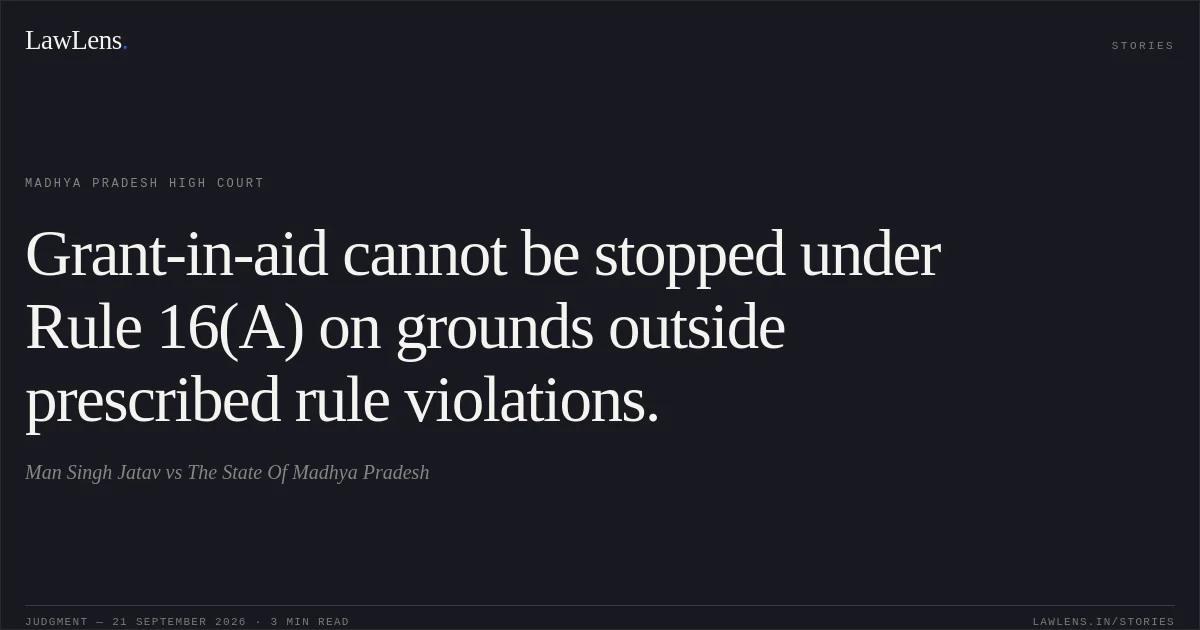
Source reference: pp. 5–6; paras. 19–20It relied on Rule 16(A) of the Madhya Pradesh Grant-in-Aid Rules, 1985, under which grant-in-aid may be stopped, reduced, or recovered only where an institution fails to remedy an irregularity or violation of the prescribed rules after receiving an appropriate notice and opportunity.
Source reference: p.5; para. 16The Court further applied the audi alteram partem principle, holding that a proper notice and meaningful opportunity of hearing must precede an adverse decision affecting grant-in-aid and the employees dependent upon it.
Source reference: pp. 2–6; paras. 17–20The decision was governed by the binding factual and legal reasoning in Munnalal and Others v. State of M.P. and Others, which directed quashing of the order and remand for fresh consideration.
Source reference: p.1; paras. 2–6Reasoning
The Court found that the State could not distinguish the present case from Munnalal and therefore adopted that decision mutatis mutandis.
Source reference: p.1; paras. 2–6In Munnalal, the Collector had relied on the existence of other schools in the vicinity, although such circumstance did not, by itself, constitute a violation of the Grant-in-Aid Rules contemplated by Rule 16(A). Further, the relevant notice did not clearly identify a rule violation or provide a proper opportunity to respond.
Source reference: pp. 5–6; paras. 17–20Since the same controversy was involved here, the Court considered the impugned action unsustainable and directed that the matter be dealt with in accordance with the procedure prescribed in Munnalal.
Source reference: pp. 5–6; paras. 20–21The Court separately protected the petitioners’ accrued salary entitlement by directing payment for any period during which they had actually worked.
Source reference: p.7; para. 7Holding
The petition was disposed of on the same terms and conditions as Munnalal, applicable mutatis mutandis.
Accordingly, the Collector’s order dated 26.05.2025 was liable to be quashed, and the matter was to be remitted for issuance of a proper notice to the concerned institution, submission of its response and documents, and a fresh decision after granting due opportunity of hearing, with the exercise to be completed within two months of receipt of the certified order.
Source reference: pp. 5–6; paras. 20–21The respondents were further directed to pay the petitioners’ salary if they had actually worked during the relevant period.
Source reference: p.7; para. 7Any pending interlocutory application was also disposed of.
Source reference: p.7; para. 8Original Court PDF
Man Singh JatavvsThe State Of Madhya Pradesh
Click to open original judgment
Original judgment, available to read, download and summarize on LawLens.in