Facts
On 2 March 1997, Harekrushna Parida and Prafulla Parida, who operated a grocery shop near Rajghat, were allegedly attacked by the petitioners with a sword and bhujali while closing their shop.
Source reference: p.2–3Both victims sustained cut injuries, including grievous injuries. An FIR was lodged by Pranakrushna Parida, and the petitioners were charge-sheeted under Sections 307/34 IPC.
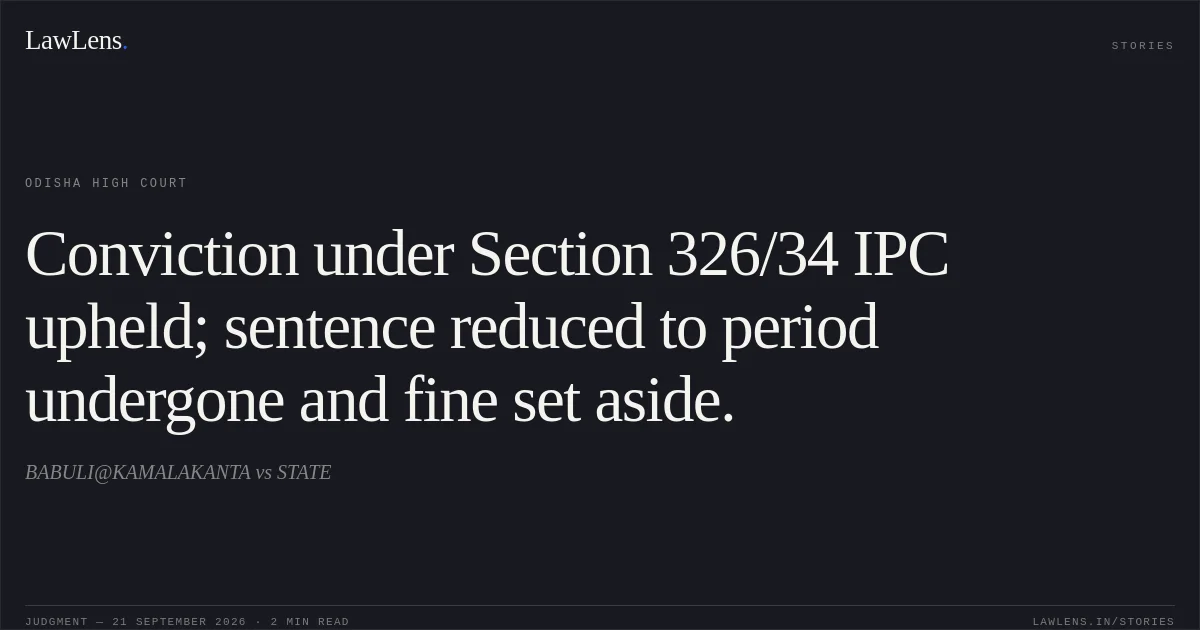
Source reference: p.2–3The Trial Court acquitted the petitioners of the charge under Section 307 IPC but convicted them under Sections 326/34 IPC and sentenced each to three years’ rigorous imprisonment with a fine of Rs.10,000, payable equally to the injured persons under Section 357 Cr.P.C.
Source reference: p.3–4The appellate court affirmed the conviction and sentence. The petitioners challenged both decisions in revision under Section 401 Cr.P.C.
Source reference: p.1, p.4Issues
Whether the concurrent findings of conviction under Sections 326/34 IPC were perverse or otherwise liable to interference in revisional jurisdiction under Section 401 Cr.P.C.?
Source reference: p.4–5, para. 7Whether, having regard to the petitioners’ age, time elapsed since the occurrence, period of incarceration, and absence of criminal proclivity, the sentence should be modified?
Source reference: p.5–6, paras. 9–11-ALaw Applied
The Court applied Sections 326 and 34 IPC, concerning voluntarily causing grievous hurt by dangerous weapons with common intention, and Section 401 Cr.P.C., governing the High Court’s revisional jurisdiction.
Source reference: p.1–4It also considered Section 307 IPC, under which the petitioners had originally been charged but acquitted by the Trial Court, and Section 357 Cr.P.C., relating to compensation from fine to victims.
Source reference: p.1–4On the scope of revisional interference with concurrent findings, the Court relied on Amit Kapoor v. Ramesh Chander, (2012) 9 SCC 460, applying the principle that interference is warranted where the appreciation of evidence is perverse or suffers from a serious legal or factual infirmity.
Source reference: p.5, para. 7Reasoning
The Court found no perversity in the concurrent appreciation of evidence by the Trial Court and the appellate court.
Source reference: p.4–5, paras. 5–8The evidence of the two injured witnesses, read with the medical evidence of the doctor, supported the finding that the petitioners had caused grievous injuries using dangerous weapons.
Source reference: p.4–5, paras. 5–8The defence contention regarding suppression of the genesis of the occurrence and the defence injury report did not demonstrate a sufficient infirmity warranting revisional interference.
Source reference: p.4–5, paras. 5–8On sentence, however, the Court considered that the occurrence was from 1997, the petitioners had already undergone some incarceration, were approximately 59 and 62 years old, and had no criminal proclivity apart from the present case.
Source reference: p.5–6, paras. 9–11In these circumstances, the Court exercised leniency and held that the ends of justice would be met by reducing the sentence to the period already undergone.
Source reference: p.5–6, paras. 9–11It further set aside the fine in view of the peculiar facts of the case.
Source reference: p.6, para. 11-AHolding
The revision was partly allowed.
The conviction of the petitioners under Sections 326/34 IPC was upheld, as the concurrent findings were not perverse and did not warrant interference under Section 401 Cr.P.C.
Source reference: p.5, paras. 7–8However, the substantive sentence was altered to the period already undergone, and the fine of Rs.10,000 imposed on each petitioner was set aside.
Source reference: p.6, paras. 11–12The criminal revision was accordingly disposed of.
Source reference: no citationActs & Sections Cited
5 provisions across 2 statutes referred to in this judgment. Each provision opens on LawLens.
Code of Criminal Procedure, 19732
Indian Penal Code, 18603
Original Court PDF
BABULI@KAMALAKANTAvsSTATE
Click to open original judgment
Original judgment, available to read, download and summarize on LawLens.in