Facts
On 13 June 1990, Ghasiram Mahto and his brother Kandru Mahto were fencing a Bari when Laxmikant Das, Amulya Kumar Das and Gyani Das allegedly arrived armed with a gun, bow and arrow, and tangi, respectively.
Source reference: pp. 2–3After an objection to the fencing, Amulya allegedly shot an arrow and Laxmikant allegedly fired three bullets, injuring Ghasiram, Kandru and Ranjeet Mahto.
Source reference: pp. 2–3A counter-case was also lodged by Laxmikant, alleging that the informant party had formed an unlawful assembly, cut trees and attacked the accused, compelling Amulya to fire in self-defence.
Source reference: pp. 6–8The prosecution examined eleven witnesses, including the injured witnesses, but the Investigating Officer was not examined.
Source reference: p. 5The injury report was unavailable, the doctor could not depose about the injuries, no ballistic report was produced, and only one empty cartridge was seized from Amulya’s house.
Source reference: pp. 9–10The trial court convicted Laxmikant under Sections 307 IPC and 27 of the Arms Act and sentenced him to seven years’ rigorous imprisonment under Section 307 IPC and three years under Section 27 of the Arms Act.
Source reference: pp. 1–3The other two accused were convicted under Sections 307/34 IPC.
Source reference: pp. 1–3During the appeal, Amulya and Gyani died, and the appeal abated against them.
Source reference: pp. 1–3Issues
1. Whether the prosecution proved beyond reasonable doubt that Laxmikant Das had fired the gunshot with the intention or knowledge required for conviction under Section 307 IPC.
Source reference: pp. 4–5, 13–142. Whether the evidence established that Laxmikant Das used the firearm so as to attract criminal liability under Section 27 of the Arms Act.
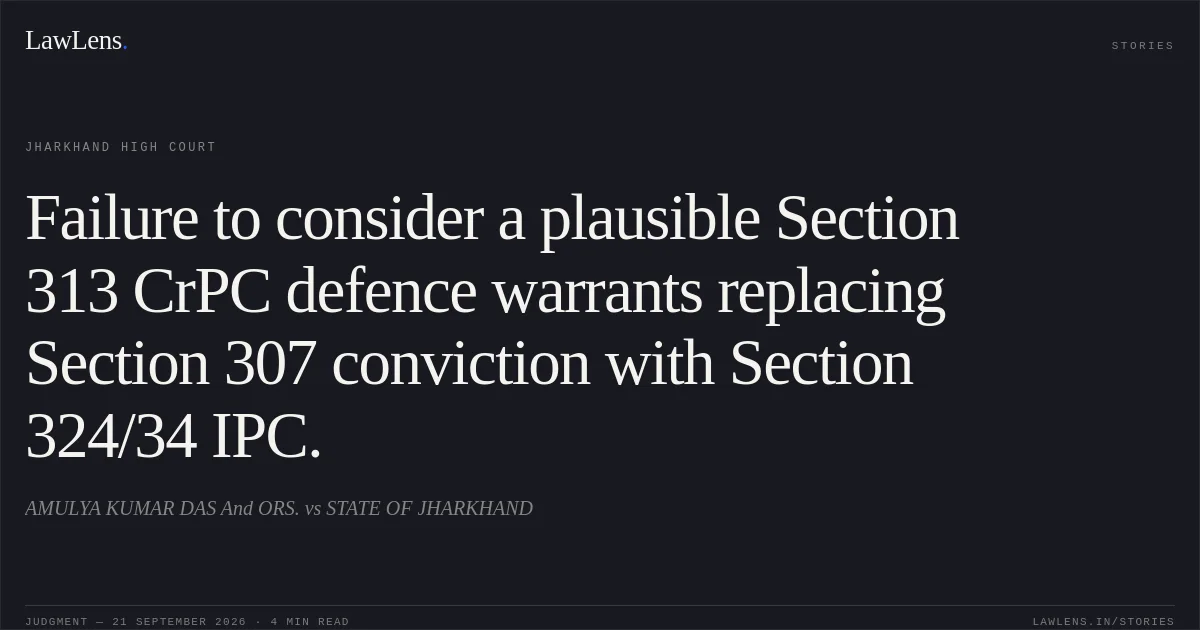
Source reference: pp. 10–11, 143. Whether, notwithstanding the failure to establish the ingredients of Section 307 IPC, the evidence and the accused’s statement under Section 313 Cr.P.C. established an offence under Section 324/34 IPC.
Source reference: pp. 11–144. Whether the trial court had adequately considered the defence version, including the plea of firing in self-defence, under Section 313 Cr.P.C.
Source reference: pp. 11–13Law Applied
The Court applied Section 307 IPC, under which conviction requires an intention or knowledge to cause death accompanied by an overt act, although the infliction of a potentially fatal injury is not essential; such intention may be inferred from the weapon, manner of assault, injuries and surrounding circumstances, as explained in State of M.P. v. Saleem, (2005) 5 SCC 554.
Source reference: pp. 4–5The Court also considered Section 324/34 IPC concerning voluntarily causing hurt by dangerous weapons with common intention, and Section 27 of the Arms Act concerning use of a firearm in contravention of the statutory requirements.
Source reference: pp. 13–14Under Section 313 Cr.P.C., the accused has a valuable statutory and constitutional right to explain incriminating circumstances, and the court must consider and either accept or reject the defence with reasons, in accordance with Reena Hazarika v. State of Assam, (2019) 13 SCC 289.
Source reference: pp. 11–12Criminal conviction must otherwise rest on evidence establishing guilt beyond reasonable doubt.
Source reference: no citationReasoning
Although the injured witnesses attributed the firing to Laxmikant, the Court found material gaps in the prosecution case: the injury report was absent, the doctor could not establish the nature of the injuries, the Investigating Officer was not examined, no ballistic evidence linked the seized gun to the occurrence, and only one empty cartridge was recovered despite the allegation of three shots.
Source reference: pp. 9–10, 13The Court further relied on the admitted existence of a counter-case and Amulya’s statement under Section 313 Cr.P.C. that he had fired into the air in self-defence.
Source reference: pp. 11–14Since the gun licence was stated to be in Amulya’s name and the evidence did not reliably establish that Laxmikant was the shooter, the Court extended the benefit of doubt to him on the charge under Section 27 of the Arms Act.
Source reference: pp. 11–14The Court also held that the trial court had failed to properly consider the defence version under Section 313 Cr.P.C.
Source reference: pp. 12–13It concluded that the requisite intention or knowledge for Section 307 IPC could not be safely inferred.
Source reference: pp. 13–14Nevertheless, considering the admitted occurrence of firing and the resulting pellet injuries, the Court held that the ingredients of Section 324/34 IPC were made out, while modifying the conviction from Section 307 IPC to Section 324/34 IPC.
Source reference: pp. 13–14Holding
The appeal was partly allowed.
Laxmikant Das was acquitted of the charge under Section 27 of the Arms Act and was not held liable under Section 307 IPC.
Source reference: pp. 13–15His conviction was modified to one under Section 324/34 IPC.
Source reference: pp. 13–15As he had already undergone five months and fifteen days in custody, and the incident dated back to 1990 with the appellant having faced litigation for over two decades, the sentence was reduced to the period already undergone, against the maximum statutory punishment of three years under Section 324 IPC.
Source reference: p. 14Since he was already on bail, he was discharged from the liability of his bail bonds; the trial court record was directed to be returned, and any pending interlocutory application was disposed of.
Source reference: p. 15Acts & Sections Cited
6 provisions across 3 statutes referred to in this judgment. Each provision opens on LawLens.
Indian Penal Code, 18603
Arms Act, 19591
Code of Criminal Procedure, 19732
Original Court PDF
AMULYA KUMAR DAS And ORS.vsSTATE OF JHARKHAND
Click to open original judgment
Original judgment, available to read, download and summarize on LawLens.in