Facts
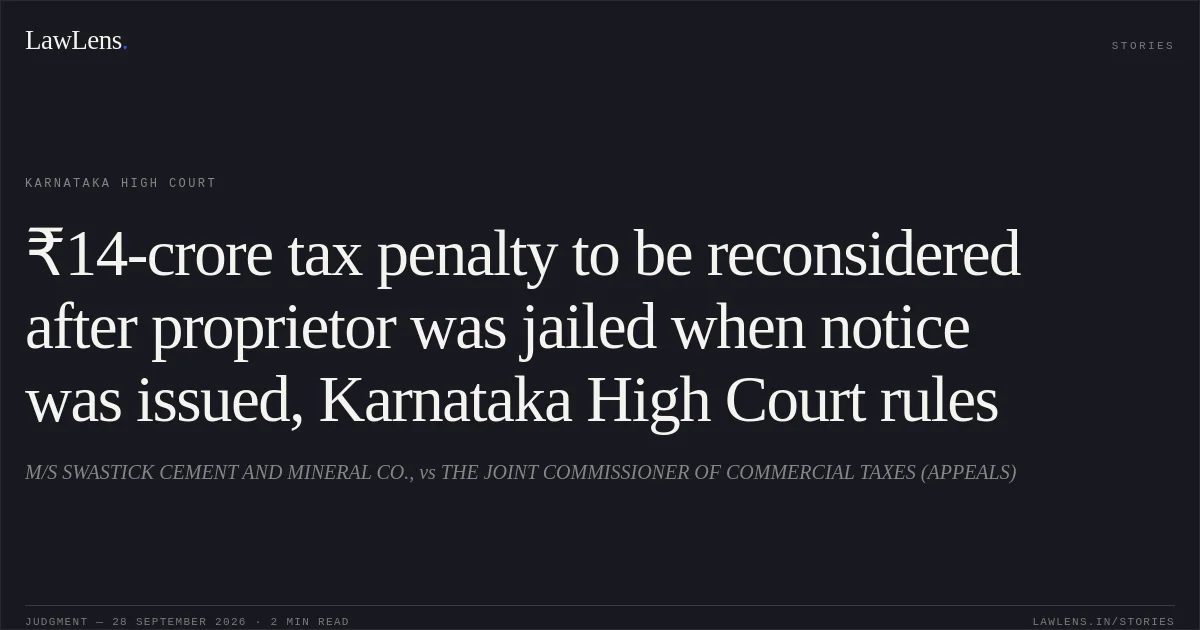
The appellant, a dealer registered under the Karnataka Value Added Tax Act, 2003 (KVAT Act) and the Central Sales Tax Act, 1956 (CST Act), was in custody from 14 March 2013 until 17 October 2015.
Source reference: pp. 3–4, 10–11While he was in custody, the Deputy Commissioner issued a show-cause notice dated 5 April 2014 proposing reassessment for 2006–07 on the basis of alleged suppressed inter-State sales. The appellant did not reply, and the proceedings resulted in a substantial tax demand and penalty.
Source reference: pp. 7–10, 15–16The appellant’s appeal against the assessment was dismissed by the Joint Commissioner on 28 July 2018; his rectification application under Section 69(3) of the KVAT Act read with Section 9(2) of the CST Act was also rejected.
Source reference: pp. 11–13The appellant’s writ petition challenging the relevant orders was dismissed because an appeal was available before the Karnataka Appellate Tribunal under Section 63 of the KVAT Act. He appealed that dismissal.
Source reference: pp. 12–14Issues
Whether the High Court should entertain the writ appeal despite the alternative statutory remedy under Section 63 of the KVAT Act, where the assessment was allegedly made in breach of natural justice.
Source reference: pp. 14–16Whether the appellant’s inability to respond to the show-cause notice while in custody warranted setting aside the Single Judge’s order and remitting the assessment proceedings for a fresh hearing.
Source reference: pp. 15–17Law Applied
Section 63 of the KVAT Act provides a statutory appellate remedy before the Karnataka Appellate Tribunal, but the availability of an alternative remedy does not absolutely bar a writ petition under Article 226 of the Constitution.
Source reference: pp. 14–15Relying on Assistant Commissioner of State Tax v. Commercial Steel Ltd., (2022) 16 SCC 447, the Court noted that writ jurisdiction may be exercised in exceptional cases, including where there is a violation of the principles of natural justice.
Source reference: pp. 14–15The relevant proceedings arose under Section 9(2) of the CST Act, while the appellant’s rectification application was made under Section 69(3) of the KVAT Act.
Source reference: pp. 4, 11Reasoning
The Court found that the show-cause notice was issued while the appellant was in prison and that he did not submit a reply before the assessment order was made. The respondents admitted his custody during the relevant period, and the detention certificate supported that fact.
Source reference: pp. 10–11, 15–16Because the appellant had no opportunity to answer the proposed assessment before a substantial demand was imposed, the Court held that the proceedings involved a demonstrable breach of natural justice. That breach justified entertaining the appeal notwithstanding the alternative statutory remedy.
Source reference: pp. 15–16Holding
The Court allowed the writ appeal and set aside the Single Judge’s order dismissing the writ petition.
It remitted the matter to the Deputy Commissioner of Commercial Taxes (Audit) 6.2, Bangalore, from the stage of the appellant’s reply to the show-cause notice. The appellant was directed to submit his reply within four weeks of receiving the order, after which the Deputy Commissioner was to proceed in accordance with law; all contentions were left open.
Source reference: pp. 16–17Acts & Sections Cited
12 provisions across 5 statutes referred to in this judgment. Each provision opens on LawLens.
KARNATAKA HIGH COURT ACT, 19611
Central Sales Tax Act, 19561
Indian Penal Code, 18606
Prevention of Corruption Act, 19881
Mines and Minerals (Development and Regulation) Act, 19573
Original Court PDF
M/S SWASTICK CEMENT AND MINERAL CO.,vsTHE JOINT COMMISSIONER OF COMMERCIAL TAXES (APPEALS)
Click to open original judgment
Original judgment, available to read, download and summarize on LawLens.in