Facts
The respondents had sought fixation of pay in the scale of Rs. 3,050–4,590, relying on an order dated 17 March 2003. The High Court allowed their writ petition by order dated 13 November 2025.
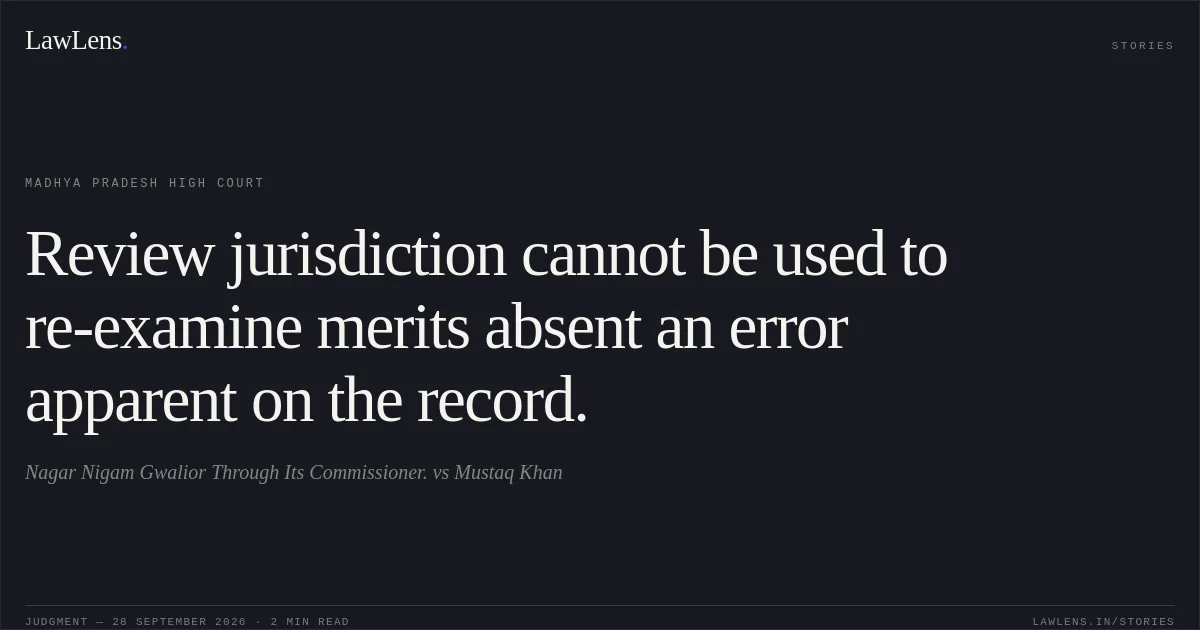
Source reference: para. 2Nagar Nigam Gwalior sought review, relying on an order dated 7 June 2003—which it said it had subsequently discovered—placing appointment and promotion orders issued between 7 February 2002 and 7 June 2003 in abeyance and constituting a committee to examine the matter. The review petitioner argued that this document affected the respondents’ claim; the respondents opposed review on the ground that it sought a rehearing on the merits. The Court condoned the delay in filing the review petition.
Source reference: paras. 2–5Issues
1. Whether the subsequently discovered order dated 7 June 2003 provided a ground to review the order dated 13 November 2025.
Source reference: paras. 4–72. Whether the review petitioner established an error apparent on the face of the record warranting review.
Source reference: paras. 7, 15–16Law Applied
Section 114 CPC and Order XLVII Rule 1 CPC permit review on discovery of new and important matter or evidence that, despite due diligence, was not within the applicant’s knowledge or could not previously be produced; an error apparent on the face of the record; or another sufficient reason.
Source reference: paras. 8–14Under Kamlesh Verma v. Mayawati, (2013) 8 SCC 320, and State of West Bengal v. Kamal Sengupta, (2008) 8 SCC 612, review is not an appeal or a rehearing, and an apparent error must be prima facie visible without detailed examination. Col. Avatar Singh Sekhon v. Union of India, 1980 Supp SCC 562, and Parsion Devi v. Sumitri Devi, (1997) 8 SCC 715, further establish that review is confined to patent or manifest error; an error requiring reasoning to detect does not ordinarily qualify.
Source reference: paras. 8–14Reasoning
The Court treated the petitioner’s reliance on the 7 June 2003 order as requiring reconsideration of the earlier decision and the merits of the respondents’ claim. That would amount to re-examination rather than correction of a patent error.
Source reference: paras. 7, 15–16The petitioner therefore had not shown an error apparent on the face of the record or otherwise established a basis for interference within the limited review jurisdiction.
Source reference: paras. 15–16Holding
The Court answered the review issues against the petitioner and dismissed the review petition as devoid of merit.
The delay in filing had been condoned, but no review relief was granted.
Source reference: paras. 2, 17Acts & Sections Cited
2 provisions across 2 statutes referred to in this judgment. Each provision opens on LawLens.
Limitation Act, 19631
Code of Civil Procedure, 19081
Original Court PDF
Nagar Nigam Gwalior Through Its Commissioner.vsMustaq Khan
Click to open original judgment
Original judgment, available to read, download and summarize on LawLens.in