Facts
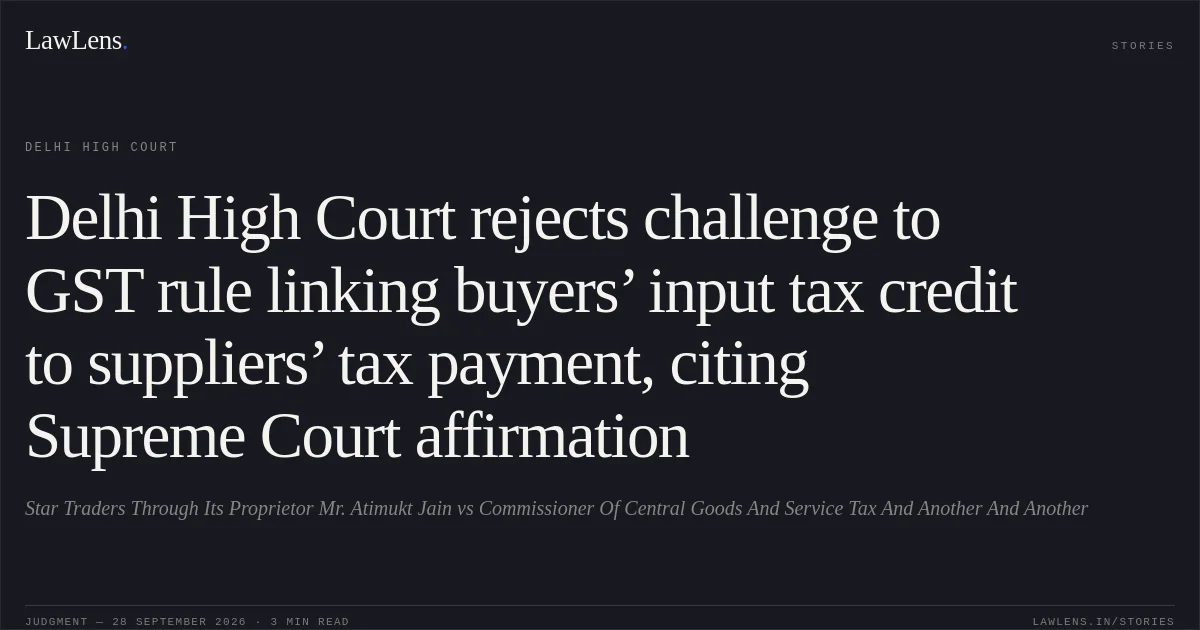
Following an investigation and search of the petitioner’s premises, during which ₹11,00,000 was seized, the GST authorities issued a show-cause notice under Section 74 alleging wrongful availment of ITC of ₹3,53,40,345 and passing on of ITC of ₹3,24,67,297 through invoices unsupported by actual supplies.
Source reference: pp. 2–4, paras. 2–8The adjudicating authority confirmed the demand ex parte.
Source reference: pp. 2–4, paras. 2–8The petitioner challenged the show-cause notice and order-in-original, arguing that parallel proceedings were barred by Section 6(2)(b) of the CGST Act, that it was denied natural justice, and that Section 16(2)(c) was unconstitutional.
Source reference: pp. 2–4, paras. 2–8It acknowledged an alternative statutory appeal was available.
Source reference: pp. 2–4, paras. 2–8Issues
1. Whether the proceedings and order-in-original were barred by Section 6(2)(b) of the CGST Act because another GST proceeding concerned the same subject matter.
Source reference: pp. 3–5, paras. 7–132. Whether the petitioner was denied natural justice in the adjudication proceedings.
Source reference: p. 5, para. 143. Whether Section 16(2)(c) of the CGST Act was unconstitutional.
Source reference: pp. 3, 6, paras. 8, 154. Whether the writ petition should be entertained despite the available statutory appellate remedy.
Source reference: pp. 3, 6, paras. 6, 16–19Law Applied
Section 6(2)(b) of the CGST Act bars proceedings by a proper officer under the central enactment only where a State GST proper officer has already initiated proceedings and the subject matter of both proceedings is the same; both conditions must be met.
Source reference: p. 4, para. 9A party that has been afforded repeated opportunities to respond and appear cannot establish a denial of natural justice merely by failing to avail them.
Source reference: p. 5, para. 14In considering the challenge to Section 16(2)(c), the Court relied on the Gujarat High Court’s decision in Maruti Enterprise v. Union of India and the Supreme Court’s subsequent order affirming that view, which treated the provision as intra vires.
Source reference: p. 6, para. 15The Court also applied the principle that a writ petition may be declined where an efficacious statutory appeal is available, leaving the petitioner to raise its objections before the appellate authority.
Source reference: p. 6, paras. 16–19Reasoning
The Court distinguished the two proceedings: the State proceeding concerned alleged wrongful ITC availment identified through reconciliation of the petitioner’s GSTR-3B turnover, while the central proceeding arose from intelligence and the search and included allegations of issuing invoices without supply and passing on ITC.
Source reference: pp. 4–5, paras. 10–13Because the allegations, material, and nature of the defaults differed, the subject matter was not the same; the bar in Section 6(2)(b) therefore did not apply, and the Court did not need to determine which proceeding began first.
Source reference: p. 5, para. 13On natural justice, the petitioner had received multiple hearing notices and had not filed a detailed reply or attended the hearings.
Source reference: p. 5, para. 14The constitutional challenge was rejected in light of the cited Gujarat High Court and Supreme Court decisions.
Source reference: p. 6, para. 15Given the available appeal, the Court declined to examine the merits of the demand in writ jurisdiction.
Source reference: p. 6, para. 16Holding
The Court found no ground to entertain the writ petition and disposed of it, with liberty to the petitioner to appeal and raise all objections before the appellate authority.
It directed that the appeal, if filed, be decided independently and uninfluenced by the writ court’s observations.
Source reference: pp. 6–7, paras. 16–19The appellate authority was also to consider, in accordance with law, any application under Section 14 of the Limitation Act seeking exclusion of the period during which the writ petition remained pending.
Source reference: pp. 6–7, paras. 16–19Acts & Sections Cited
4 provisions across 2 statutes referred to in this judgment. Each provision opens on LawLens.
Central Goods and Services Tax Act, 20173
Limitation Act, 19631
Original Court PDF
Star Traders Through Its Proprietor Mr. Atimukt JainvsCommissioner Of Central Goods And Service Tax And Another And Another
Click to open original judgment
Original judgment, available to read, download and summarize on LawLens.in