Facts
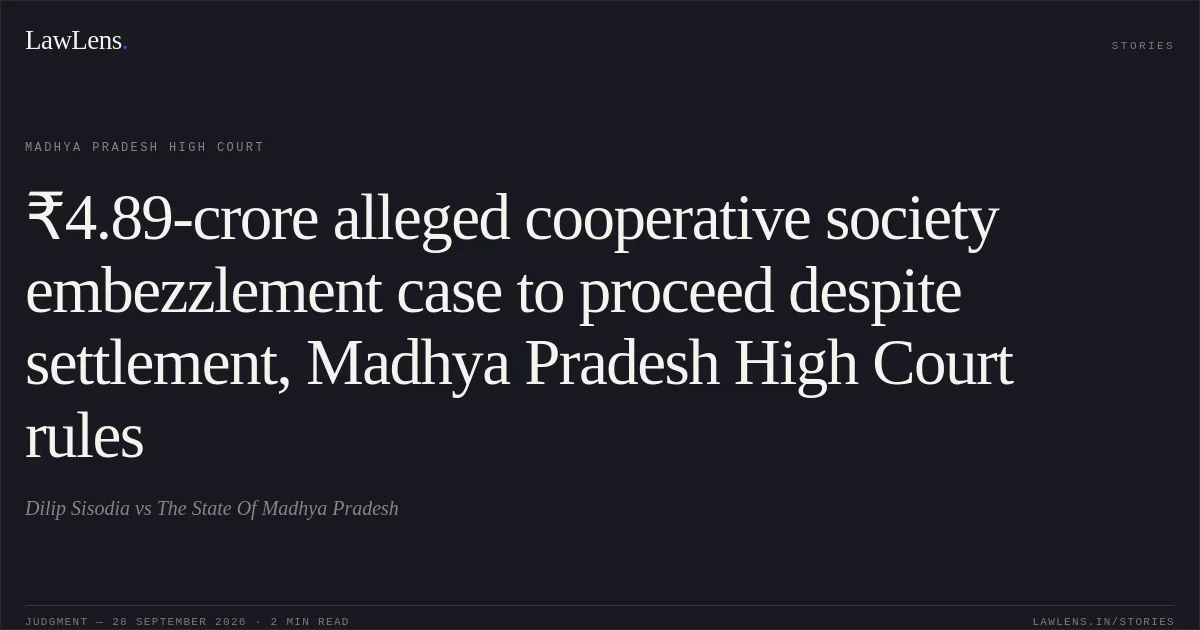
Kalpataru Grih Nirman Sahakari Sanstha Maryadit’s administrator lodged a complaint alleging that, between financial years 2018–19 and 2021–22, society properties were sold at undervalued prices and sale proceeds were diverted, including approximately ₹4.89 crore to the petitioner’s bank account.
Source reference: para. 2–4, 12The petitioner, a former chairman, was charge-sheeted for offences under Sections 409, 420, 34 and 120-B IPC; investigation against other named persons remained pending.
Source reference: para. 2–4, 12He sought quashing of the FIR and pending trial, contending that the dispute was civil in nature and that the society had settled its recovery suit with him through a compromise recorded in a National Lok Adalat. The compromise was verified before the High Court, and the society stated that it did not wish to prosecute him.
Source reference: para. 5–7The State opposed the petition.
Source reference: para. 8Issues
1. Whether the allegations and material collected during investigation met the *Bhajan Lal* principles for quashing the FIR and proceedings.
Source reference: para. 10(i)2. If not, whether the FIR and consequential proceedings could nevertheless be quashed on the basis of the parties’ compromise.
Source reference: para. 10(ii)Law Applied
The High Court considered its inherent power under Section 482 CrPC, corresponding to Section 528 BNSS, to prevent abuse of process and secure the ends of justice.
Source reference: para. 1Under *State of Haryana v. Bhajan Lal*, proceedings may be quashed in specified categories, including where the allegations and supporting material do not disclose an offence.
Source reference: para. 11*Gian Singh v. State of Punjab* distinguishes quashing on settlement from statutory compounding and permits quashing of certain non-compoundable offences with a predominantly civil character where justice so requires; serious offences affecting society are not ordinarily quashed merely because the parties settled.
Source reference: para. 15*State of Madhya Pradesh v. Laxmi Narayan* similarly limits compromise-based quashing to appropriate cases and requires consideration of the nature and societal impact of the offence.
Source reference: para. 16The Court also relied on *Ramgopal v. State of Madhya Pradesh* and *Dakshaben v. State of Gujarat* concerning serious non-compoundable offences and the limits of a complainant’s ability to withdraw prosecution.
Source reference: para. 18Section 409 IPC was identified as non-compoundable.
Source reference: para. 17Reasoning
The Court found that the allegations—diversion of substantial society funds into the petitioner’s account, alleged collusion with society office-holders, and steps said to conceal the transactions—disclosed cognizable offences and did not satisfy the relevant *Bhajan Lal* ground for quashing.
Source reference: para. 12–13It further held that the alleged embezzlement concerned members’ funds and was reported by an administrator appointed by the Sub-Registrar; it was therefore not merely a private dispute. Given the nature and alleged societal impact of the offences, the compromise concerning the society’s recovery claim did not justify quashing the criminal proceedings.
Source reference: para. 18–19Holding
The Court answered the first issue against the petitioner, holding that the FIR could not be quashed under the *Bhajan Lal* principles, and rejected compromise as a basis for quashing the proceedings.
It dismissed the petition, leaving the FIR and consequential criminal proceedings in place.
Source reference: para. 13, 19Acts & Sections Cited
10 provisions across 3 statutes referred to in this judgment. Each provision opens on LawLens.
Code of Criminal Procedure, 19735
Bharatiya Nagarik Suraksha Sanhita, 20231
Indian Penal Code, 18604
Original Court PDF
Dilip SisodiavsThe State Of Madhya Pradesh
Click to open original judgment
Original judgment, available to read, download and summarize on LawLens.in