Facts
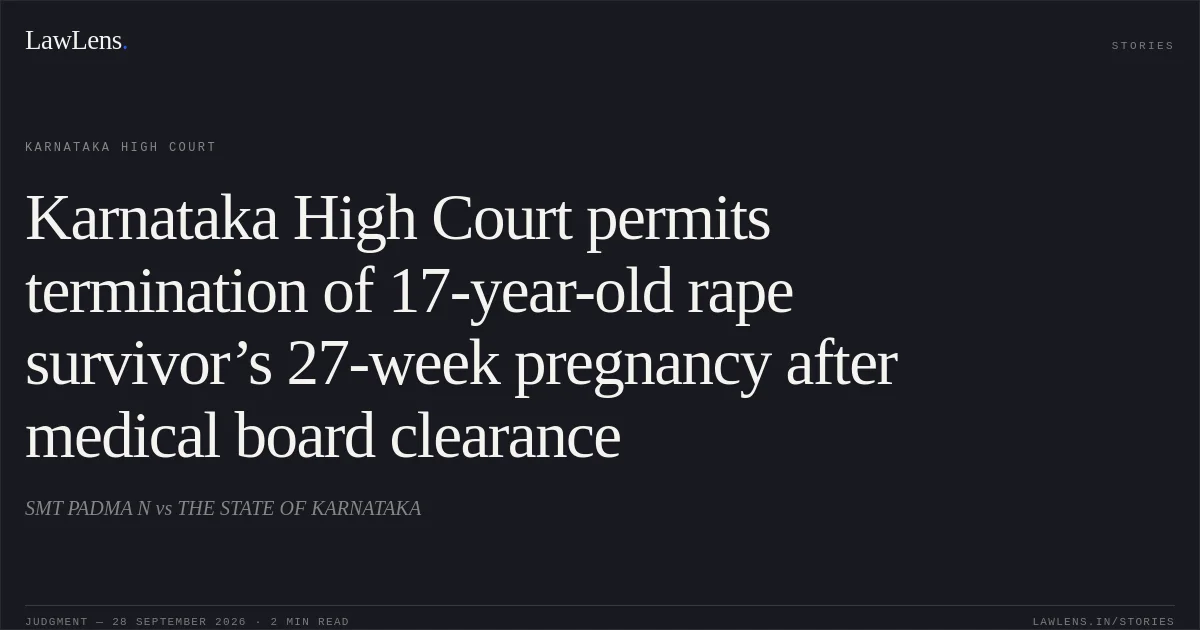
Petitioner No. 1, the mother of petitioner No. 2, a 17-year-old minor, sought medical termination of her daughter’s pregnancy. The pregnancy was discovered during a hospital examination, following which a criminal case was registered against the alleged perpetrator under the POCSO Act, 2012 and the Bharatiya Nyaya Sanhita, 2023.
Source reference: p. 3, para. 2At the time of the petition, petitioner No. 2 was in her 27th week of pregnancy. The Child Welfare Committee’s request for termination was referred to the Mother and Child Hospital, Hosapete, and the hospital sought an order of the Court because of the gestational period.
Source reference: p. 4, para. 3On 24 September 2026, the Court directed a Medical Board to examine petitioner No. 2 and report on the feasibility of termination. The Board’s report, based on specialist opinions, found her medically fit for the proposed procedure.
Source reference: p. 5, para. 5; p. 6, paras. 7–9Issues
Whether, in the circumstances—including the petitioner’s age, 27-week pregnancy, and the Medical Board’s opinion—the Court should permit medical termination of the pregnancy.
Source reference: pp. 3–4, paras. 1–4; p. 7, paras. 9–12Whether consequential directions were required to address medical contingencies, preservation and testing of the fetus, care of any child born, and the costs of treatment.
Source reference: pp. 8–10, paras. 13(ii)–(ix)Law Applied
The Court directed that the procedure be carried out in accordance with the Medical Termination of Pregnancy Rules, 1971.
Source reference: p. 8, para. 13(ii)It relied on the Supreme Court’s decision in Meera Santosh Pal v. Union of India, reported in 2017 (3) SCC 462, and two coordinate-bench decisions of the Karnataka High Court permitting termination in similar circumstances.
Source reference: p. 7, para. 11The Court’s order also contemplated compliance with the Juvenile Justice (Care and Protection of Children) Act, 2015, if a child were born.
Source reference: p. 9, para. 13(vii)The POCSO Act and BNS provisions were identified as the offences underlying the registered criminal case.
Source reference: p. 3, para. 2Reasoning
The Court considered the petitioner’s minority, her status as the victim of an alleged offence, her unwillingness to give birth, and the Medical Board’s unqualified opinion that she was medically fit for the procedure.
Source reference: pp. 7–8, paras. 9–12Applying the cited decisions permitting termination in similar circumstances, it found it appropriate to allow the petition. It preserved the Medical Board’s discretion to respond to any medical concern arising during the procedure and issued directions addressing evidentiary preservation, medical care if birth occurred, and the petitioner’s choice concerning any child born.
Source reference: pp. 8–10, para. 13(iii)–(viii)Holding
The petition was allowed.
Respondents Nos. 2 and 3 were directed to carry out the medical termination in accordance with the Medical Termination of Pregnancy Rules, 1971, subject to the Medical Board’s discretion in the event of medical concerns.
Source reference: p. 8, para. 13(i)–(iii)The Court further directed preservation and DNA analysis of the fetus if the procedure was carried out; appropriate medical care and arrangements under the Juvenile Justice Act if a child was born; payment by the State of expenses, including conveyance and pre- and post-care; and consideration of applicable compensation.
Source reference: pp. 8–10, para. 13(iv)–(ix)The petition was disposed of accordingly.
Source reference: p. 10, para. 13(xii)Acts & Sections Cited
7 provisions across 2 statutes referred to in this judgment. Each provision opens on LawLens.
Bharatiya Nyaya Sanhita, 20235
Original Court PDF
SMT PADMA NvsTHE STATE OF KARNATAKA
Click to open original judgment
Original judgment, available to read, download and summarize on LawLens.in