Facts
Geetaben married the respondent on 23 May 2010. The prosecution alleged that he consumed alcohol, gambled with her salary, and subjected her to physical and mental harassment, leading her to commit suicide by hanging on or around 8 February 2011.
Source reference: para. 2, 10–11Her father initially received a call from the respondent asking him to check the staff quarter; the deceased’s brother then discovered her body.
Source reference: para. 10The Sessions Court acquitted the respondent of abetment of suicide under Sections 306 and 114 of the IPC but convicted him under Section 498A and sentenced him to three years’ rigorous imprisonment and a fine. The respondent did not appeal the conviction and had served the sentence.
Source reference: para. 1, 13–13.1The State appealed against the acquittal.
Source reference: para. 6Issues
Whether the evidence established that the respondent abetted or instigated Geetaben’s suicide, warranting reversal of his acquittal under Sections 306 and 114 of the IPC.
Source reference: para. 8–9, 12–14Whether the trial court’s acquittal was a permissible view of the evidence, or whether it disclosed an error warranting appellate interference.
Source reference: para. 18–23Law Applied
Section 306 of the IPC, read with Section 107, requires proof of abetment, including instigation or intentional aid; cruelty within the meaning of Section 498A does not, without the necessary evidence of abetment, itself establish the offence of abetment of suicide.
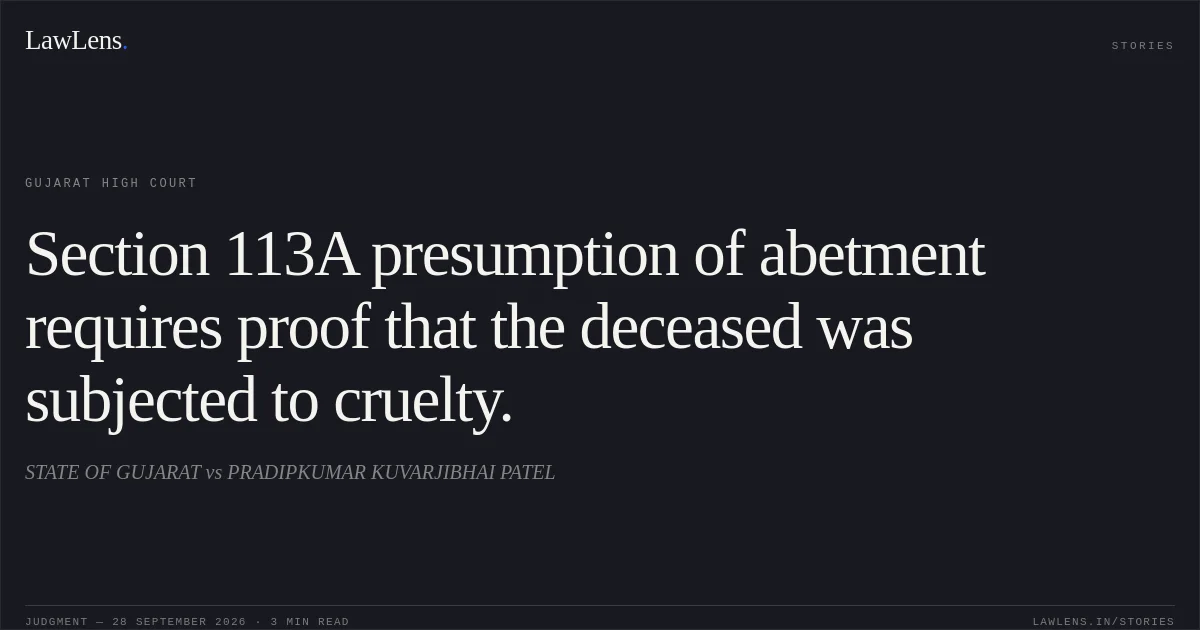
Source reference: para. 13–15Under Section 113A of the Evidence Act, a court may presume abetment where a married woman commits suicide within seven years of marriage and her husband or his relative subjected her to cruelty, having regard to all the circumstances; the foundational fact of cruelty must first be shown.
Source reference: para. 14–15.1Section 113B concerns dowry death and was not applicable on the facts as described in the judgment.
Source reference: para. 15.1In an appeal against acquittal, the appellate court may review and reappreciate the evidence, but the acquittal reinforces the presumption of innocence; where two reasonable views are possible, the acquittal should not be disturbed.
Source reference: para. 18–21Reasoning
The Court found no direct or indirect evidence substantiating the allegations that the respondent habitually consumed alcohol or gambled with the deceased’s money; no independent witness supported the prosecution, and the family members’ initial statements had not raised suspicion against him.
Source reference: para. 10, 12The medical evidence established death by hanging but did not connect the respondent to its cause.
Source reference: para. 11–12Although the suicide occurred within seven years of the marriage, the evidence did not establish the cruelty required to support a presumption under Section 113A; nor did it establish instigation or abetment under Sections 107 and 306 IPC.
Source reference: para. 14, 17, 22The Court also noted that the respondent had not appealed his Section 498A conviction and had served the sentence; it therefore did not further consider that conviction, while observing that it was not substantiated by the evidence.
Source reference: para. 13.1, 17Applying the restrained standard for appeals against acquittal, the Court found no basis to disturb the trial court’s decision.
Source reference: para. 18–23Holding
The Court held that the prosecution had failed to prove the charges relating to abetment of suicide beyond reasonable doubt and that the trial court committed no reviewable error in acquitting the respondent.
The State’s appeal was dismissed and the acquittal was confirmed; the bail bond was cancelled and the record and proceedings were directed to be returned to the trial court.
Source reference: para. 24Acts & Sections Cited
5 provisions across 2 statutes referred to in this judgment. Each provision opens on LawLens.
Code of Criminal Procedure, 19732
Indian Penal Code, 18603
Original Court PDF
STATE OF GUJARATvsPRADIPKUMAR KUVARJIBHAI PATEL
Click to open original judgment
Original judgment, available to read, download and summarize on LawLens.in