Facts
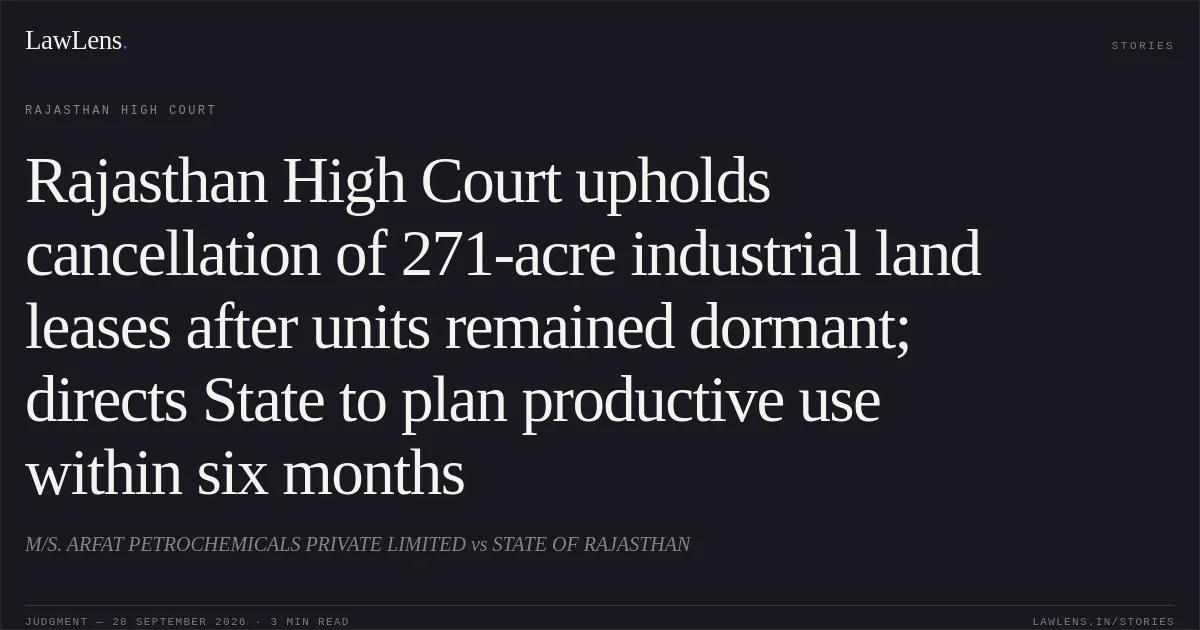
The State had transferred seven leases covering approximately 271.40 acres of government land to M/s. Arfat Petrochemicals Private Limited (APPL) in 2007, following the AAIFR rehabilitation scheme for J.K. Synthetics Limited.
Source reference: para. 87, 98–100The transfer was linked to revival of the Kota industrial units and settlement of workers’ liabilities.
Source reference: para. 87, 98–100After industrial operations largely ceased, APPL sought subdivision and change of land use; the Supreme Court later set aside RIICO’s permissions, while allowing APPL to approach the State under the 1959 Rules.
Source reference: para. 88–94The State rejected APPL’s tourism-use proposal on 7 March 2025.
Source reference: para. 21–29Following show-cause notices issued on 16 June 2025 and APPL’s replies, the District Collector cancelled the seven leases on 24 June 2025.
Source reference: para. 21–29APPL challenged the tourism-proposal rejection and the lease cancellations in the two writ petitions.
Source reference: para. 1, 85Issues
1. Whether the District Collector had jurisdiction to cancel the leases.
Source reference: para. 85(i)2. Whether the cancellation proceedings were vitiated by denial of natural justice, including non-supply of the fact-finding report, inadequate time, or pre-determination.
Source reference: para. 85(ii)3. Whether APPL breached the lease conditions, the rehabilitation arrangements, or the applicable Rules.
Source reference: para. 85(iii)4. Whether APPL had a right or legitimate expectation to change the industrial use, including under paragraph 106 of the Supreme Court’s judgment in Bishambhar Prasad.
Source reference: para. 85(iv), 85(vi)–(vii)5. Whether the leases were obtained through misrepresentation or fraud, and whether the impugned orders were arbitrary, malicious, or based on irrelevant considerations.
Source reference: para. 85(v), 85(viii)Law Applied
The Rajasthan Industrial Areas Allotment Rules, 1959 governed the land: Rule 8 restricted use to the authorised industrial purpose, subject to permission under the Rules, and the leases provided for reversion upon default.
Source reference: para. 88, 98–100The Court treated the leases as Government grants governed by their terms; it relied on Tata Steel Ltd. v. State of Jharkhand and Union of India v. Sir Sobha Singh & Sons Pvt. Ltd. for the rule that rights under a government grant are determined by its tenor.
Source reference: para. 95–98Under Bishambhar Prasad v. M/s. Arfat Petrochemicals Pvt. Ltd., RIICO lacked authority to grant conversion or subdivision permissions for this land, and the liberty to seek conversion did not create a right to obtain it.
Source reference: para. 89–94Natural justice required a fair opportunity where reversion followed an alleged breach, but the Court applied the prejudice principle in State of U.P. v. Sudhir Kumar Singh and related cases: a procedural defect does not invalidate an order absent demonstrated prejudice.
Source reference: para. 106–124Judicial review was confined to legality of the decision-making process, not a reappraisal of the merits, under Tata Cellular v. Union of India.
Source reference: para. 125–126Reasoning
The Court held that the State remained the lessor and the land’s authorised purpose remained industrial; neither APPL’s claimed expenditure nor RIICO’s invalid permissions created an enforceable right to a different use.
Source reference: para. 89–94, 144–146It found the District Collector competent to act under the governing arrangements and the 1995 circular, rejecting the challenge based on the later circular.
Source reference: para. 99–103The notices communicated the substance of the alleged breaches, APPL filed detailed replies, and the orders addressed its objections. The short interval before the successor Collector’s decisions and the non-supply of the separate committee report did not establish actual prejudice, since the report’s substance had been put to APPL.
Source reference: para. 108–124, 127–131On the merits, the Court treated revival of the industrial units as integral to the transfer and found that prolonged dormancy and subsequent efforts to secure alternative uses supported the State’s finding of breach and fraud.
Source reference: para. 149–157It also held that paragraph 106 of Bishambhar Prasad permitted APPL to apply for conversion but did not require the State to grant it; the tourism proposal’s rejection therefore did not violate that judgment.
Source reference: para. 94, 158–162Holding
The Court dismissed both writ petitions and upheld the seven lease-cancellation orders dated 24 June 2025 and the rejection of the tourism-use proposal dated 7 March 2025.
It vacated the interim orders and permitted the State to deal with the land according to law.
Source reference: para. 167It further directed the State, within six months, to examine the feasibility of reviving the industrial units and formulate a lawful plan for productive use of the land, taking account of the former workers’ legitimate interests; the State was not required to adopt any particular activity or create employment contrary to law or policy.
Source reference: para. 168Acts & Sections Cited
4 provisions across 3 statutes referred to in this judgment. Each provision opens on LawLens.
rajasthan government grant act, 19611
RAJASTHAN GENERAL CLAUSES ACT, 19551
RAJASTHAN LAND REVENUE ACT, 19562
Original Court PDF
M/S. ARFAT PETROCHEMICALS PRIVATE LIMITEDvsSTATE OF RAJASTHAN
Click to open original judgment
Original judgment, available to read, download and summarize on LawLens.in