Facts
Tripura University issued an advertisement dated 4 June 2008 for appointment of a Lecturer in its BBA programme on contractual terms, prescribing M.Com. with at least 55% marks and relevant teaching ability.
Source reference: para. 3The appellant, who possessed an M.Com. degree with 63% marks, was selected by the Interview Board on 20 July 2008 and joined on 4 February 2009 at a monthly remuneration of ₹15,000.
Source reference: paras. 4–5She continued through successive extensions as Lecturer until 2 February 2016, when the University re-designated her as Assistant Placement Officer (Contractual), without assigning a clear reason.
Source reference: paras. 6–7The appellant repeatedly protested the re-designation, contending that she was qualified to teach in the Business Management Department.
Source reference: paras. 8–11From January 2022, the University stopped paying her salary and, by order dated 30 September 2022, treated her as a daily-wage worker at ₹1,200 per working day.
Source reference: paras. 12–18The High Court granted interim protection and directed payment of arrears and continuation of her earlier status.
Source reference: paras. 20–26The learned Single Judge dismissed her writ petition, holding that a contractual appointee had no right to regularisation or renewal and declined to interfere with the daily-wage order.
Source reference: paras. 27–30The appellant filed the present writ appeal.
Source reference: para. 31Issues
1. Whether the appellant’s initial appointment as Lecturer was against a sanctioned post, despite being described as contractual.
Source reference: paras. 36–652. Whether the appellant possessed the prescribed qualification for appointment as Lecturer in the Business Management Department in 2008.
Source reference: paras. 65–803. Whether her appointment was made through a regular recruitment process in accordance with the applicable requirements.
Source reference: paras. 80–854. Whether the University lawfully re-designated her from Lecturer to Assistant Placement Officer on 2 February 2016.
Source reference: paras. 85–975. Whether the University lawfully reduced her remuneration to ₹1,200 per working day by order dated 30 September 2022.
Source reference: paras. 97–1086. Whether the appellant was entitled to regularisation of her services and, if so, in which post.
Source reference: paras. 108–130Law Applied
The Court applied Article 14 principles against arbitrary and exploitative action by a State instrumentality, holding that the University, as a Central University and instrumentality of the State, was required to act fairly and reasonably.
Source reference: para. 2It relied on Secretary, State of Karnataka v. Uma Devi (3) for the general proposition concerning contractual appointments, but distinguished it where the appointment was not a back-door or illegal appointment and had followed public advertisement and selection.
Source reference: paras. 109–112Relying on Vinod Kumar v. Union of India, Jaggo v. Union of India, Dharam Singh v. State of U.P., and Shripal v. Nagar Nigam, the Court held that long, continuous performance of recurring and essential duties cannot be defeated merely by contractual nomenclature, and that prolonged ad hocism cannot justify exploitation.
Source reference: paras. 53–64, 113–117U.P. Junior High School Council Instructor Welfare Association v. State of U.P. was relied upon for the principle that an appointment made after a prescribed selection process may be substantive even where the existence of a formal sanctioned post is disputed.
Source reference: para. 55Under Chandraprakash Madhavrao Dadwa v. Union of India, later changes in essential qualifications cannot be applied retrospectively to invalidate an earlier appointment.
Source reference: paras. 68–70The Court also applied the principles of natural justice to the reduction of the appellant’s remuneration and referred to State of Punjab v. Jagjit Singh regarding entitlement to minimum time-scale remuneration for employees performing duties comparable to regular employees.
Source reference: para. 128Reasoning
The Court found that the BBA programme had been continuously conducted since 2003–04 and that the University had repeatedly engaged lecturers to perform permanent and essential teaching functions.
Source reference: paras. 37–50The University’s failure to create or obtain formal sanctioned posts could not be used to defeat the appellant’s claim, particularly when the University had itself sought and obtained approval for additional teaching posts and had approved her selection through its Executive Council.
Source reference: para. 64The appellant satisfied the qualification expressly prescribed in the 2008 advertisement, while the University failed to produce any applicable rule existing at that time showing that she lacked eligibility; subsequent UGC or AICTE requirements could not operate retrospectively.
Source reference: paras. 66–80Her selection through an advertised interview process was therefore not a back-door appointment.
Source reference: paras. 81–85The re-designation as Assistant Placement Officer was held arbitrary because the order disclosed no valid reason, the alleged reliance on later UGC requirements was misplaced, and the University’s subsequent discontinuance of the BBA programme could not justify a decision taken before that discontinuance was formally approved.
Source reference: paras. 86–97The conversion of her status into that of a daily-wage worker was also invalid because it was unsupported by reasons, preceded by no notice or hearing, and was not required by the Finance Committee’s decision relied upon by the University.
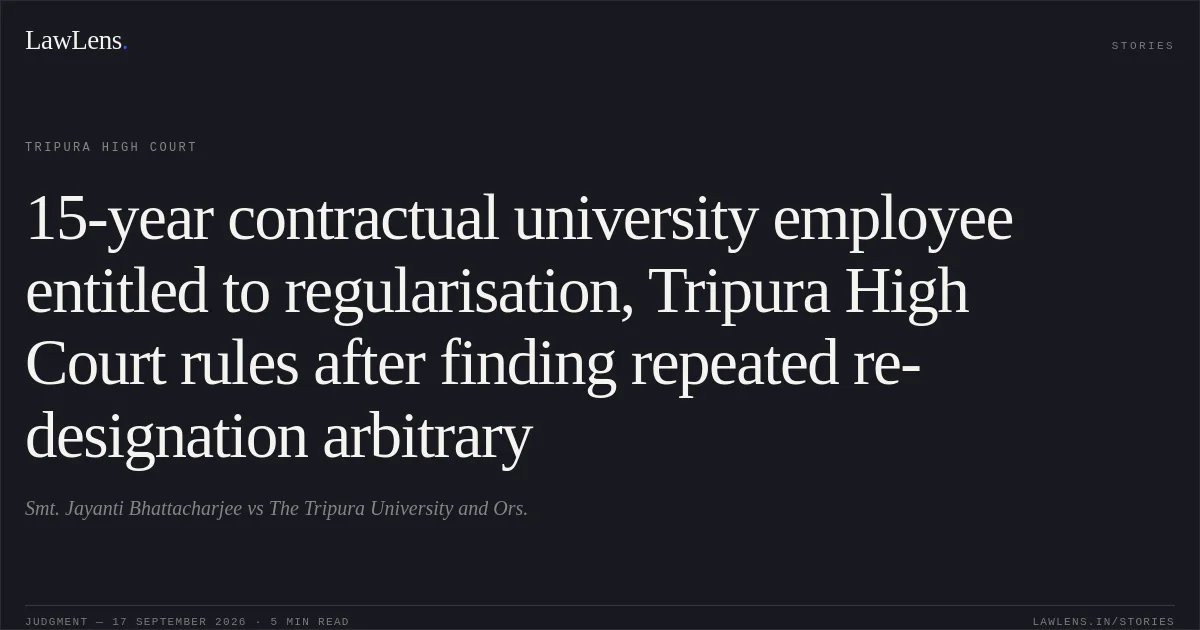
Source reference: paras. 98–108In light of her nearly fifteen years of continuous service, regular selection process, performance of essential duties, and the absence of any illegal entry into service, the Court held that Uma Devi could not be used to perpetuate precarious employment.
Source reference: paras. 111–128However, because she had worked as Lecturer only until 2016 and had thereafter served as Assistant Placement Officer for approximately eight years, regularisation was directed in the latter post rather than as Lecturer/Assistant Professor.
Source reference: paras. 111–128Holding
The writ appeal was allowed.
The Court held that the appellant’s appointment as Lecturer was not shown to be outside a sanctioned post, that she possessed the prescribed qualification in 2008, and that her selection followed a valid recruitment process.
Source reference: para. 129(a)–(c)Her re-designation as Assistant Placement Officer on 2 February 2016 was declared arbitrary and illegal, and the order dated 30 September 2022 reducing her remuneration to ₹1,200 per working day was set aside for violating natural justice and Article 14.
Source reference: para. 129(d)–(e)The University was directed to reinstate her as Assistant Placement Officer in the Business Management Department, regularise her services in that post within one month, pay the applicable regular pay scale and allowances, and count her service from 4 February 2009 for pension and other retirement benefits.
Source reference: paras. 129(f), 130–131The University was further directed to pay ₹25,000 as costs.
Source reference: para. 132Original Court PDF
Smt. Jayanti BhattacharjeevsThe Tripura University and Ors.
Click to open original judgment
Original judgment, available to read, download and summarize on LawLens.in