Facts
Steel Authority of India Limited (“SAIL”) entered into a Contract of Affreightment dated 5 December 2007 with British Marine PLC (“British Marine”) for transportation of approximately three million metric tonnes of coking coal from Australia/New Zealand to Indian ports over five years.
Source reference: pp.2–3, paras. 5–7The agreement contained an arbitration clause providing for maritime arbitration under the Arbitration and Conciliation Act, 1996 (“A&C Act”) and the Maritime Arbitration Rules of the Indian Council of Arbitration (“ICA”).
Source reference: p.3, para. 7After issuing several STEMs and receiving substantial shipments, SAIL stopped declaring further STEMs and subsequently sought to terminate the contract under Clause 62, the default clause.
Source reference: pp.3–4, paras. 9–11British Marine initiated arbitration, and a three-member tribunal was constituted.
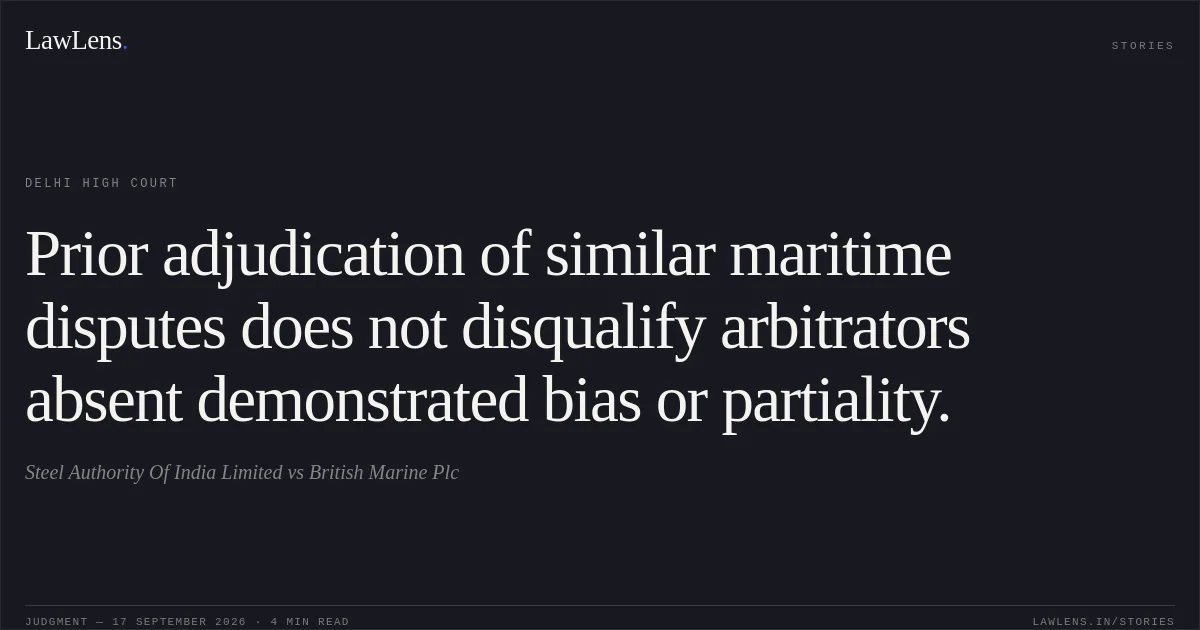
Source reference: p.4, para. 12SAIL challenged two arbitrators, Captain S.M. Berry and Mr. Niranjan Chakraborty, because they had previously served on a tribunal that interpreted a similar Clause 62 in an arbitration between SAIL and SeaSpray Shipping Company Ltd.
Source reference: pp.4–8, paras. 13–16The challenge was rejected, and the arbitral tribunal issued an award dated 13 September 2018. SAIL’s petition under Section 34 of the A&C Act was dismissed by the learned Single Judge on 13 October 2025, who upheld the award. SAIL preferred the present appeal under Section 37 of the A&C Act.
Source reference: pp.1–2, paras. 1–2, 17–19Issues
Whether the two arbitrators were disqualified under Section 12 read with the Fifth and Sixth Schedules of the A&C Act because they had previously adjudicated a related issue involving SAIL in the SeaSpray arbitration?
Source reference: p.17, para. 29(i); pp.30–37, paras. 39–57Whether SAIL’s challenge to the arbitrators was barred by delay, waiver, or failure to comply with the prescribed challenge procedure under Section 13 of the A&C Act and the ICA Maritime Arbitration Rules?
Source reference: pp.33–37, paras. 43–52Whether the arbitral tribunal correctly interpreted Clause 62 of the Contract of Affreightment as not permitting SAIL to terminate the contract merely because SAIL failed to issue further STEMs?
Source reference: p.17, para. 29(ii); pp.47–52, paras. 58–63Whether the award of damages and interest was legally sustainable?
Source reference: p.17, para. 29(iii); pp.13–15, paras. 18(D), 64–65Law Applied
The Court held that, since the dispute constituted an international commercial arbitration under Section 2(1)(f) of the A&C Act, the award could be challenged under Section 34 only on the limited grounds of conflict with the public policy of India; the ground of patent illegality under Section 34(2A) was unavailable.
Source reference: pp.18–29, paras. 30–33Under Section 12, the Fifth Schedule guides the determination of justifiable doubts regarding an arbitrator’s independence or impartiality, while the Sixth Schedule prescribes the form of disclosure.
Source reference: pp.30–35, paras. 39–46Item 24 of the Fifth Schedule must be read with Explanation 3, which recognises that maritime arbitration may involve a small specialised pool of arbitrators.
Source reference: pp.30–32, paras. 39–42Section 13 and the ICA Rules require a prompt challenge, ordinarily within fifteen days, and Section 4 embodies waiver where a party proceeds without timely objection.
Source reference: pp.33–37, paras. 43–52Relying principally on HRD Corporation v. GAIL (India) Ltd., Ssangyong Engineering & Construction Co. Ltd. v. NHAI, OPG Power Generation (P) Ltd. v. Enexio Power Cooling Solutions India (P) Ltd., and the decisions in SeaSpray Shipping Co. Ltd. v. SAIL and Noble Chartering Inc. v. SAIL, the Court reiterated that a prior decision on a similar issue does not, by itself, establish bias or disqualification, and that contractual interpretation is primarily for the arbitral tribunal unless the view is impermissible or impossible.
Source reference: pp.25–29, 39–46, paras. 32–33, 53–54, 61–62Damages were governed by the compensatory principles under Section 73 of the Indian Contract Act, 1872.
Source reference: pp.13–15, paras. 18(D), 64–65Reasoning
The Court found that SAIL knew from the outset that the two challenged arbitrators had served in the SeaSpray arbitration and was also aware of the earlier award interpreting a similar Clause 62. Nevertheless, SAIL did not challenge their appointment within the fifteen-day period prescribed by Section 13 of the A&C Act and Rule 10(4)(e) of the ICA Maritime Arbitration Rules; its later challenge was therefore belated and amounted to waiver.
Source reference: pp.33–38, paras. 43–52On merits, the Court held that the specialised nature of maritime arbitration and the limited pool of maritime arbitrators were relevant under Explanation 3 to the Fifth Schedule. The arbitrators’ prior decision on a related contractual issue did not demonstrate a closed mind, actual bias, or justifiable doubts as to impartiality, particularly in the absence of any additional evidence of partiality.
Source reference: pp.35–37, paras. 47–57Clause 62, read with Clause 61 and the Contract of Affreightment as a whole, was held to address failure or inability of the supplier to provide material, or other events constituting frustration, and not to confer an unfettered right on SAIL to terminate the contract for its own failure to issue STEMs.
Source reference: pp.47–52, paras. 58–63SAIL had not invoked the force majeure provision and had continued sourcing coal in the spot market; it therefore could not rely on its own non-performance to terminate the agreement without liability.
Source reference: pp.47–52, paras. 58–63The damages methodology—based on the difference between the contractual freight rate and the relevant spot-market rate applied to the affected tonnage—was considered rational, compensatory, and free from any public-policy defect.
Source reference: pp.52–53, paras. 64–65Holding
The Division Bench dismissed SAIL’s appeal and upheld the judgment dated 13 October 2025 as well as the arbitral award dated 13 September 2018.
It held that the challenged arbitrators were neither disqualified nor shown to be biased; SAIL had waived its objection by raising it belatedly; Clause 62 did not permit SAIL to terminate the Contract of Affreightment for its own failure to issue STEMs; and the award of damages and interest did not violate the restricted public-policy standard applicable to an international commercial arbitration.
Source reference: pp.35–37, 47–53, paras. 57–67The Court also refused SAIL’s request to stay the judgment pending challenge, observing that the judgment merely upheld the arbitral award.
Source reference: Order, para. 4Acts & Sections Cited
21 provisions across 4 statutes referred to in this judgment. Each provision opens on LawLens.
Arbitration and Conciliation Act, 1996
Delhi High Court Act, 19661
Commercial Courts Act, 20151
Indian Contract Act, 18723
Original Court PDF
Steel Authority Of India LimitedvsBritish Marine Plc
Click to open original judgment
Original judgment, available to read, download and summarize on LawLens.in