Facts
The accused was prosecuted in connection with the disappearance and death of a minor girl whose body was recovered from a jungle at Pub Nandapur on 27.02.2020.
Source reference: paras. 4–6The prosecution alleged offences under Sections 302 and 376(A) of the IPC and Section 6 of the POCSO (Amendment) Act, 2019.
Source reference: paras. 1, 5The prosecution case principally rested on the deceased allegedly being last seen with the accused, an alleged extra-judicial confession, a judicial confession under Section 164 CrPC, medical evidence, and the accused’s conduct in removing the body.
Source reference: paras. 4–6, 28–29, 36The Additional District and Sessions Judge, Hojai convicted the accused and sentenced him to death on 08.02.2021 and 10.02.2021 respectively.
Source reference: paras. 1–2The matter reached the High Court through the accused’s criminal appeal and the statutory death sentence reference.
Source reference: paras. 1–2The High Court independently reappreciated the evidence because the case involved both an appeal against conviction and a reference for confirmation of the death sentence.
Source reference: para. 27It found no eyewitness to the actual occurrence and treated the prosecution case as one based entirely on circumstantial evidence.
Source reference: para. 28Issues
Whether the prosecution established a complete and unbroken chain of circumstantial evidence proving beyond reasonable doubt that the accused committed the homicidal death and alleged sexual assault of the minor?
Source reference: paras. 28–35Whether the evidence of the deceased being last seen with the accused was sufficiently proximate and reliable to support conviction?
Source reference: paras. 37–45Whether the alleged extra-judicial confession and reconstruction of the occurrence were admissible and reliable, particularly when made while the accused was in police custody?
Source reference: paras. 46–47Whether the judicial confession under Section 164 CrPC, containing both inculpatory and exculpatory portions, could independently sustain the conviction after the explanation of accidental death was rejected?
Source reference: paras. 48–61Whether Section 106 of the Evidence Act or the accused’s allegedly false explanation and denial under Section 313 CrPC could fill the evidentiary gaps in the prosecution case?
Source reference: paras. 63–68Whether the death sentence should be confirmed by the High Court?
Source reference: paras. 27, 71–74Law Applied
The Court applied Sections 302 and 376(A) IPC and Section 6 of the POCSO (Amendment) Act, 2019, concerning murder, aggravated sexual assault resulting in death, and aggravated penetrative sexual assault respectively.
Source reference: paras. 1, 5For circumstantial evidence, it relied on Sharad Birdhichand Sarda v. State of Maharashtra and Hanumant v. State of Madhya Pradesh, holding that every circumstance must be fully established, must point only to the guilt of the accused, must exclude every reasonable hypothesis consistent with innocence, and must form a complete chain.
Source reference: paras. 30–34The Court applied the last-seen principle from Bodh Raj v. State of Jammu and Kashmir, State of Goa v. Sanjay Thakran, Ganpat Singh v. State of Madhya Pradesh, and Satpal v. State of Haryana, under which last-seen evidence is weak where a substantial time gap permits intervention by another person.
Source reference: paras. 11–12, 43The alleged police-custody confession was assessed under Sections 25, 26 and 27 of the Evidence Act, while the judicial confession was considered under Section 164 CrPC and the principles in Pyare Lal Bhargava, Palvinder Kaur, and Nishi Kant Jha, requiring the confession to be voluntary, truthful, and read as a whole.
Source reference: paras. 46, 49–55Section 106 of the Evidence Act was governed by the rule in Sambhu Nath Mehra and Trimukh Maroti Kirkan that it does not shift the prosecution’s primary burden or cure failure to establish foundational facts.
Source reference: paras. 17, 63–64A false explanation or denial may provide an additional link only where the prosecution has already established a complete chain; it cannot supply a missing link.
Source reference: paras. 65–68Reasoning
The Court held that PW-1, PW-2 and PW-11 did not provide direct last-seen evidence; their material assertions were hearsay.
Source reference: paras. 38–40, 44–45PW-3 was the only substantive last-seen witness, but her evidence showed merely that the accused and the deceased were together at approximately 1:00 p.m. on 26.02.2020.
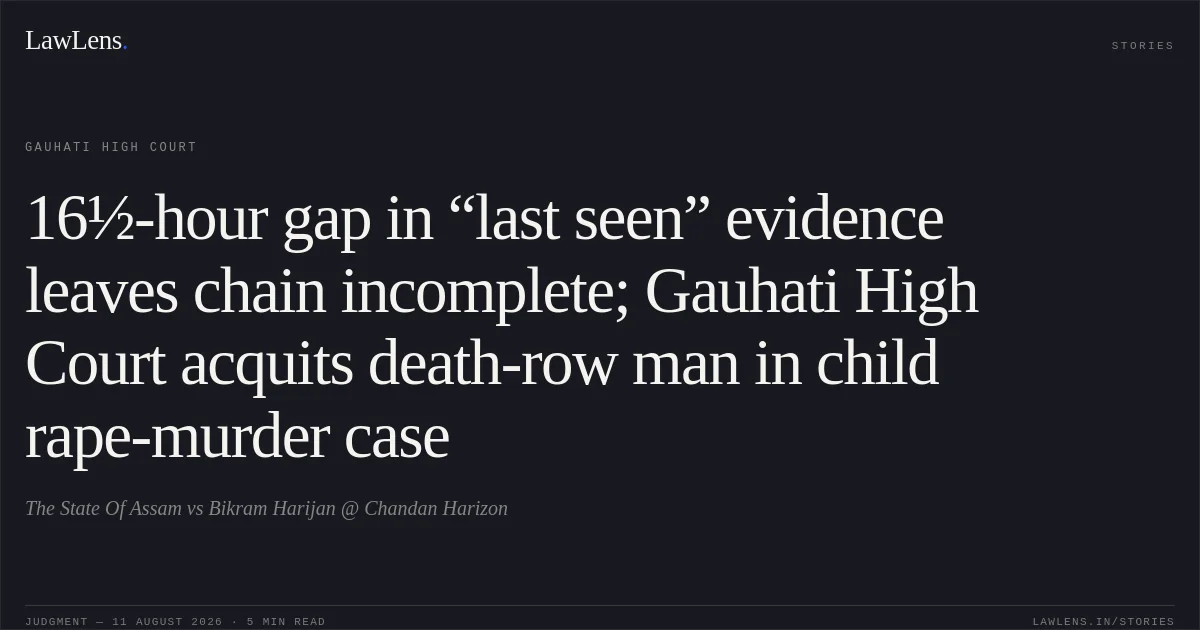
Source reference: paras. 41–43The body was recovered around 5:30 a.m. the next day, leaving a gap of approximately 16½ hours, and neither the medical evidence nor other evidence excluded intervention by another person.
Source reference: paras. 41–43The alleged extra-judicial confession was inadmissible under Sections 25 and 26 of the Evidence Act because the accused was already in police custody when the witnesses were summoned to the police station; the reconstruction similarly yielded no discovery of a new fact and had no independent evidentiary value.
Source reference: paras. 46–47Although the judicial confession was found to have been recorded after substantial compliance with Section 164 CrPC and was not rejected as involuntary, it did not amount to an unqualified confession of guilt.
Source reference: paras. 49–52The accused admitted taking the child to a jujube tree and removing her body but claimed that her death resulted from an accidental blow and denied strangulation and sexual assault.
Source reference: paras. 49–52Medical evidence disproved the accidental-death explanation by establishing death from strangulation, but rejection of that explanation did not independently prove that the accused caused the strangulation.
Source reference: paras. 52–55The medical and forensic evidence established homicidal death but did not identify the perpetrator; no incriminating forensic material, weapon, or article connecting the accused with the offence was recovered.
Source reference: paras. 57–61The accused’s conduct in removing the body and his false explanation generated strong suspicion but could not substitute for proof.
Source reference: paras. 62–68Since the prosecution failed to establish that the accused remained in the deceased’s exclusive company until her death, Section 106 of the Evidence Act and the accused’s Section 313 CrPC answers could not be used to complete the chain.
Source reference: paras. 62–68Holding
The High Court held that the prosecution proved only that the deceased suffered a homicidal death, that she was seen with the accused several hours before recovery of the body, and that the accused admitted accompanying her and removing the body.
It failed to prove beyond reasonable doubt that the accused committed the strangulation or the alleged sexual assault.
Source reference: para. 69The conviction and death sentence were therefore set aside, and the accused was acquitted by extending the benefit of reasonable doubt.
Source reference: paras. 70–72The Death Sentence Reference was answered in the negative and rejected, while Criminal Appeal No. 80/2021 was allowed.
Source reference: paras. 73–74The accused was directed to be released forthwith unless required in another case.
Source reference: paras. 73–74The trial court’s direction concerning victim compensation under Section 357-A CrPC was left undisturbed, with an expectation of expeditious compliance.
Source reference: paras. 76–77Acts & Sections Cited
4 provisions across 3 statutes referred to in this judgment. Each provision opens on LawLens.
Indian Penal Code, 18601
Protection of Children from Sexual Offences Act, 20121
Code of Criminal Procedure, 19732
Original Court PDF
The State Of AssamvsBikram Harijan @ Chandan Harizon
Click to open original judgment
Original judgment, available to read, download and summarize on LawLens.in