Facts
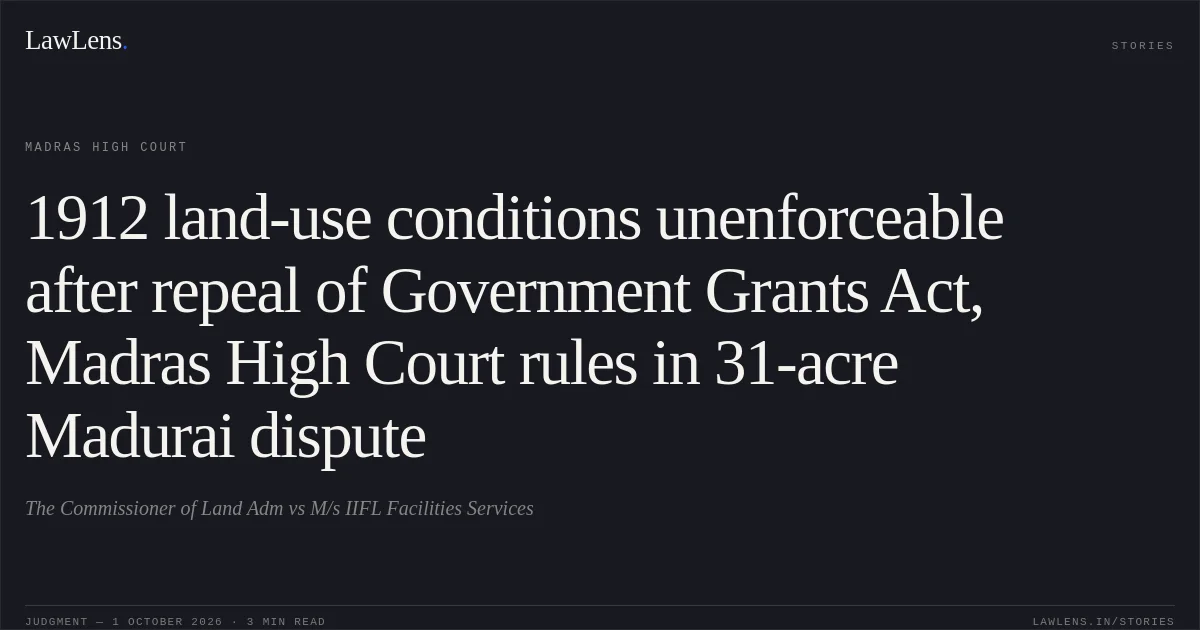
In 1912, the Government assigned 31.10 acres at Tallakulam, Madurai, to the American Board of Commissioners for Foreign Missions for an industrial home for needy women.
Source reference: para. 3–6The grant required the land to be used for industrial and charitable purposes and reserved a right of resumption if that purpose ceased.
Source reference: para. 3–6In 1973, the successor missionary body transferred the land to the Church of South India Trust Association (CSI TA).
Source reference: para. 10–16The land was thereafter held, developed, and partly transferred to third parties, without Government action to enforce the original conditions.
Source reference: para. 10–16In 2022, D. Devasahayam obtained a direction requiring the Commissioner of Land Administration to enquire into alleged breach of the grant conditions.
Source reference: para. 17–20The Commissioner ordered resumption, prompting four writ petitions, which the Single Judge allowed on 09.05.2025.
Source reference: para. 17–20The State and others appealed; Devasahayam also filed connected appeals and sought leave to appeal in two matters.
Source reference: para. 17–20Issues
1. Whether, following repeal of the Government Grants Act, 1895, the Government could initiate resumption proceedings to enforce conditions in the 1912 grant, where no such proceedings were pending before repeal.
Source reference: para. 28–36, 55–582. Whether prolonged non-enforcement of the grant conditions and official acquiescence in subsequent transfers and development rendered those conditions unenforceable under the doctrine of desuetude.
Source reference: para. 44–513. Whether the Commissioner’s resumption order could deprive the respondents of property consistently with Article 300A of the Constitution.
Source reference: para. 60–644. Whether the Transfer of Property Act, 1882, governed the original assignment or the conditions attached to it.
Source reference: para. 42–43, 65Law Applied
The Court relied on the Repealing and Amending (Second) Act, 2017, including its savings provision, and Section 6 of the General Clauses Act, 1897, to consider the effect of repeal on accrued rights and pending proceedings; it held that the repeal did not preserve a power to initiate proceedings that were not pending at the time.
Source reference: para. 29–36Applying Kolhapur Canesugar Works Ltd. v. Union of India, (2000) 2 SCC 536, it stated that repeal ordinarily obliterates the repealed enactment, subject to applicable savings.
Source reference: para. 30–36It applied the doctrine of desuetude, as discussed in Municipal Corporation for City of Pune v. Bharat Forge Co. Ltd., (1995) 3 SCC 434, and Cantonment Board, MHOW v. M.P. State Road Transport Corporation, (1997) 9 SCC 450: prolonged non-use or non-enforcement, accompanied by a contrary practice, may render a law or condition unenforceable.
Source reference: para. 39–50The Court also considered Section 12(2) of the Tamil Nadu Board of Revenue Abolition Act, 1980, and Article 300A, which prohibits deprivation of property except by authority of law.
Source reference: para. 52–62It held that the Transfer of Property Act did not apply to the 1912 assignment, which was made under the Government Grants Act and fell within Section 2(d) of the Transfer of Property Act.
Source reference: para. 12, 42–43, 65Reasoning
The Government had not initiated resumption proceedings before the Government Grants Act was repealed or before the Board of Revenue was abolished; the Commissioner acted only after the 2022 court direction.
Source reference: para. 18–20, 55–59The Court therefore found no pending proceeding preserved by the applicable savings provisions and concluded that the Government could not initiate enforcement after repeal.
Source reference: para. 34–36, 57–59It further relied on decades of non-enforcement and official acceptance of transfers, mutations, and building permissions to find that the conditions had become a “dead letter” and that subsequent transactions had been acquiesced in.
Source reference: para. 47–51In the absence of legal authority to resume the property, the Commissioner’s order could not stand under Article 300A.
Source reference: para. 60–64The Court disagreed with the Single Judge only insofar as the latter had applied the Transfer of Property Act; it concluded that the Act did not govern the original grant.
Source reference: para. 65Holding
The Court held that the Government could not enforce the 1912 grant conditions or resume the lands through proceedings initiated after repeal, where no proceedings had been pending at the relevant time; the subsequent transactions were upheld.
It dismissed W.A.(MD) Nos. 2487–2490 and 3288 of 2025 and W.A.(MD) No. 152 of 2026, confirmed the Single Judge’s order allowing the four writ petitions, dismissed the leave applications, and rejected the two appeals at the SR stage.
Source reference: para. 66–68There was no order as to costs, and connected miscellaneous petitions were closed.
Source reference: para. 66–68Acts & Sections Cited
9 provisions across 5 statutes referred to in this judgment. Each provision opens on LawLens.
Code of Civil Procedure, 19081
Transfer of Property Act, 18824
Repealing and Amending (Second) Act, 20171
General Clauses Act, 18971
Tamil Nadu Board of Revenue Abolition Act, 19802
Original Court PDF
The Commissioner of Land AdmvsM/s IIFL Facilities Services
Click to open original judgment
Original judgment, available to read, download and summarize on LawLens.in